By Louis ‘Barok’ C Biraogo — April 22, 2025
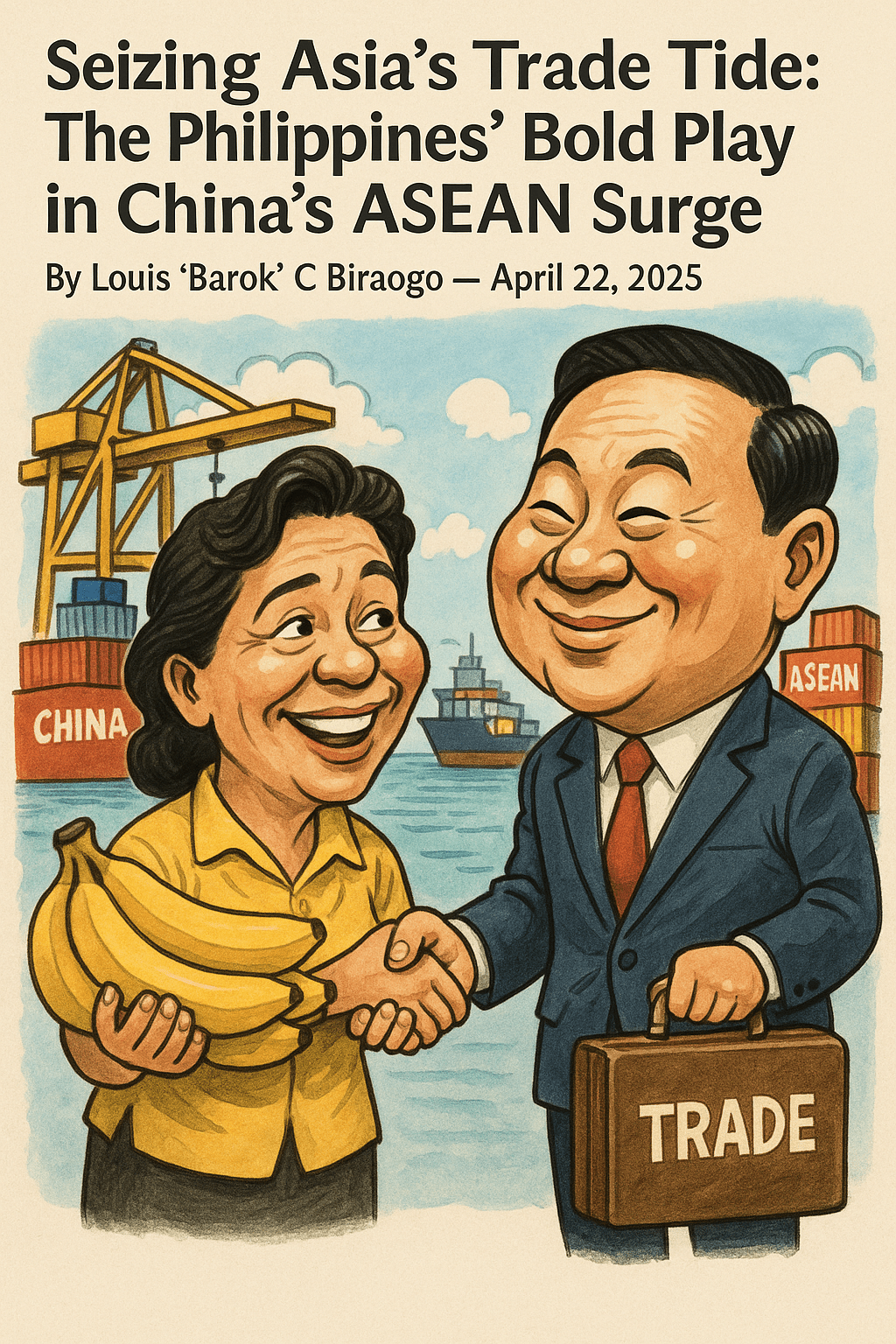
IN THE bustling port city of Davao, Maria Santos, a small-scale exporter of organic bananas, watched her business teeter on the edge. The U.S. market, once a reliable buyer, had grown erratic with new tariffs looming. Then came an unexpected lifeline: a Chinese buyer, eager for her produce, offered a contract that doubled her exports overnight. Maria’s story is a microcosm of a seismic shift in global trade. As U.S. tariffs choke China’s exports, Beijing is turning to Southeast Asia, and the Philippines stands at a crossroads—poised for opportunity, yet wary of overdependence.
China’s pivot to ASEAN, spurred by U.S. tariffs reaching 145% in 2025, is reshaping the region’s economic landscape. For the Philippines, this shift promises a 6.2% GDP boost, new jobs, and infrastructure upgrades. But it also raises questions about economic sovereignty and geopolitical risks. As a Filipino policymaker, how can the Department of Trade and Industry (DTI) harness this moment while safeguarding the nation’s long-term interests? The answer lies in pragmatic strategies that balance economic gains with resilience.
Decoding the Global Trade Shakeup
The U.S.-China trade war, now in its fiercest chapter, has upended global supply chains. With U.S. tariffs slashing China’s $525 billion export market, Beijing is doubling down on ASEAN, a region of 698 million consumers (South China Morning Post, 2025). The ASEAN+3 Macroeconomic Research Office (AMRO) projects China’s GDP growth at 4.8% in 2025, buoyed by trade with neighbors like Vietnam and the Philippines (AMRO, 2025). ASEAN’s trade with China, already at $468.8 billion in 2023, has grown threefold since 2000, while reliance on the U.S. market has dropped from 24% to under 15% (China Briefing, 2023).
For China, ASEAN offers a shield against Western tariffs and access to critical resources like Philippine nickel and copper (China Briefing, 2023). Investments under the Belt and Road Initiative (BRI) and trade pacts like the Regional Comprehensive Economic Partnership (RCEP) are knitting a tighter regional economy (Asia Society, 2023). Yet, this integration comes with strings: China’s growing influence could tilt the balance of power, particularly in contested areas like the South China Sea (Wikipedia, 2025).
Philippines’ Golden Opportunity—or Perilous Trap?
The Philippines stands to gain immensely. Chinese investments, which surged to $975 million in 2018, are fueling manufacturing and infrastructure (Board of Investments, 2020). Over 200 BRI projects since 2000 promise better ports and roads, cutting logistics costs (CSIS, 2025). The RCEP could lift Philippine exports by 3.7% by 2030, with semiconductors (40% of exports) and agricultural goods like bananas finding eager buyers in China’s vast market (DTI Philippines, 2025). Job creation is another windfall—manufacturing and tech sectors are expanding, offering opportunities for workers like Maria’s son, a recent engineering graduate (China Briefing, 2023).
Yet, dangers lurk. Over-reliance on China risks economic vulnerability, especially if South China Sea tensions escalate (Wikipedia, 2025). A Manila Times report warns of a $1.89 billion export loss if U.S. tariffs persist, underscoring the need for diversification (Manila Times, 2025). Small and medium enterprises (SMEs), which employ 60% of the workforce, often lack the expertise to tap Chinese markets (CSIS, 2025). Ethical concerns also loom: BRI projects have faced criticism for lax labor and environmental standards, and heavy Chinese investment could erode economic sovereignty (Asia Society, 2023).
Sizing Up a Bold Trade Blueprint
The strategies I propose for the DTI—leveraging trade agreements, promoting high-value exports, attracting foreign direct investment (FDI), developing BRI infrastructure, supporting SMEs, and mitigating risks—are designed to seize China’s ASEAN pivot. These approaches are ambitious, but their feasibility varies, requiring careful calibration to maximize impact.
- Strengthening the China-ASEAN Free Trade Area (CAFTA) and RCEP is a robust foundation, given the $52.4 billion in Philippines-China trade in 2023 (CSIS, 2025). These frameworks can drive a projected 3.7% export increase by 2030 (DTI Philippines, 2025). However, my proposal to subsidize exporters’ shipping costs by 15% could strain fiscal resources unless paired with clear metrics for return on investment.
- Attracting FDI through streamlined approvals and tax incentives aligns with China’s $17.6 billion ASEAN investments in 2023 (China Briefing, 2023). Doubling FDI by 2027 is a stretch but achievable if bureaucratic hurdles and corruption are addressed (Board of Investments, 2020).
- My BRI infrastructure plan, emphasizing public-private partnerships (PPPs), is critical for logistics but demands rigorous oversight to avoid debt traps seen elsewhere (CSIS, 2025).
- The SME initiative, targeting 10,000 firms for training, is essential for inclusive growth, though the proposed $100 million budget may fall short of nationwide needs (China Briefing, 2023).
- The risk mitigation strategy—diversifying trade with Japan, South Korea, and the EU while bolstering domestic industries—is the cornerstone of resilience. Scaling non-China exports by 10% by 2028 is realistic but requires aggressive diplomacy (Manila Times, 2025). The $200 million investment in agriculture and manufacturing is a start, but competing with China’s economies of scale necessitates further funding and innovation (Asia Society, 2023).
A Roadmap to Ride the Trade Wave
To seize this moment, the DTI must prioritize strategies that deliver quick wins while building long-term resilience. Here’s a roadmap, ordered by feasibility and impact, with timelines and risk considerations:
1. Turbocharge Trade Pacts (Q3 2025–Q4 2026)
- Action: Negotiate reduced non-tariff barriers under CAFTA for semiconductors and bananas. Host a Philippines-China Trade Summit in September 2025 to align priorities.
- Rationale: Builds on existing frameworks, leveraging China’s demand. A 3.7% export boost by 2030 is achievable, per RCEP projections (DTI Philippines, 2025).
- Risk: Geopolitical tensions could stall talks; a DTI task force should monitor South China Sea developments (Wikipedia, 2025).
- Cost: $5 million for summits and negotiations.
2. Unleash SME Export Power (Q3 2025–Q2 2026)
- Action: Train 5,000 SMEs in 2025 on e-commerce and compliance for Chinese markets. Develop an online matchmaking portal by April 2026. Allocate $50 million in loans via the Small Business Corporation.
- Rationale: SMEs drive 60% of jobs but lack export savvy. A 20% export share increase by 2030 is feasible with targeted support (CSIS, 2025).
- Risk: Limited SME capacity requires phased scaling; prioritize urban hubs like Cebu and Davao.
- Cost: $60 million for training, portal, and loans.
3. Magnetize Chinese Investment (Q1 2026–Q4 2027)
- Action: Reduce BOI approval times to 30 days by Q2 2026. Offer CREATE Act tax breaks for Chinese firms in EVs and solar. Host investment roadshows in Beijing in August 2025.
- Rationale: China’s expertise in renewables aligns with Philippine needs. Doubling FDI by 2027 is ambitious but possible with streamlined processes (Board of Investments, 2020).
- Risk: Corruption could deter investors; transparency reforms are critical.
- Cost: $10 million for roadshows and BOI upgrades.
4. Build Tomorrow’s Infrastructure (Q4 2025–Q1 2028)
- Action: Finalize PPP agreements for Davao port upgrades by Q4 2025. Train 3,000 workers annually for BRI projects starting 2026. Enforce environmental and labor standards.
- Rationale: Improved logistics will cut export costs by 10%. PPPs ensure local benefits, avoiding Sri Lanka-style debt issues (CSIS, 2025).
- Risk: Public backlash over Chinese influence; transparent contracts are essential (Asia Society, 2023).
- Cost: $20 million for training and oversight.
5. Break Free from Single-Market Shackles (Q1 2026–Q4 2028)
- Action: Negotiate trade deals with Japan and the EU, targeting a 10% non-China export increase by 2028. Invest $100 million in agriculture modernization.
- Rationale: Reduces China dependency, mitigating a $1.89 billion export risk. Japan’s $20 billion ASEAN trade in 2023 offers a model (Manila Times, 2025).
- Risk: Slow diplomatic progress; prioritize Japan for quicker results.
- Cost: $110 million for trade missions and agriculture.
Weighing Riches Against Risks
The economic upside is dazzling: a 6.2% GDP growth in 2025, thousands of jobs, and modernized infrastructure (CSIS, 2025). Maria Santos and her peers could see their incomes soar, and young engineers could find work in new factories. But the risks—overdependence, geopolitical friction, and uneven benefits—demand vigilance (Wikipedia, 2025). Diversifying trade partners and enforcing BRI standards will preserve economic sovereignty (Asia Society, 2023). A DTI task force, launched by Q3 2025, should track risks, ensuring the Philippines doesn’t swap one form of reliance (on the U.S.) for another (Manila Times, 2025).
Ethically, the Philippines must weigh short-term gains against long-term autonomy. Chinese investments should empower local industries, not displace them. SMEs, the economy’s backbone, need more than loans—they need skills to compete globally (China Briefing, 2023). Transparency in BRI deals will build public trust, countering fears of foreign overreach (Asia Society, 2023).
Charting the Future Amid Churning Seas
The Philippines stands at a defining juncture. China’s ASEAN surge offers a chance to leap forward, but only if Manila plays its cards deftly. By turbocharging trade pacts, unleashing SMEs, and diversifying partners, the DTI can craft a path that lifts millions like Maria while safeguarding the nation’s future. The South China Sea may churn, but economic pragmatism can steady the course (Wikipedia, 2025). In a world of tariffs and tempests, the Philippines can emerge not just a beneficiary, but a beacon in a new Asian century.
References
- AMRO. (2025). ASEAN+3 Economies to Sustain Growth at 4.2% in 2025 Despite Rising Headwinds from Escalating Trade Tensions. https://amro-asia.org
- Asia Society. (2023). Balancing Act: Assessing China’s Growing Economic Influence in ASEAN. https://asiasociety.org
- Asia Society. (2023). ASEAN Caught Between China’s Export Surge and Global De-Risking. https://asiasociety.org
- Board of Investments. (2020). Philippines-China Business Relations. https://boi.gov.ph
- China Briefing. (2023). China-ASEAN Trade and Investment Relations. https://www.china-briefing.com
- China Briefing. (2023). China-Philippines: Bilateral Trade and Investment Prospects. https://www.china-briefing.com
- CSIS. (2025). Rocking the Boat: The Philippines Trade Strategy Amid Rising Geoeconomic Tensions. https://www.csis.org
- DTI Philippines. (2025). The Association of Southeast Asian Nations. https://www.dti.gov.ph
- Manila Times. (2025). China: ASEAN Trade Can Offset US Tariffs. https://www.manilatimes.net
- South China Morning Post. (2025). China’s Trade with Asia Could Plug Hole Left by US Tariffs, Economists Say. https://www.scmp.com
- Wikipedia. (2025). China–Philippines Relations. https://en.wikipedia.org

- ₱75 Million Heist: Cops Gone Full Bandit

- ₱6.7-Trillion Temptation: The Great Pork Zombie Revival and the “Collegial” Vote-Buying Circus

- ₱1.9 Billion for 382 Units and a Rooftop Pool: Poverty Solved, Next Problem Please

- ₱1.35 Trillion for Education: Bigger Budget, Same Old Thieves’ Banquet

- ₱1 Billion Congressional Seat? Sorry, Sold Out Na Raw — Si Bello Raw Ang Hindi Bumili

- “We Will Take Care of It”: Bersamin’s P52-Billion Love Letter to Corruption

- “Skewed Narrative”? More Like Skewered Taxpayers!

- “Scared to Sign Vouchers” Is Now Official GDP Policy – Welcome to the Philippines’ Permanent Paralysis Economy
- “Robbed by Restitution?” Curlee Discaya’s Tears Over Returning What He Never Earned

- “No Pressure” Luistro? The House Pork Bazaar Exposed
- “My Brother the President Is a Junkie”: A Marcos Family Reunion Special

- “Mapipilitan Akong Gawing Zero”: The Day Senator Rodante Marcoleta Confessed to Perjury on National Television and Thought We’d Clap for the Creativity






 KWEBA ni BAROK
Leave a comment