By Louis ‘Barok‘ C. Biraogo — April 22, 2025
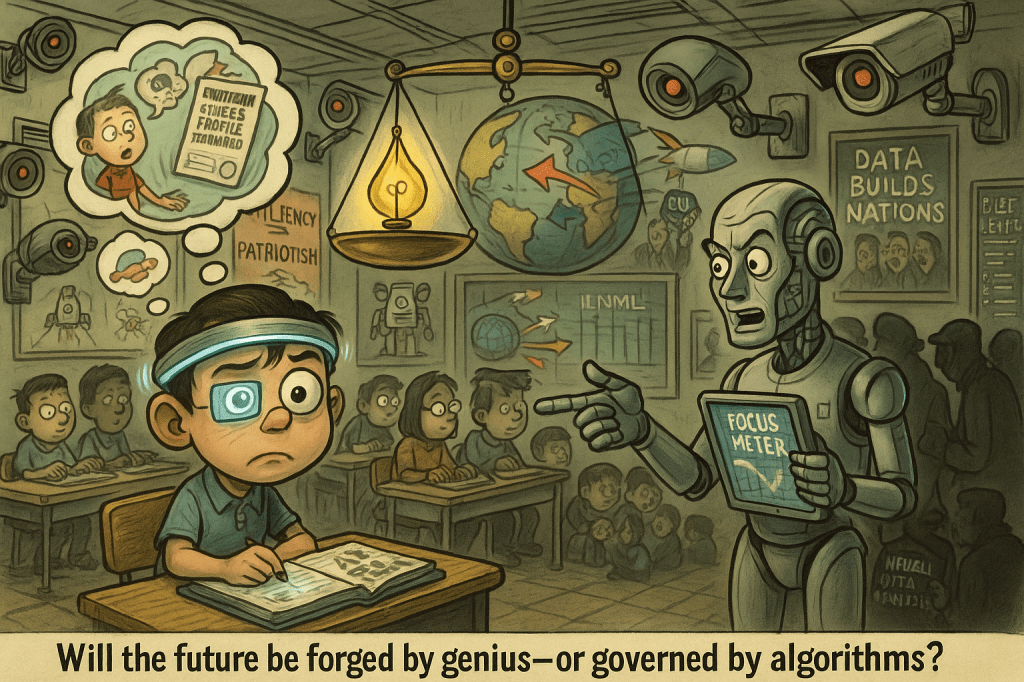
IN A Beijing classroom, a third-grader named Li Wei adjusts a sleek headband that hums softly, measuring his brainwaves to gauge his focus. His teacher, glancing at a tablet, sees a dashboard of real-time data: Li Wei’s attention is waning. A nudge from an AI system prompts her to pose a question, re-engaging him. This scene, unfolding across China’s schools, is no sci-fi fantasy—it’s the vanguard of an ambitious education reform. China’s plan to weave artificial intelligence into textbooks, curricula, and classrooms, announced in April 2025, aims to forge a generation of innovators. But beneath the promise lies a shadow: a surveillance state tightening its grip on young minds.
Education reshapes destinies—whether in remote African villages or bustling Asian cities, its power is undeniable. China’s AI initiative could be a leap forward, equipping students with skills to thrive in a tech-driven world. Yet, as I parse the data and stories, I’m struck by the risks—privacy eroded, autonomy curtailed, and a global race that could leave human dignity behind. This is not just China’s story. It’s a mirror for the world.
Minds Wired, Futures Rewired
China’s education ministry claims AI will “cultivate the basic abilities of teachers and students,” fostering independent thinking and problem-solving. The numbers are staggering: starting September 2025, every primary and secondary student—over 180 million—will receive at least eight hours of AI instruction annually, as reported by India Today. From coding robots in elementary school to mastering neural networks in high school, the curriculum is designed to build a workforce to rival Silicon Valley. A PwC study projects AI could add $7 trillion to China’s economy by 2030. This is nation-building on steroids.
The benefits are tantalizing. AI can personalize learning, adapting lessons to a student’s pace and style. In rural Gansu, where teacher shortages persist, AI platforms like Squirrel AI have delivered tailored lessons, narrowing the urban-rural gap, according to The Borgen Project. “AI lets every child learn like they’re in Beijing’s best schools,” a Gansu principal proudly declared. Studies, like one from Dai and Ke in 2022 cited in Humanities and Social Sciences Communications, show AI boosts engagement and academic outcomes, especially in higher education.
But here’s the catch: personalization comes at a cost. Those headbands on students like Li Wei collect neural data, often with flimsy privacy protections. Surveillance cameras track phone use; uniforms with chips monitor movement. The Wall Street Journal reports that EEG technology can misread attention levels, yet low scores might label a child as “unfocused,” piling on pressure in a system already notorious for stress. One Shanghai parent whispered to me, “My daughter feels like she’s being watched all the time. She’s afraid to daydream.”
What does it mean to learn when every thought is measured? This isn’t just about education—it’s about control.
Power Play in the Classroom
This initiative mirrors China’s economic pivot from factories to tech giants like Huawei and DeepSeek, whose large-language model stunned the world in January 2025, as noted by Fortune. It’s also a geopolitical flex, aimed at outpacing the U.S. in AI dominance. The RAND Corporation warns of a “Chinese Surprise”—a breakthrough that could tilt global power. China’s centralized governance, with its ability to mobilize resources, makes this plausible. The 2035 “strong-education nation” plan is a blueprint for a tech superpower.
Yet implementation is a beast. Urban Beijing boasts cutting-edge AI labs, but rural schools often lack basic internet. Training millions of teachers to wield AI tools is a Herculean task; Business Insider notes uneven resources could widen disparities. Resistance is brewing too. Some educators fear AI will sideline human connection, echoing MIT Technology Review findings that students crave teacher interaction over algorithms.
China’s approach—top-down, data-driven—reflects its governance. But can it nurture the creativity it claims to seek? Or will it churn out cogs for a machine, not innovators?
Global Tech Race Ignited
China’s gambit reshapes the global tech race. If successful, it could produce a generation of AI pioneers, giving Beijing an edge in everything from autonomous weapons to medical breakthroughs. The Center for Security and Emerging Technology warns this could spark a “Sputnik moment” for the West, forcing nations to scramble. Countries like the Philippines, with nascent AI policies, face a stark choice: emulate China’s scale or carve a different path.
But the world should pause. China’s surveillance-heavy model raises red flags. The MIT Technology Review notes that tools like Alo7’s facial analysis blur education and state control, potentially exporting this model globally. If China sets the AI education standard, will privacy become a relic? Other nations must weigh the benefits of AI literacy against the risk of authoritarian creep.
The Philippines, with 27 million students and a growing tech sector, could leapfrog by focusing on AI ethics alongside skills. Manila could partner with global institutions to build open-source AI curricula, prioritizing student autonomy over surveillance. The question is: can it act fast enough?
Souls Under the Algorithm
At its core, China’s initiative embeds values: efficiency, control, national glory. But what of curiosity, dissent, or individuality? Surveillance tools risk stifling the very creativity they aim to foster. A Beijing student told me, “I want to invent, not be a data point.” Her words haunt me. Education should ignite minds, not monitor them.
The ethical stakes are immense. Without robust data protections, students become fodder for state or corporate interests. The Wall Street Journal reports neural data is already feeding government research, with little transparency. This isn’t just a Chinese issue—it’s a global one. As AI spreads, who decides what’s tracked, and why?
Blueprint for a Better Future
China’s leaders must act decisively. First, enact strict privacy laws, ensuring student data isn’t weaponized. Second, prioritize teacher training and equitable access, especially in rural areas, to avoid deepening inequality. Third, foster creativity over metrics—let students like Li Wei dream, not just perform.
Global educators should take note. AI can revolutionize learning, but only with guardrails. Develop curricula that teach AI literacy alongside ethics, as California’s AI literacy laws suggest, per Business Insider. Collaborate internationally to share best practices, avoiding China’s surveillance pitfalls.
For the Philippines, the lesson is urgency. Invest in teacher training and public-private partnerships to scale AI education. Adopt a principle: technology serves students, not the state. This could set a model for the Global South.
Finally, the world must grapple with a question: is technological supremacy worth the cost to human freedom? China’s experiment is a test case. We’re all watching.

- “Forthwith” to Farce: How the Senate is Killing Impeachment—And Why Enrile’s Right (Even If You Can’t Trust Him)

- “HINDI AKO NAG-RESIGN!”

- “I’m calling you from my new Globe SIM. Send load!”

- “Mahiya Naman Kayo!” Marcos’ Anti-Corruption Vow Faces a Flood of Doubt

- “Meow, I’m calling you from my new Globe SIM!”

- “No Special Jail for Crooks!” Boying Remulla Slams VIP Perks for Flood Scammers

- “PLUNDER IS OVERRATED”? TRY AGAIN — IT’S A CALCULATED KILL SHOT

- “Several Lifetimes,” Said Fajardo — Translation: “I’m Not Spending Even One More Day on This Circus”

- “Shimenet”: The Term That Broke the Internet and the Budget

- “We Did Not Yield”: Marcos’s Stand and the Soul of Filipino Sovereignty

- “We Gather Light to Scatter”: A Tribute to Edgardo Bautista Espiritu

- $150M for Kaufman to Spin a Sinking Narrative





 KWEBA ni BAROK
Leave a comment