By Louis ‘Barok‘ C. Biraogo — April 23, 2025
Caught in the Crosshairs: A Fisherman’s Plight
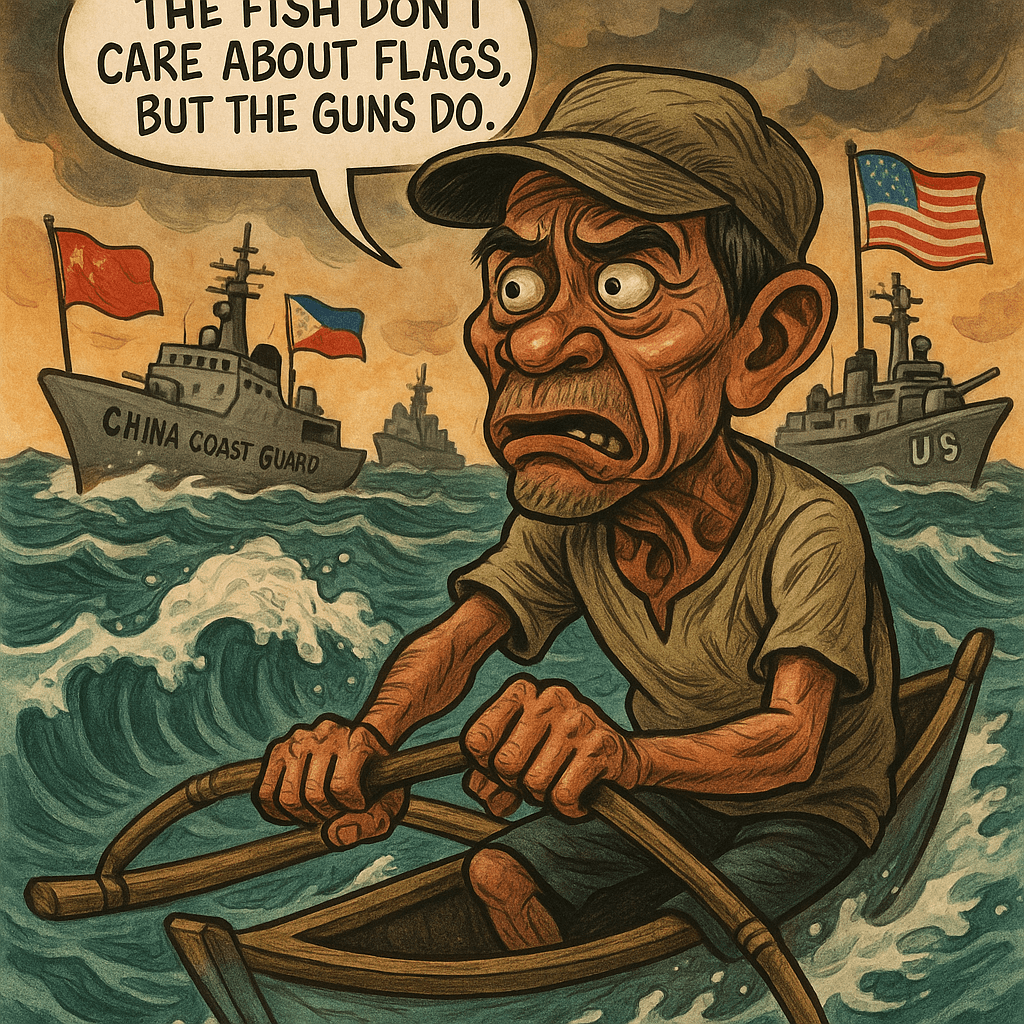
In the predawn haze off Palawan’s coast, Juanito, a wiry Filipino fisherman with calloused hands and a weathered cap, steers his outrigger toward the Spratly Islands. The sea, once his family’s lifeblood, now feels like a battlefield. Last month, a Chinese coast guard vessel loomed over his boat, its horn blaring, forcing him to retreat from his usual fishing grounds. Today, as he spots U.S. and Philippine warships on the horizon—part of the Balikatan 2025 exercises—he wonders if these drills will protect his livelihood or drag his village into a conflict he cannot fathom. “The fish don’t care about flags,” he mutters, “but the guns do.” Juanito’s story, one of countless in the Philippines’ coastal communities, captures the human stakes of a geopolitical chess game unfolding in the South China Sea.
Empires and Allies: The Roots of a Raging Rivalry
The Balikatan exercises, meaning “shoulder-to-shoulder” in Tagalog, began in 1991 as a modest partnership rooted in the U.S.-Philippines Mutual Defense Treaty of 1951. Back then, the focus was counterterrorism, a response to regional insurgencies. But as China’s ambitions grew—militarizing artificial islands and claiming nearly the entire South China Sea—the drills evolved into a high-stakes display of deterrence. The Philippines, a former U.S. colony, has long balanced its alliance with Washington against economic dependence on Beijing. Under President Rodrigo Duterte, Manila briefly tilted toward China, but recent maritime clashes, like the 2024 Scarborough Shoal standoff, have pushed President Ferdinand Marcos Jr. to deepen ties with the U.S.
China’s rise has reshaped the region. Its navy, now the world’s largest by hull count, patrols waters claimed by the Philippines, Vietnam, Malaysia, Brunei, and Taiwan. Beijing views Balikatan as a U.S.-led containment strategy, a sentiment echoed by its foreign ministry’s warning that “those who play with fire will burn themselves” (The Guardian, April 22, 2024). Meanwhile, the U.S., under the Trump administration, has doubled down on its Indo-Pacific presence, deploying advanced systems like the Navy-Marine Expeditionary Ship Interdiction System (NMESIS) to signal resolve. This year’s exercises, involving 14,000 troops and simulating an island invasion, are the largest yet, a clear message to China: the U.S. stands with its ally (U.S. Embassy in the Philippines, April 11, 2023).
Voices from the Vortex: The Human Toll of Power Plays
While generals and diplomats debate strategy, the exercises ripple through Filipino lives. In Batanes, a province just 200 miles from Taiwan, farmers like Maria Santos worry about their fields being trampled during special operations drills. “The soldiers bring medicine and build schools,” she says, “but what if war comes?” Her fear is not abstract: China’s recent patrols near Taiwan have raised alarms about a potential invasion scenario (CSIS, March 28, 2023). In Cagayan, where counter-landing operations are staged, small businesses benefit from troops’ spending, yet protests erupt. Groups like BAYAN decry Balikatan as a U.S. scheme to “advance geopolitical interests,” accusing Manila of surrendering sovereignty (Philstar.com, April 3, 2025).
Fishermen like Juanito face the starkest reality. China’s coast guard has harassed Filipino vessels, slashing nets and blocking access to traditional fishing grounds (Reuters, August 26, 2024). The exercises promise enhanced maritime security, but locals doubt they’ll reclaim their waters. “The Americans train, then leave,” says a Palawan barangay captain. “China stays.” Meanwhile, disinformation campaigns—some linked to Chinese bots—stoke fears that Balikatan invites war, complicating public support (Philstar.com, April 3, 2025). Yet, the drills also bring tangible benefits: in 2023, Balikatan funded health centers and school renovations, earning goodwill in rural areas (U.S. Embassy in the Philippines, April 11, 2023).
Brinkmanship’s Balance Sheet: Who Wins, Who Loses?
To understand the stakes, I’ve crafted a SWOT analysis for the key players, balancing their strategic calculus with the human toll.
- United States
- Strengths: Bolsters alliance credibility, tests advanced systems like NMESIS, and projects power with allies like Australia and Japan. Humanitarian efforts enhance soft power (U.S. Embassy in the Philippines, April 11, 2023).
- Weaknesses: Risks provoking China, straining trade ties. Domestic fatigue over foreign commitments could limit sustainment.
- Opportunities: Deepen trilateral ties with Japan and Australia, potentially integrating South Korea. Lead ASEAN-wide maritime security initiatives.
- Threats: Escalation into conflict, especially if China misinterprets drills as prelude to war. Economic backlash if Beijing retaliates via tariffs.
- Philippines
- Strengths: Gains cutting-edge training, modernizes forces with FA-50 jets and frigates, and secures U.S. defense guarantees (USNI News, April 11, 2023). Local economies benefit from infrastructure projects (U.S. Embassy in the Philippines, April 11, 2023).
- Weaknesses: Domestic opposition fuels polarization; reliance on U.S. risks sovereignty concerns (Philstar.com, April 3, 2025).
- Opportunities: Leverage exercises to attract investment in defense and tourism. Strengthen ASEAN partnerships to counter China’s pressure.
- Threats: Caught in U.S.-China crossfire, risking economic coercion from Beijing. Disinformation undermines public trust.
- China
- Strengths: Uses Balikatan to justify military buildup and rally domestic support. Expands influence via economic leverage over ASEAN states.
- Weaknesses: Alienates neighbors, risking diplomatic isolation. Aggressive posturing invites international scrutiny (Asia Media Centre, April 24, 2024).
- Opportunities: Exploit Philippine domestic unrest to weaken U.S. alliance. Deepen ties with non-aligned ASEAN nations like Malaysia.
- Threats: Miscalculation could spark conflict, especially near Taiwan or Scarborough Shoal. Global backlash over maritime bullying (The Guardian, April 22, 2024).
Steering Clear of the Abyss: A Roadmap for Peace
The Balikatan exercises teeter on a knife’s edge—vital for deterrence, yet flammable in a region bristling with arms. Here are pragmatic steps to maximize benefits while minimizing risks:
- Hearts Over Warheads: Increase Balikatan’s civic projects—schools, clinics, disaster relief—to win local hearts and counter disinformation. Involve ASEAN observers to regionalize goodwill, as seen in 2023’s outreach (U.S. Embassy in the Philippines, April 11, 2023).
- Truth as a Shield: The U.S. and Philippines should jointly clarify that drills are defensive, not provocative, via public campaigns and ASEAN briefings. Engage local media to amplify voices like Juanito’s, grounding abstract security in human stories (Rappler, January 31, 2019).
- Bridge Over Troubled Waters: Push for an ASEAN maritime security forum, using Balikatan’s observer program (19 nations in 2025) as a springboard (Philstar.com, April 3, 2025). Include China to reduce miscalculations, focusing on shared interests like piracy prevention.
- Breaking Beijing’s Grip: The Philippines must reduce reliance on Chinese trade by courting investment from Japan, South Korea, and the EU. U.S. aid should prioritize coastal economies hit by maritime disputes.
- Hotlines, Not Headlines: Establish a U.S.-China-Philippines hotline for maritime incidents, modeled on Cold War precedents, to prevent flashpoints like Scarborough Shoal from spiraling (Reuters, August 26, 2024).
These steps acknowledge the reality: no side wants war, but mistrust fuels escalation. Diplomacy, not just deterrence, must anchor the strategy.
Storm Clouds on the Horizon: A World at the Brink
As I reflect on Juanito’s weathered face and Maria’s anxious gaze, I see the South China Sea as more than a geopolitical hotspot—it’s a microcosm of our world’s fragility. The Balikatan exercises mirror tensions from Ukraine to the Middle East, where great powers flex muscles while ordinary lives hang in the balance. China’s assertiveness, the U.S.’s resolve, and the Philippines’ precarious position echo a global struggle over rules-based order versus might-makes-right. Yet, there’s hope in the “shoulder-to-shoulder” ethos—not just of soldiers, but of communities, allies, and even rivals who could choose dialogue over destruction. The question is whether we’ll heed Juanito’s quiet wisdom: the sea belongs to no flag, only to those who navigate it with care.
This analysis, rooted in the voices of the overlooked and the realities of power, urges us to tread lightly. Strength matters, but so does restraint. In the South China Sea, as in the world, peace demands both.





 KWEBA ni BAROK
Leave a comment