By Louis ‘Barok‘ C. Biraogo — April 23, 2025
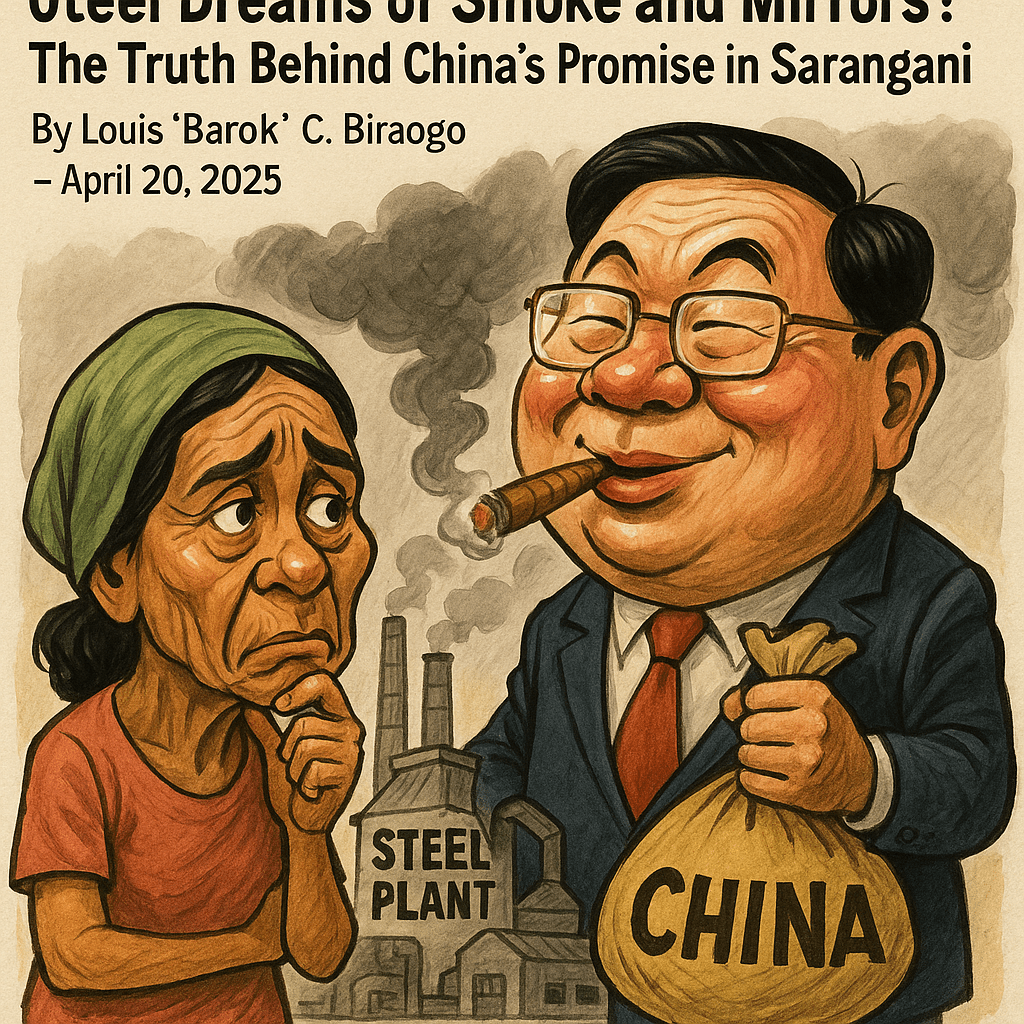
IN THE quiet coastal town of Maasim, Sarangani, Rosadelima Mangelen once tilled land her family owned, coaxing life from the soil. Today, that land is transforming into a sprawling steel plant, a $1 billion project by China’s Panhua Group that promises jobs and progress. For Mangelen, now the village chief, the arrival of Chinese investment stirs both pride and unease. “It’s a chance for our people,” she told me during a visit to Mindanao, “but we wonder what we’re giving up.” Her story mirrors a broader tension in the Philippines, where the allure of foreign capital collides with questions of sovereignty, sustainability, and fairness.
As a journalist long attuned to Asia’s economic tides, I’ve seen this drama unfold before: a developing nation, eager for growth, opens its arms to Chinese investment, only to grapple with the fine print. The Sarangani steel plant, heralded by Chinese Ambassador Huang Xilian as a $3.5 billion “landmark” of Sino-Philippine friendship, is no exception. Yet beneath the rhetoric lies a troubling discrepancy—one that raises questions about transparency, power, and the true cost of progress.
Unmasking the Billion-Dollar Bluff
Let’s start with the numbers. Ambassador Huang’s claim of a $3.5 billion project, announced in a closed-door briefing in Makati, doesn’t hold up. Recent reports from the Philippine Daily Inquirer, BusinessWorld, and the Office of the Special Assistant to the President for Investment and Economic Affairs, as cited in Malaya Business Insight, peg the investment at $1 billion. This isn’t a rounding error. The $3.5 billion figure harks back to a 2019 plan for a massive 10-million-metric-ton steel mill in Misamis Oriental, reported by Philstar and Philippine News Agency, which was quietly scaled down and relocated to Sarangani. Why the ambassador inflated the figure remains unclear—perhaps to amplify China’s benevolence or to gloss over a less ambitious reality.
This discrepancy matters. In a country where trust in institutions is fragile, exaggerated claims erode credibility. The Marcos administration, keen to showcase foreign direct investment (FDI), risks appearing complicit in Beijing’s narrative. Meanwhile, local officials like Miguel Rene Dominguez, former Sarangani governor, tout the project’s potential to produce 2 million metric tons of steel annually, supporting industries nationwide. But if the investment is a third of what was promised, what else has been overstated?
A Nation Starving for Steel—and Sovereignty
The Philippines desperately needs steel. As the only ASEAN nation without an integrated steel mill, it imports nearly all its flat steel, a dependency that hampers infrastructure and industrialization. The Sarangani plant, set to begin production in December 2025, could change that, supplying 30% of its output locally and creating up to 25,000 jobs, according to Panhua’s chairman, Li Xinghua, as noted in Asia News Network. For a region like Mindanao, where poverty rates hover above 30%, this is no small promise.
Yet the Philippines’ economic vulnerabilities make it a ripe target for exploitation. With a GDP per capita of $3,600 and a history of uneven development, the country craves FDI to fuel President Marcos’ “Build Better More” program. China, the Philippines’ largest trading partner, exported $52.4 billion in goods in 2023, dwarfing Manila’s $10.65 billion in exports. This imbalance gives Beijing leverage, especially amid tensions in the South China Sea, where Chinese aggression tests bilateral ties, as highlighted in the Philippine Daily Inquirer. Why, then, does Manila welcome Chinese investment? The answer lies in necessity—and a pragmatic willingness to compartmentalize economics from geopolitics.
China’s Grand Gambit in Southeast Asia
The Sarangani project is a microcosm of China’s broader strategy in Southeast Asia. Through its Belt and Road Initiative (BRI), Beijing has poured billions into infrastructure across the region, from Cambodian highways to Indonesian railways. In the Philippines, over 200 BRI-backed projects have been launched since 2000, often with grandiose promises that fizzle out. Former President Duterte’s pivot to China yielded pledges but little follow-through, a pattern critics call “China’s pledge trap,” as documented in Global Energy Monitor.
Panhua’s project fits this mold. Initially announced as a $3.5 billion venture on Panhua Group’s website, it mirrors other scaled-down Chinese investments, like the HBIS-SteelAsia deal in Batangas, reported by Philippine News Agency. Across Southeast Asia, Chinese steel plants—such as those in Indonesia and Malaysia—boost local economies but often come with strings: environmental degradation, labor disputes, and debt dependency. In Sarangani, the promise of 25,000 jobs is tempered by a 2021 incident where 48 Chinese workers were detained for permit violations, as reported by the Philippine Daily Inquirer, raising fears that Filipino jobs might be sidelined.
From afar, I’ve tracked how Cambodia and Laos mirror regional trend: Chinese-funded projects bring roads and factories but often bypass local labor and skirt environmental regulations. In Sarangani, the plant’s blast furnace technology, while efficient, risks air and water pollution in a region already strained by a coal-fired plant nearby, as noted in SteelOrbis. Where is the oversight to ensure Maasim’s fishermen and farmers aren’t left with toxic runoff?
Voices Caught in the Crucible
For locals like Mangelen, the steel plant is a double-edged sword. “We want jobs,” she said, “but we don’t want to lose our way of life.” Her community, once sustained by agriculture, now faces displacement and environmental uncertainty. Panhua’s donations—20 million RMB during COVID, school bags, ambulances—soften the blow but don’t address long-term impacts, as reported in Asia News Network. A Filipino worker I met, wary of being replaced by Chinese labor, whispered, “They say it’s for us, but it feels like it’s for them.”
Local leaders, however, are more optimistic. Dominguez sees the plant as a catalyst for Mindanao’s growth, noting that FDI in the region reached P198.6 billion from 2022 to 2024, per Asia News Network. Yet the benefits hinge on execution. Will Panhua prioritize local hiring, as promised? Will the Kamanga Agro-Industrial Ecozone deliver equitable growth, or will profits flow back to Jiangsu? These questions linger, unanswered.
Forging a Fairer Future
The Sarangani project need not be a cautionary tale. Here’s how stakeholders can steer it toward shared prosperity:
- Philippine Government: Strengthen oversight through the Philippine Economic Zone Authority (PEZA). Mandate public disclosure of investment details, environmental impact assessments, and labor contracts. Regular audits can ensure Panhua meets its job creation promises.
- Panhua Group: Commit to transparent reporting and local hiring quotas. Partner with Filipino universities to train engineers, ensuring knowledge transfer. Implement robust environmental safeguards, like advanced emissions controls, to protect Maasim’s ecosystem.
- Local Communities: Form citizen watchdog groups to monitor the plant’s impact. Engage with NGOs to advocate for fair wages and safe working conditions. Mangelen’s village could lead by example, demanding a seat at the table.
- International Community: The U.S. and Japan, key Philippine allies, should offer technical assistance to bolster Manila’s regulatory capacity. ASEAN could develop a code of conduct for foreign investments, balancing economic gains with social protections.
Beyond the Furnace: A Fight for Dignity
The Sarangani steel plant is more than a factory; it’s a test of whether the Philippines can harness foreign capital without losing its soul. The darker chapters of Asia’s economic rise—exploitative labor, displaced communities, environmental ruin—all teach the same lesson: progress without accountability is a hollow victory. The people of Maasim deserve better than inflated promises and half-truths. They deserve a future where steel strengthens their community, not just China’s influence.
Can Manila rise to the challenge? Can Beijing invest with integrity? The answers will shape not just Sarangani but the broader dance of power in Southeast Asia. For now, Rosadelima Mangelen watches the cranes rise, hoping her children inherit a legacy of opportunity, not regret.
- ₱75 Million Heist: Cops Gone Full Bandit

- ₱6.7-Trillion Temptation: The Great Pork Zombie Revival and the “Collegial” Vote-Buying Circus

- ₱1.9 Billion for 382 Units and a Rooftop Pool: Poverty Solved, Next Problem Please

- ₱1.35 Trillion for Education: Bigger Budget, Same Old Thieves’ Banquet

- ₱1 Billion Congressional Seat? Sorry, Sold Out Na Raw — Si Bello Raw Ang Hindi Bumili

- “We Will Take Care of It”: Bersamin’s P52-Billion Love Letter to Corruption

- “Skewed Narrative”? More Like Skewered Taxpayers!

- “Scared to Sign Vouchers” Is Now Official GDP Policy – Welcome to the Philippines’ Permanent Paralysis Economy

- “Robbed by Restitution?” Curlee Discaya’s Tears Over Returning What He Never Earned

- “No Pressure” Luistro? The House Pork Bazaar Exposed
- “My Brother the President Is a Junkie”: A Marcos Family Reunion Special

- “Mapipilitan Akong Gawing Zero”: The Day Senator Rodante Marcoleta Confessed to Perjury on National Television and Thought We’d Clap for the Creativity




 KWEBA ni BAROK
Leave a comment