By Louis ‘Barok‘ C. Biraogo — April 28, 2025
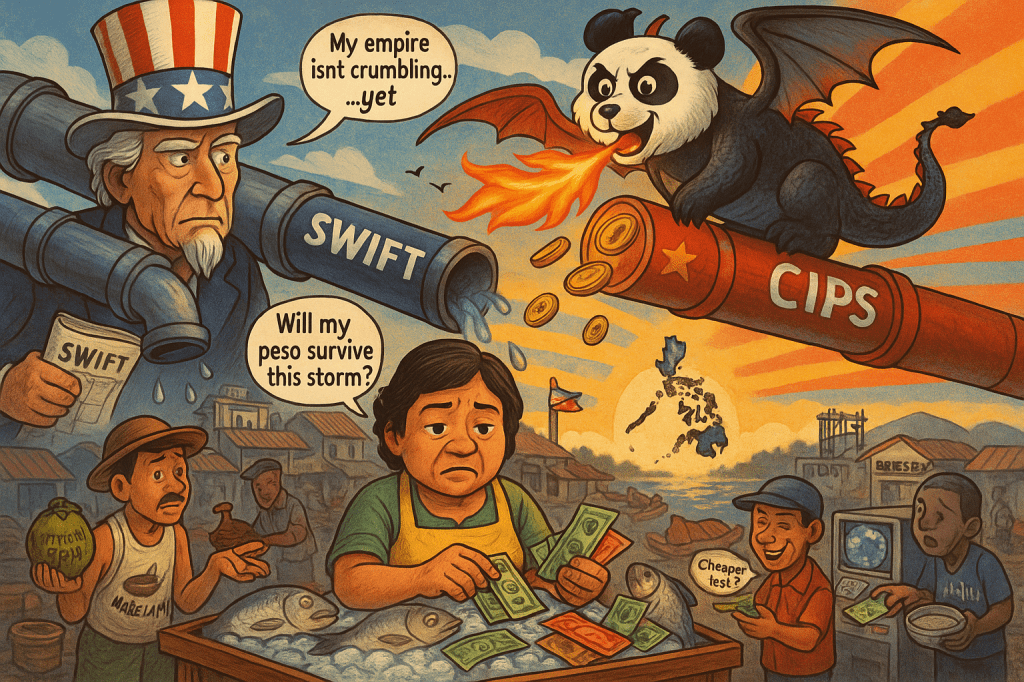
IN A bustling Manila market, Linda Dela Cruz, a 38-year-old fish vendor, sorts her day’s earnings in pesos, her hands swift despite the weight of worry. Prices for fuel, rice, and the ice that keeps her catch fresh are climbing, gnawing at her slim margins. “Everything’s more expensive,” she tells me, her voice tinged with frustration. “I don’t know why it’s harder to save.” Linda’s daily grind seems worlds apart from the high-stakes financial maneuvering in Shanghai, where China is launching a daring assault on the U.S. dollar’s global reign. Yet her struggles are tethered to this seismic shift, driven by China’s Cross-Border Interbank Payment System (CIPS) and BRICS Pay, which could redraw the map of global power—and reshape Linda’s life in the Philippines.
China’s audacious plan is to dethrone the dollar, the linchpin of international trade and finance since World War II. The dollar anchors 85% of global transactions and 60% of foreign exchange reserves, cementing U.S. economic dominance. But Beijing, through CIPS and the fledgling BRICS Pay, is spinning a new financial web, one that elevates the yuan and local currencies over the greenback. This isn’t just a currency war; it’s a battle for influence, autonomy, and the future of nations like the Philippines, caught in the turbulent wake of a multipolar world.
Unraveling the Global Money Machine
To grasp China’s bold gambit, imagine the global financial system as a sprawling network of pipes. SWIFT, the Belgium-based messaging system, is the central artery, channeling $150 trillion in annual transactions, mostly in dollars. It’s the lifeblood of global trade but also a Western chokehold—recall Russia’s SWIFT ban after invading Ukraine. China’s CIPS, launched in 2015, is a rival conduit, now linking over 1,300 institutions across 110 countries for yuan-based payments. BRICS Pay, still embryonic, aims to leapfrog SWIFT with blockchain, enabling direct transactions in local currencies among Brazil, Russia, India, China, South Africa, and their allies.
These aren’t mere technical upgrades; they’re geopolitical thunderbolts. By boosting the yuan, China seeks to shield itself from U.S. sanctions and reduce reliance on dollar-based banks. BRICS Pay, propelled by Russia’s sanctions-dodging agenda, could sidestep SWIFT entirely, offering a lifeline to pariah states. The BRICS bloc, with 45% of the world’s population and 35% of its GDP, has clout. Success could erode the dollar’s grip, curbing America’s financial leverage.
But the path is treacherous. CIPS processes a sliver of SWIFT’s volume, and the yuan holds just 3% of global payments. BRICS Pay grapples with technical snarls—meshing systems like India’s UPI or Russia’s Mir is a logistical nightmare. Doubters, including Indian officials, suspect geopolitical grandstanding overshadows economic sense. Western banks, sensing a threat, may retaliate with sanctions or tariffs, as U.S. rhetoric in 2025 suggests. A fractured financial system looms, which the IMF warns could choke global growth.
The Human Toll in the Philippines’ Heartland
For the Philippines, this isn’t a distant boardroom drama. Linda’s rising costs mirror the peso’s fragility amid global tremors. The country leans heavily on dollar-based trade—70% of its exports, like electronics and garments, are dollar-invoiced. Overseas Filipino workers, remitting $40 billion yearly, mostly in dollars, sustain families like Linda’s. A fading dollar or rising yuan could jolt these flows, inflating costs for fuel and food, which sting small vendors most.
Geopolitically, the Philippines is a high-wire act. Its U.S. alliance, anchored by military bases and trade deals, collides with economic ties to China, a top trading partner. China’s Belt and Road Initiative funds Philippine infrastructure, often with yuan loans and Chinese bank strings. If CIPS and BRICS Pay gain steam, Manila might face pressure to pivot toward yuan-based trade, risking U.S. backlash. The South China Sea tensions sharpen this bind; China’s territorial flexing makes financial reliance a diplomatic minefield.
Take Eduardo, a Manila coconut exporter. Chinese buyers nudge him toward yuan payments via CIPS, touting lower fees. “It’s cheaper,” he admits, “but tying to China’s system feels risky. What if the U.S. pushes back?” Eduardo’s quandary reflects the nation’s: economic pragmatism versus strategic loyalty. A multipolar financial order could free the Philippines to trade in pesos or yuan, but volatility lurks as currencies vie for supremacy.
Weighing the Scales of Power and Peril
China’s crusade isn’t a comic-book plot. It’s a logical riposte to U.S. financial dominance, which has punished nations like Russia and Iran. Emerging economies, scarred by dollar-fueled crises like the 1997 Asian collapse, hunger for independence. CIPS and BRICS Pay could slash transaction costs and diversify risk, perks even U.S. allies might welcome. Yet the political undertow—China’s grip on CIPS, Russia’s sanctions-evasion goals—raises hackles. Neutral nations may balk, wary of a Sino-Russian snare.
The U.S. bears blame, too. Weaponizing the dollar, from Venezuela’s asset freezes to Afghanistan’s, has bred resentment. But swapping one overlord for another isn’t freedom. China’s capital controls and murky governance cap the yuan’s reserve currency allure. A multipolar system sounds fair, but fragmentation could spike costs and destabilize markets, hammering small economies like the Philippines hardest.
Charting a Course Through the Storm
The Philippines, and the world, must navigate this upheaval with clarity. Here are bold yet grounded steps:
- Embrace Currency Kaleidoscope: Manila should diversify trade currencies—pesos, yuan, euros—via bilateral pacts. This softens dollar reliance without wedding China’s system. ASEAN trials in local currency trade offer a blueprint.
- Forge ASEAN’s Financial Shield: The Philippines should spearhead ASEAN efforts to blend CIPS with regional platforms like Thailand’s PromptPay. This preserves sovereignty while leveraging China’s infrastructure, dodging a U.S.-China binary.
- Empower the Market’s Pulse: Small traders like Linda need defenses against currency swings. Government training in hedging and digital payments can shield vendors and exporters from global jolts.
- Reshape Global Rules: The U.S. and allies must overhaul SWIFT and the IMF to ease Global South burdens, like steep borrowing costs. Manila should champion these reforms in the G20, undercutting BRICS Pay’s appeal.
- Dance with Both Giants: Deepen U.S. ties while engaging China economically, using diplomacy to avoid superpower crossfire. Transparent Chinese loan terms will avert debt traps.
Envisioning a New Dawn
Linda’s market stall, Eduardo’s export trade, and the Philippines’ destiny hang on a world where money isn’t a single empire. China’s CIPS and BRICS Pay herald a multipolar era—one that could liberate smaller nations or entangle them in fresh chains. The dollar’s fall isn’t near, but its unchallenged throne wobbles. For the Philippines, the task is to turn this flux into opportunity, not chaos.
Picture Linda tallying her earnings in pesos, yuan, or a BRICS digital token, each sale a quiet claim to sovereignty. That horizon demands fearless, people-first policies that transcend great-power games. The global financial order teeters; let’s steer it toward markets where vendors like Linda don’t just endure, but flourish.

- “I Warned You in 2022!” — Sara’s Crystal Ball Meets Claire’s Nonfeasance Roast

- 200 Mega Boxes of Lies: Remulla Unleashes AI to Sort the Swamp (Before It Swallows Us All)
- Three-Way Circus 2028: Sara, Leni & Tulfo Walk Into a Poll…
- Marcoleta’s Zero Donations Lie: How a Televised Confession Became “Legal Complications”
- Priest Sentences Duterte to Life – No Trial Needed

- Flood Control or Flood of Corruption? Marcos’ Infrastructure Probe Hits a Curious Pause
- Tau Gamma Phi: Where Brotherhood Means Beating You to Death and Blaming the Rogue Chapter
- Procurement Mafia’s Latest Hit Job: Why Herbosa Can’t Catch a Break
- Abra-Cadabra! 4.3 Million Poor Filipinos Just Vanished – Thanks, DHSUD Math

- Sara’s Magic Plane Fantasy vs. Marcos’ Bureaucratic Black Hole: Who Screws OFWs Worse?
- Sara’s Bagman Blows the Whistle – Then She Blows Perjury Smoke
- Bong Suntay’s Wet Dream Defense: How One Congressman Turned Impeachment into Pornhub Testimony


 KWEBA ni BAROK
Leave a comment