By Louis ‘Barok‘ C. Biraogo — May 1, 2025
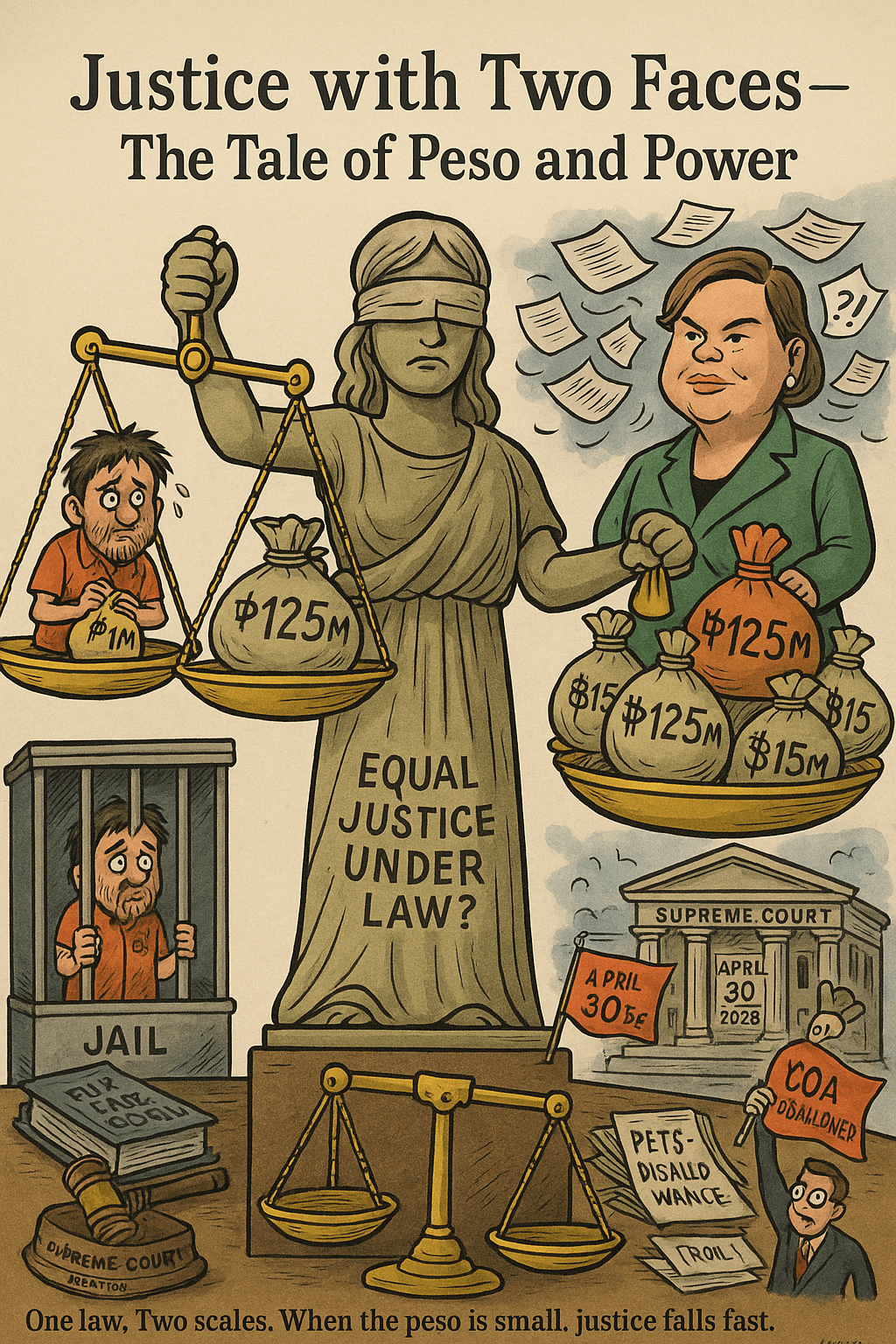
TWO scandals. One rule of law. The Supreme Court just hammered a corrupt mayor for stealing confidential funds—while Vice President Sara Duterte’s P125 million secret spending escapes scrutiny. This isn’t just hypocrisy; it’s a constitutional crisis in disguise. Let us dive into how these cases expose a dangerous rift between justice for the powerful and the powerless.
1. Caught Red-Handed: The Ruiz Conviction Unraveled
Facts of the Scandal
From 1998 to 2001, Joseph Cedrick Ruiz, then Mayor of Dapitan City, orchestrated a brazen scheme. In May 2001, weeks before his term ended after a re-election loss, Ruiz directed Deputy Chief of Police Pepe Nortal to secure a P1 million cash advance from the city’s 2001 confidential and intelligence funds (CIF), claiming it was for post-election violence. Nortal delivered the funds to Ruiz, who allocated a mere P50,000 for police operations and pocketed the remaining P950,000 without a trace. Nortal’s whistleblowing complaint to the Office of the Ombudsman sparked an investigation, culminating in Ruiz’s conviction by the Sandiganbayan, upheld by the Supreme Court on January 27, 2025, in a scathing 32-page decision by Associate Justice Ramon Paul Hernando (SC Decision).
Crimes Exposed: Substantive Law Violations
- Republic Act No. 3019, Section 3(e): This anti-graft law punishes public officers for causing “undue injury” through “manifest partiality, evident bad faith, or gross inexcusable negligence.” The Supreme Court ruled Ruiz’s request for the entire 2001 CIF was a deliberate act of bad faith, draining Dapitan City’s intelligence budget and forcing budget realignment, inflicting undue injury. His collusion with finance officers to bypass controls cemented his guilt.
- Revised Penal Code, Article 217 (Malversation): Malversation occurs when a public officer misappropriates public funds. The Court found Ruiz guilty of diverting P950,000 for personal gain, as his failure to liquidate the funds was damning evidence.
Navigating the Legal Maze: Procedural Journey
Nortal’s complaint landed at the Office of the Ombudsman, which charged Ruiz before the Sandiganbayan. In 2013, the anti-graft court convicted him of graft and malversation. Ruiz appealed to the Supreme Court (G.R. Nos. 209073-74), but the First Division upheld the verdict, dismissing his claim that Nortal bore sole responsibility. The Court cited Ruiz’s orchestrating role, evidenced by financial records and witness testimonies.
Ethical Betrayal: Breaching Public Trust
Ruiz flouted Republic Act No. 6713, the Code of Conduct for Public Officials, particularly Section 4(a) and (c), demanding integrity and transparency. His clandestine misuse of CIF and failure to account for public funds shattered ethical standards, eroding public confidence.
Hammer of Justice: Penalties Imposed
- Graft (RA 3019): Up to 8 years in prison.
- Malversation (RPC): Up to 8 years and 8 months in prison.
- Fine: P950,000, matching the stolen funds.
- Perpetual Disqualification: Banned from public office, echoing Mataga v. Rosete (483 Phil. 235, 2004), which demands harsh penalties for fund mismanagement.
Supreme Court’s Iron Logic
The Court condemned Ruiz’s request for the entire 2001 CIF as unjustifiable, as it gutted Dapitan City’s intelligence budget, causing undue injury through forced budget realignment. His bad faith was clear in bypassing financial safeguards and using Nortal as a front due to prior unliquidated advances. The failure to account for P950,000 confirmed personal gain, fulfilling malversation criteria. The ruling leaned on NBI v. Reyes (382 Phil. 872, 2000), which mandates rigorous accountability for CIF.
2. Firestorm of Funds: Duterte’s CIF Controversy
Facts of the Uproar
In December 2022, Vice President Sara Duterte’s Office of the Vice President (OVP) received P125 million in CIF, transferred from the Office of the President’s (OP) contingent funds via the Department of Budget and Management (DBM). Shockingly, the funds were spent in just 11 days, raising red flags. On August 8, 2024, the Commission on Audit (COA) issued a Notice of Disallowance for P73 million, citing missing documentation for intelligence activities (Rappler: COA Report). Supreme Court petitions, including those by former Solicitor General Jose Calida and the Makabayan bloc, challenge the transfer’s constitutionality (Rappler: SC Petition). As of April 30, 2025, the case is unresolved, with Duterte facing an impeachment trial partly tied to these funds (Wikipedia: Impeachment).
Legal Fault Lines: Substantive Issues
- Article VI, Section 25(5), 1987 Constitution: This prohibits fund transfers without congressional approval. Critics argue the OP-to-OVP transfer was illegal, as the 2022 OVP budget lacked a CIF allocation. The use of contingent funds may violate Melloria vs. Jimenez (G.R. No. 245894, 2023), requiring CIF to support intelligence or law enforcement.
- Republic Act No. 9184 (Government Procurement Reform Act): The 11-day spending spree raises doubts about compliance with transparency and bidding requirements for large disbursements.
- Presidential Decree No. 1445 (Government Auditing Code): Section 2(2) mandates proper documentation. The COA’s disallowance highlights the OVP’s failure to prove intelligence outcomes, suggesting mismanagement.
Procedural Battlefield
The controversy erupted during 2023 budget hearings, with lawmakers questioning the CIF transfer. The COA’s 2024 audit flagged P73 million, issuing a disallowance. Supreme Court petitions seek to nullify the transfer and order the funds’ return, while the House Committee on Good Government uncovered dubious recipient names (e.g., “Mary Grace Piattos”) (Rappler: COA Report). An impeachment complaint, approved on February 5, 2025, for a Senate trial, amplifies the stakes.
Ethical Quagmire
Duterte’s case breaches RA 6713, particularly Section 7(b)(2), mandating transparency in financial dealings. The lack of documentation and alleged use of fictitious names (e.g., “Milky Secuya”) undermine accountability, though no personal gain is alleged.
Burning Questions
- OVP’s CIF Legitimacy: Does the OVP, without a direct intelligence mandate, qualify for CIF, per Melloria vs. Jimenez?
- Procurement Compliance: Did the rapid expenditure violate RA 9184’s transparency rules?
- Constitutional Breach: Does the transfer flout Article VI, Section 25(5), as argued in Carpio v. Executive Secretary (2023)?
Guiding Precedents
- Melloria vs. Jimenez (G.R. No. 245894, 2023): Restricts CIF to intelligence or law enforcement, questioning OVP’s eligibility.
- Carpio v. Executive Secretary (2023): Challenges executive fund transfers, critical to questioning the OP’s role in CIF allocations.
3. Clash of Scandals: Ruiz vs. Duterte
| Aspect | Ruiz | Duterte |
|---|---|---|
| Legal Violations | RA 3019 (graft), RPC Article 217 (malversation) | Article VI, Sec. 25(5), PD 1445 (audit), RA 9184 (procurement) |
| Intent | Personal gain (proven) | Mismanagement (alleged, no personal gain) |
| Stage | Convicted, final (SC, Jan. 27, 2025) | Pending (SC petitions, COA disallowance, impeachment) |
| Scale | Local (P1M, Dapitan City) | National (P125M, OVP) |
| Precedents | NBI v. Reyes (2000), Mataga v. Rosete (2004) | Melloria v. Jimenez (2023), Carpio v. Executive Secretary (2023) |
| Ethical Breaches | RA 6713 (transparency, integrity) | RA 6713 (transparency, documentation) |
Shared Sins
- Opaque Operations: Both cases reveal murky CIF handling, violating RA 6713’s transparency mandates. Ruiz’s unliquidated P950,000 mirrors Duterte’s undocumented P73 million.
- Eroding Faith: Both scandals dent public trust, with Ruiz’s greed exposing personal corruption and Duterte’s case spotlighting systemic flaws.
- CIF Weaknesses: Both highlight lax oversight of CIF, demanding tighter controls.
Dividing Lines
- Motive: Ruiz’s personal enrichment contrasts with Duterte’s alleged mismanagement, lacking evidence of personal gain.
- Legal Fate: Ruiz faces prison and disqualification, while Duterte’s case awaits SC rulings and impeachment outcomes.
- Scope: Ruiz’s local P1 million theft pales against Duterte’s national P125 million, with constitutional stakes.
4. Verdict and Fallout: Shaping Accountability
Ruiz’s Reckoning
The Supreme Court’s upholding of Ruiz’s conviction (SC Decision) cements a zero-tolerance stance on CIF misuse. By affirming penalties under RA 3019 and RPC Article 217, it sets a deterrent precedent, reinforced by NBI v. Reyes (A.M. No. MTJ-97-1120, 2000) and Mataga v. Rosete (A.M. No. MTJ-03-1488, 2004).
Duterte’s Tightrope
Duterte’s saga probes the boundaries of executive fund discretion, with Article VI, Section 25(5) at its core. The COA’s disallowance and SC petitions, guided by Melloria vs. Jimenez (G.R. No. 245894, 2023) and Carpio v. Executive Secretary (2023), could reshape CIF rules. Impeachment adds political heat, but the lack of personal gain allegations sets it apart from Ruiz (Wikipedia: Impeachment).
Systemic Shockwaves
Both cases expose CIF oversight gaps, from local to national levels. Ruiz’s punishment deters individual corruption, while Duterte’s case challenges executive overreach. Bolstering COA audits, clarifying CIF mandates via Melloria, and enforcing RA 6713 are vital to rebuild trust. As of April 30, 2025, Ruiz’s case is closed, but Duterte’s legal and political battles loom large.
Key Citations:
- SC Affirms Conviction of Ex-Dapitan City Mayor
- Sara Duterte’s Office Tried to Block COA Report
- Confidential Funds Controversy Erupts
- Impeachment of Sara Duterte
- Experts Petition SC to Order Funds Return
- Carpio Challenges Confidential Funds
- VP Seeks Dismissal of Cases
- SC Asked to Declare Funds Unconstitutional
- OVP’s Fund Use May Reach SC
Disclaimer: This is legal jazz, not gospel. It’s all about interpretation, not absolutes. So, listen closely, but don’t take it as the final word.

- “Forthwith” to Farce: How the Senate is Killing Impeachment—And Why Enrile’s Right (Even If You Can’t Trust Him)
- “HINDI AKO NAG-RESIGN!”

- “I’m calling you from my new Globe SIM. Send load!”

- “Mahiya Naman Kayo!” Marcos’ Anti-Corruption Vow Faces a Flood of Doubt

- “Meow, I’m calling you from my new Globe SIM!”

- “No Special Jail for Crooks!” Boying Remulla Slams VIP Perks for Flood Scammers

- “Philippine-Controlled” or Yankee Gas Station? The Davao Fuel Depot Farce Exposed

- “PLUNDER IS OVERRATED”? TRY AGAIN — IT’S A CALCULATED KILL SHOT

- “Several Lifetimes,” Said Fajardo — Translation: “I’m Not Spending Even One More Day on This Circus”

- “Shimenet”: The Term That Broke the Internet and the Budget

- “We Did Not Yield”: Marcos’s Stand and the Soul of Filipino Sovereignty

- “We Gather Light to Scatter”: A Tribute to Edgardo Bautista Espiritu





 KWEBA ni BAROK
Leave a comment