By Louis ‘Barok‘ C. Biraogo — May 1, 2025
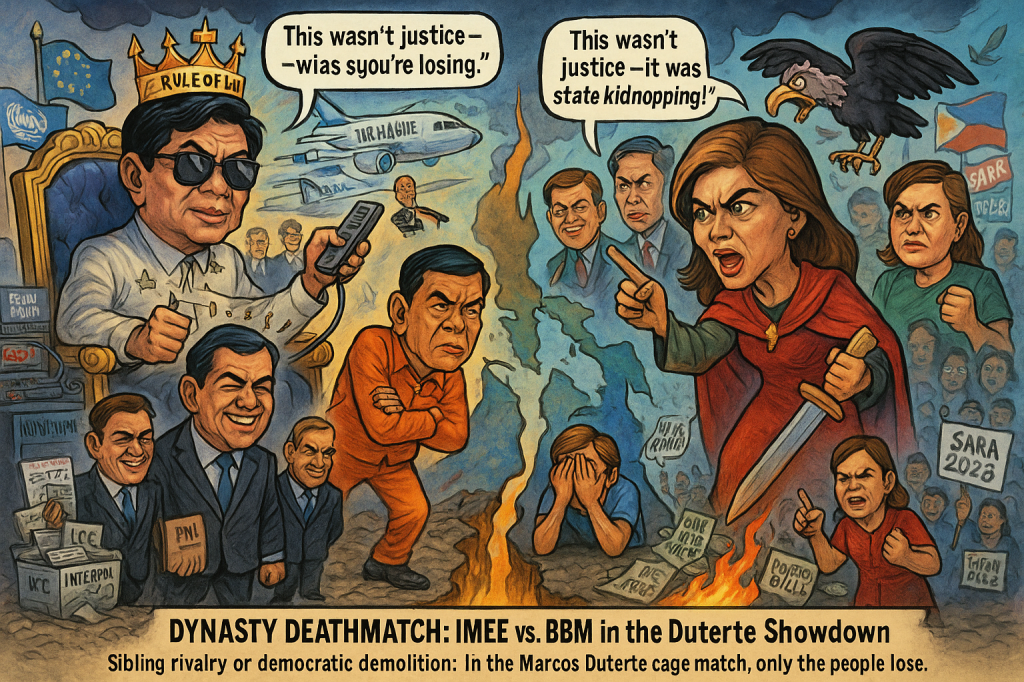
IN A dimly lit Manila hangar, former President Rodrigo Duterte, the Philippines’ once-untouchable strongman, was hustled onto a jet bound for The Hague on March 11, 2025. Arrested on an International Criminal Court (ICC) warrant for crimes against humanity, his transfer was swift—too swift, some say, for a nation that prides itself on sovereignty. President Ferdinand Marcos Jr. called it justice, a nod to global law. His sister, Senator Imee Marcos, branded it a “state kidnapping,” a brazen political hit to crush the Duterte dynasty. This sibling clash, erupting from a shattered Marcos-Duterte alliance, isn’t just family drama—it’s a seismic threat to Philippine democracy. As dynasties spar, is this accountability for a bloody past or a coup dressed in legal robes?
Unmasking the Power Grab: Core Issues Laid Bare
Duterte’s Arrest: Triumph of Justice or Political Assassination?
Rodrigo Duterte’s arrest was a spectacle of precision. Executed via an ICC warrant through Interpol, it targeted his drug war, which killed at least 6,000—possibly 30,000, per human rights estimates. Marcos Jr. insists it was lawful, noting the complaints originated in 2017, before his presidency. “We followed every single necessary procedure,” he told reporters, framing Interpol compliance as a global duty (Philstar, April 30, 2025).
But Senator Imee Marcos’s Senate probe tells a darker tale. Her report, released March 27, 2025, found “glaring violations” of Duterte’s rights: no Philippine court issued a warrant, extradition protocols were bypassed, and constitutional due process was shredded (GMA News, March 27, 2025). She claims it was a “planned effort” to kneecap Duterte and Vice President Sara Duterte, timed suspiciously with Sara’s impeachment by Marcos allies. Imee even suggested a Senate inquiry into China-funded troll farms was a smokescreen for the arrest’s backlash (Inquirer, April 29, 2025).
The contradictions are glaring. Marcos leans on Interpol’s legitimacy, but Imee cites its prohibition on “political” actions, arguing this was exactly that. The Philippines quit the ICC in 2019, yet Marcos’s team expedited Duterte’s transfer, raising questions about selective globalism. Is this justice for drug war victims or a calculated strike to bury a rival? The evidence points to both—a legal act with undeniable political venom.
Family Feud or Democratic Funeral? The Dynastic Rift
The Marcos-Duterte saga is a dynastic blood feud, not a policy spat. Their 2022 “UniTeam” alliance—Marcos Jr. as president, Sara Duterte as vice president—was a fragile pact between titans. It crumbled as ambitions clashed. Sara’s impeachment, Duterte’s arrest, and Imee’s rebellion against her brother expose a brutal truth: in the Philippines, family ties are political empires (Lowy Institute, March 2025).
Imee’s break is seismic. Once a Marcos loyalist, she now backs the Dutertes, her Senate probe a direct affront to her brother’s rule. She admits they’ve barely spoken, blocked by his inner circle (Manila Bulletin, April 29, 2025). This mirrors global dynastic struggles—think Pakistan’s Sharif-Bhutto wars or Thailand’s Shinawatra clashes—where personal loyalties trump public good. The Marcoses (Ilocos Norte) and Dutertes (Davao) aren’t just families; they’re machines controlling votes, wealth, and power.
The cost is devastating. While elites feud, 16% of Filipinos live below the poverty line, and typhoons displace thousands yearly (University of Portsmouth, 2025). This circus diverts focus from real crises, leaving the nation’s poor as pawns in a dynastic chess game.
Uncovering Hidden Agendas: Key Players’ True Motives
Marcos Jr.: Global Hero or Ruthless Tactician?
Marcos Jr.’s “rule of law” rhetoric strains credulity. The arrest came after his alliance with Sara Duterte imploded—she quit his cabinet, faced impeachment, and was branded a threat. His February 2025 campaign speech slammed Duterte’s “disastrous legacy,” a clear signal of war (South China Morning Post, 2025). The ICC warrant, executed by loyalists, was a golden opportunity to cripple a rival without direct blame.
Marcos’s claim that 2017 complaints clear him of political motives doesn’t hold. His shift from ICC defiance to Interpol cooperation reeks of timing, especially with Sara leading 2028 polls at 29% (The Conversation, 2025). His “melancholic” post-arrest demeanor, noted by Interior Secretary Jonvic Remulla, feels staged against the political windfall. Marcos may value global ties, but his actions scream strategic opportunism.
Imee Marcos: Defender of Rights or Dynastic Survivor?
Imee’s report is a legal tour de force, exposing the arrest’s flaws: no local warrant, no extradition process, and constitutional breaches (Philstar, March 28, 2025). Yet, her motives are murky. Facing reelection with slipping polls (14th in February 2025), she needs a bold move. Aligning with the Dutertes, via her bond with Sara, is a calculated play to tap their populist base.
Her sovereignty crusade resonates with Duterte’s fans, who see the ICC as neo-colonial. But her push for charges against officials like Remulla risks becoming a personal vendetta. She conveniently sidesteps Duterte’s own due process abuses during his drug war. Imee’s constitutional zeal seems less about principle and more about political survival.
Sara Duterte: Silent Plotter or Trapped Heir?
Sara Duterte’s near-silence is strategic. From The Hague, supporting her father’s defense, she’s called the arrest a “sovereignty affront” (ABC News, March 18, 2025). Facing impeachment, delayed until post-2025 midterms, she’s biding her time. Leading 2028 polls, her dynasty’s future hinges on securing a friendly Senate to block conviction.
Her silence masks mobilization—grassroots rallies and loyalist ex-generals hint at a counteroffensive. Threats of military unrest, though veiled, signal desperation. Sara’s next move will shape whether the Dutertes reclaim power or fade under Marcos’s assault.
Remulla & Co.: Guardians of Law or Marcos’s Muscle?
Justice Secretary Remulla and officials like PNP chief Gen. Rommel Marbil defend the arrest as legal duty, unafraid of Imee’s charges. “What’s good for the country is what we did,” Remulla said (Manila Times, April 29, 2025). Their swift execution—Duterte was gone in hours—suggests premeditation.
Working closely with Marcos, their loyalty is evident. Setting aside sovereignty concerns, their actions might resemble those who prioritize power over law, similar to dynamics seen in other political contexts like Erdogan’s Turkey. Their resistance to Imee’s probe suggests they trust in Marcos’s support, though it challenges their stance on impartiality.
Decoding the Chaos: The Bigger Picture
ICC vs. Sovereignty: Global Justice or Neo-Colonial Trap?
The ICC’s case against Duterte is historic—the first Asian ex-leader in its dock. Its jurisdiction, valid for pre-2019 crimes, is legally sound but divisive. Duterte’s base, echoing Imee, sees it as Western meddling, especially post-Philippines’ ICC exit (Nikkei Asia, 2025). Marcos’s Interpol compliance aligns with global norms but bypasses local courts, fueling “usurpation” claims.
This echoes Kenya’s ICC backlash, where sovereignty trumped accountability. Marcos’s move strengthens U.S. ties but risks nationalist blowback, alienating Duterte’s rural strongholds. Is he upholding justice or sacrificing sovereignty for geopolitical points?
Election Powder Keg: Will Voters Reward or Reject the Feud?
The Marcos-Duterte clash defines the 2025 midterms, with 12 Senate seats and 317 House seats up for grabs. Marcos’s candidates lead, but Duterte’s arrest has rallied his base, painting him as a martyr (Bloomberg, 2019). Sara’s impeachment trial, post-election, depends on Senate makeup—a Duterte-friendly chamber could save her.
Marcos’s approval has plummeted from 42% to 25% since the arrest, while Sara holds 29% for 2028. Urban voters may back Marcos’s globalism; rural ones, Duterte’s populism. This polarization could fracture the nation, with escalation favoring the Dutertes’ victim narrative.
A Path Forward: Barok’s Urgent Fixes
Justice Without Bias: Demand an Independent Probe
To silence cries of politicization, an independent judicial review must scrutinize Duterte’s arrest. A panel of retired justices and international law experts should probe the warrant, Interpol’s role, and constitutional adherence. This would test Marcos’s transparency and counter Imee’s “kidnapping” charge. Without it, justice looks like a dynastic weapon.
Break the Dynastic Curse: Enforce Anti-Nepotism Laws
The feud proves dynasties choke democracy. Congress must pass stalled anti-nepotism laws, limiting family members in concurrent offices. A constitutional cap on family-wide terms could dismantle inherited fiefdoms. Civil society, like Bayan, must push lawmakers to act, or democracy stays a family affair.
ICC, Come Clean: Transparency to Defuse Bias Claims
The ICC must counter neo-colonial accusations by sharing its evidence and engaging Filipinos, including victim voices. Transparency would bolster legitimacy. Western allies, like the U.S., should fund local judicial reforms, not just applaud ICC moves, to avoid fueling anti-foreign sentiment.
A Nation’s Soul at Stake
The Philippines teeters on the edge. Duterte’s arrest could mark accountability for a brutal past or ignite a democratic collapse. The Marcos-Duterte feud, with its legal warfare and venomous rhetoric, drowns out the cries of drug war widows and typhoon-ravaged communities. Filipinos deserve a democracy where justice serves the people, not power-hungry clans. Will leaders rise above their dynastic obsessions, or will this feud bury reform’s faint hope? The world watches, and history waits to judge.
Key Citations:
- Philstar: Marcos Disagrees with Imee’s Findings on Duterte’s Arrest
- GMA News: Senate Panel Initial Findings on Duterte’s Arrest
- Inquirer: Imee Marcos Blasts Duterte Arrest
- Lowy Institute: A Family Feud in the Philippines
- Manila Bulletin: Marcos on Imee’s Findings
- University of Portsmouth: Feud Distracts from Typhoon Suffering
- South China Morning Post: What Duterte’s Downfall Means
- The Conversation: Arrest Shakes Dynastic Politics
- ABC News: Marcos-Duterte Family Feud
- Manila Times: Marcos Disagrees with Imee
- Nikkei Asia: Marcos-Duterte Conflict Worsens
- Bloomberg: Dynastic Power in the Philippines
- Philstar: Imee’s Probe Finds Violations

- ₱75 Million Heist: Cops Gone Full Bandit

- ₱6.7-Trillion Temptation: The Great Pork Zombie Revival and the “Collegial” Vote-Buying Circus

- ₱1.9 Billion for 382 Units and a Rooftop Pool: Poverty Solved, Next Problem Please

- ₱1.35 Trillion for Education: Bigger Budget, Same Old Thieves’ Banquet

- ₱1 Billion Congressional Seat? Sorry, Sold Out Na Raw — Si Bello Raw Ang Hindi Bumili

- “We Will Take Care of It”: Bersamin’s P52-Billion Love Letter to Corruption

- “Skewed Narrative”? More Like Skewered Taxpayers!

- “Scared to Sign Vouchers” Is Now Official GDP Policy – Welcome to the Philippines’ Permanent Paralysis Economy

- “Robbed by Restitution?” Curlee Discaya’s Tears Over Returning What He Never Earned

- “My Brother the President Is a Junkie”: A Marcos Family Reunion Special

- “Mapipilitan Akong Gawing Zero”: The Day Senator Rodante Marcoleta Confessed to Perjury on National Television and Thought We’d Clap for the Creativity

- “Just Following Orders” Is Dead: How the Hague Just Turned Tokhang’s Finest Into International Fugitives







 KWEBA ni BAROK
Leave a comment