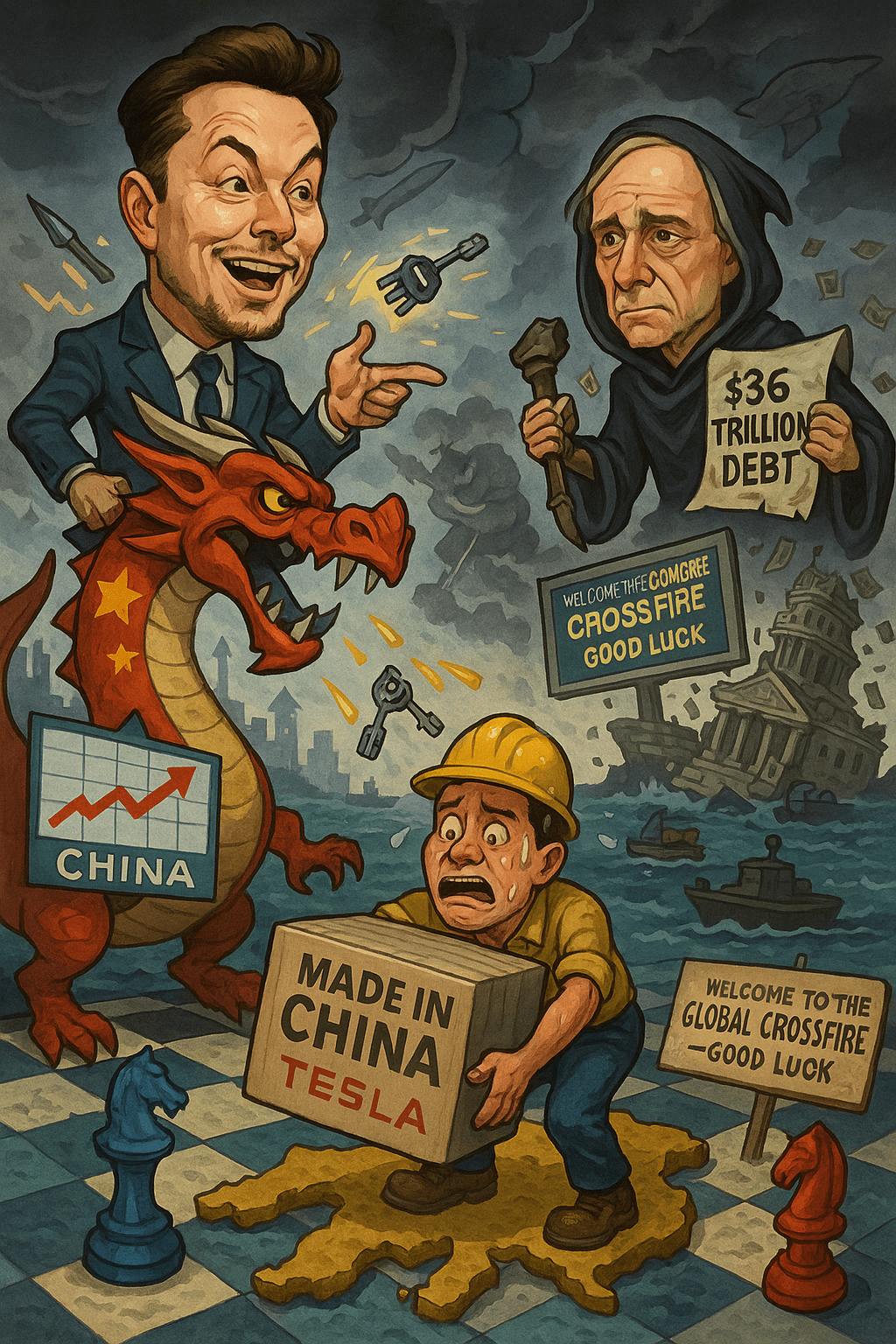
Elon Musk and Ray Dalio duel over America’s future—but for Filipino workers, the stakes are survival in a world tilting toward chaos.
By Louis ‘Barok’ C Biraogo — May 4, 2025
IN THE shadow of Manila’s sprawling port, a dockworker named Juan unloads a container of Chinese-made electric cars, each gleaming with the promise of a new era. The ships arrive faster now, laden with goods from Guangdong’s factories, where Tesla’s ambitions thrive. To Elon Musk, this is proof that China has already eclipsed America as the world’s consumer king, buying more cars than the U.S. and Europe combined. But Ray Dalio, the billionaire sage of markets, sees a darker tide: a U.S. spiraling toward decline, its debt-soaked economy teetering like Rome before the fall. For Juan, caught between these dueling visions, the question isn’t who’s right—it’s whether the Philippines can navigate the economic storm without becoming collateral damage.
The Data Wars: Musk’s Metrics vs. Dalio’s Doom
The numbers tell a story, but not the same one. Musk’s claim is rooted in hard data: in 2025, China’s auto market is projected to hit 32.9 million vehicles, dwarfing the U.S.’s 15.5 million and Europe’s 13.2 million combined. In luxury goods, China’s $113 billion market outpaces America’s $101 billion. Electronics? China’s dominance as a producer—$214 billion in consumer electronics last year—suggests it likely leads consumption, though precise figures are murky. Musk’s point is clear: China’s middle class, 400 million strong, is the new engine of global demand.
Yet Dalio’s warning isn’t about car sales—it’s about systems. The U.S. national debt, now over $36 trillion, grows faster than its economy. Its trade deficit, nearly $1 trillion in 2022, reflects a nation living beyond its means, propped up by foreign lenders like China, which holds $870 billion in U.S. Treasuries but is quietly diversifying away. Dalio sees a historical echo: empires like Britain’s crumbled when debt and hubris outran reality. The dollar’s status as the world’s reserve currency, he warns, isn’t eternal—especially as trust erodes amid political gridlock and tariff wars.
Musk’s focus feels like a sleight of hand, spotlighting consumption while dodging Dalio’s systemic concerns. China’s consumer boom doesn’t erase its own challenges: a property crisis, youth unemployment at 15%, and a debt-to-GDP ratio nearing 300%. Meanwhile, the U.S. retains strengths—its tech giants, military might, and dollar dominance—that Dalio’s gloom might underplay. The truth? Both men are right, but neither is complete. China’s rise is real, but so is America’s fragility—and the global economy is a house of cards, trembling under the weight of both.
A Filipino Factory Worker’s Precarious Future
For the Philippines, this isn’t an academic debate—it’s a matter of survival. Juan’s livelihood depends on trade flows now caught in the U.S.-China crossfire. The Philippines exports $11 billion in electronics to China annually, but its trade deficit with Beijing—$4 billion last year—signals dependency. Chinese investment, like the $24 billion pledged through the Belt and Road Initiative, has built roads and ports but also debt traps; the Philippines owes China $1.9 billion, with repayment pressures looming. Meanwhile, U.S. military aid—$500 million in 2024—bolsters security against South China Sea tensions but ties Manila to Washington’s geopolitical chessboard.
The risks are stark. If Dalio’s feared U.S. decline materializes, a devalued dollar could spike inflation in the Philippines, where 60% of imports are dollar-denominated. If Musk’s China-centric world prevails, Filipino workers face a flood of cheap Chinese goods, threatening local industries like garment manufacturing, which employs 1.2 million. Geopolitically, the Philippines is a frontline state: China’s aggression in the West Philippine Sea—where it claims 90% of disputed waters—clashes with U.S.-backed patrols, leaving Manila to balance neutrality against survival.
Yet there’s opportunity. The Philippines’ young workforce—median age 25—could attract U.S. firms diversifying supply chains away from China. Semiconductor exports, already $49 billion in 2024, could grow if Manila invests in skills and infrastructure. But the window is narrow, and missteps could trap the nation in a cycle of debt and instability.
Probing the Frame: Billionaires, Biases, and Blind Spots
Musk and Dalio aren’t just debating—they’re selling narratives. Musk’s optimism about China’s consumption aligns with Tesla’s bottom line; its Shanghai Gigafactory produces half its global output. His focus on manufacturing sidesteps Dalio’s warnings about debt and currency risks, a convenient distraction for a CEO betting on Beijing’s markets. Dalio, meanwhile, has his own lens: his hedge fund thrives on predicting systemic shifts, and his doomsday rhetoric echoes his book’s thesis on empire cycles. Both men, American billionaires, frame the world through U.S.-China binaries, sidelining Global South voices—like Filipino economists warning of BRI debt or IMF alerts about trade fragmentation.
The media amplifies this clash, casting Musk as the brash innovator and Dalio as the grim prophet. Headlines like “Musk Fires Back” prioritize drama over nuance, obscuring the multipolar reality where India, with 7% GDP growth, and the EU, with $18 trillion in output, also shape the future. The risk? A distorted debate that leaves nations like the Philippines scrambling to interpret signals through a Western fog.
Lessons from History’s Graveyard of Empires
History offers a warning: when superpowers falter, smaller nations pay the price. The Spanish Empire’s collapse left the Philippines vulnerable to American colonization; Britain’s decline after World War II sparked economic turmoil in its former colonies. Today, as the U.S. and China jostle, the Philippines risks becoming a pawn in their rivalry—squeezed by Chinese loans, U.S. military demands, and a global economy fraying under tariffs and mistrust.
Policymakers must act. The Philippines should diversify trade, boosting ties with ASEAN and India to reduce reliance on China. Investing in education—only 30% of high schoolers meet STEM benchmarks—can position the country for high-tech industries. Debt transparency, like public audits of BRI projects, can curb China’s leverage. And diplomatically, Manila must walk a tightrope, strengthening U.S. alliances while avoiding provocation in the South China Sea.
For the U.S., the lesson is urgency: tame deficits, rebuild trust in institutions, and invest in alliances like the Philippines to counter China’s influence. For China, it’s restraint—overreach could alienate partners like Manila, fueling resistance.
History seldom forgives empires that mistake hubris for permanence—or nations that bet their futures on the promises of distant titans. For Juan, unloading cars under Manila’s unrelenting sun, the stakes are simpler: a job tomorrow, a meal tonight. As Musk and Dalio spar, it’s his world—and millions like it—that hangs in the balance. The Philippines can’t afford to be a bystander. Nor can we.
Key references:
- Auto Sales Data:
- China: 32.9 million vehicles in 2025, per Trading Economics.
- U.S.: 15.5 million vehicles, per Trading Economics.
- Europe: 13.2 million vehicles, per Best-Selling-Cars.com.
- Luxury Goods:
- China: $113.33 billion market, per Consultancy.asia.
- U.S.: $101 billion market, per Statista.
- Electronics:
- China’s $214 billion consumer electronics market, per Grand View Research.
- U.S. Debt and Trade:
- China’s Economic Challenges:
- Debt-to-GDP ratio and unemployment, per IMF World Economic Outlook.
- Philippine Trade and Debt:
- $11 billion electronics exports to China, $4 billion trade deficit, and $1.9 billion BRI debt, per Philippine government trade data and World Bank.
- $24 billion BRI pledge, per Council on Foreign Relations.
- U.S. Military Aid:
- $500 million in 2024, per U.S. Department of Defense.
- Global Economic Context:
- IMF 2025 growth forecast, per IMF World Economic Outlook.
- India’s 7% GDP growth and EU’s $18 trillion output, per World Bank.

- ₱8B BBM Pork: CCTV for Every Captain’s Kumpare?
- ₱75 Million Heist: Cops Gone Full Bandit

- ₱6.7-Trillion Temptation: The Great Pork Zombie Revival and the “Collegial” Vote-Buying Circus

- ₱1.9 Billion for 382 Units and a Rooftop Pool: Poverty Solved, Next Problem Please

- ₱1.35 Trillion for Education: Bigger Budget, Same Old Thieves’ Banquet
- ₱1 Billion Congressional Seat? Sorry, Sold Out Na Raw — Si Bello Raw Ang Hindi Bumili

- “We Will Take Care of It”: Bersamin’s P52-Billion Love Letter to Corruption

- “Skewed Narrative”? More Like Skewered Taxpayers!

- “Scared to Sign Vouchers” Is Now Official GDP Policy – Welcome to the Philippines’ Permanent Paralysis Economy
- “Robbed by Restitution?” Curlee Discaya’s Tears Over Returning What He Never Earned
- “No Pressure” Luistro? The House Pork Bazaar Exposed
- “My Brother the President Is a Junkie”: A Marcos Family Reunion Special




 KWEBA ni BAROK
Leave a comment