By Louis ‘Barok‘ C. Biraogo — May 4, 2025
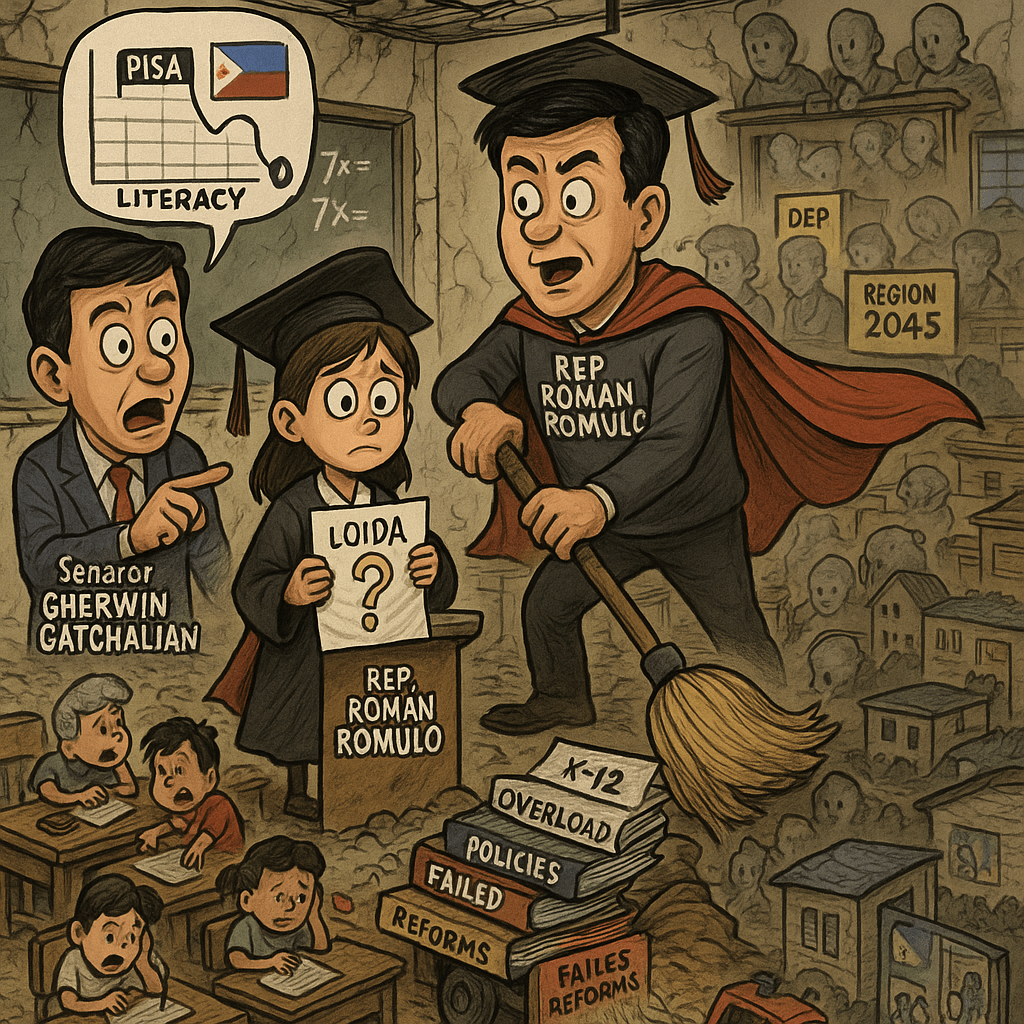
WHAT does it mean to graduate from high school but not understand what you read? Ask Loida, a 15-year-old from Pangasinan, who stood frozen before Senator Sherwin Gatchalian, unable to read a basic story. “Nakita ko ’yan with my own eyes,” he said, shaken by what he witnessed. Loida is just one face of a national crisis—18 million Filipino graduates who are functionally illiterate, according to the 2024 Functional Literacy, Education, and Mass Media Survey (FLEMMS) Manila Bulletin, May 1, 2025. Once an education leader in Southeast Asia, the Philippines is now confronting a heartbreaking truth: our schools are producing diplomas, not literacy.
Compare this to regional peers: Vietnam boasts a 98% functional literacy rate, Thailand 93%, while the Philippines languishes at 76% under FLEMMS’ updated 2024 definition, which demands comprehension and real-world application beyond rote skills. This gap is not mere statistics—it’s a death knell for economic competitiveness and social mobility. As EDCOM 2’s Karol Yee warns, with the demographic window closing by 2045, “fixing the foundations of education is an economic imperative” EDCOM 2 Year Two Report. Yet, the Philippine education system remains a house built on sand, crumbling under the weight of systemic failures.
A System in Shambles: Drowning in Subjects, Starved of Learning
The K-12 curriculum, meant to modernize education, has become a “kitchen sink” monstrosity, overloaded with subjects that suffocate students and teachers alike. As Rep. Roman Romulo, EDCOM 2 Co-Chair, passionately argues, “We have made school so difficult for students… We must reduce the number of subjects to make students love learning again” Senate Press Release, April 30, 2025. His call for “balik sa basics” cuts through the jargon, exposing a truth: the curriculum’s congestion—70% of which the MATATAG framework aims to trim—has prioritized breadth over depth, leaving foundational skills like reading and numeracy in the dust.
Worse, mass promotion policies have turned graduation into a hollow ritual. Students advance without mastering basics, a practice DepEd only recently began addressing through grading reforms in 2024 Manila Bulletin, May 1, 2025. Gatchalian’s question at the April 30 Senate hearing—“Paano sila nag-graduate ng hindi sila functionally literate?”—echoes the frustration of a nation. The answer lies in a system that values completion rates over competence, producing diplomas that mask illiteracy. The 2022 PISA results, ranking the Philippines 77th out of 81 countries in reading, math, and science, confirm this failure OECD PISA 2022 Results.
Teacher shortages and resource gaps compound the crisis. With 86,000 unfilled teaching positions and a 1:40 student-teacher ratio—far from the ideal 1:30—rural and marginalized areas like the Bangsamoro Autonomous Region suffer most EDCOM 2 Year Two Report. The ARAL Program, signed into law in October 2024, deploys volunteer tutors and para-teachers to address learning gaps, but its reach remains unclear for remote regions DepEd ARAL Program Guidelines. Textbooks, too, are a scandal: only 35 of 90 titles for the MATATAG curriculum’s first phase were delivered by January 2025, a logistical failure EDCOM 2 calls indicative of “deeper administrative issues” Malaya, January 29, 2024.
Reforms on Trial: Bold Vision or Bureaucratic Band-Aids?
The MATATAG Curriculum, launched in 2023, promises to decongest K-12 by 70%, focusing on literacy, numeracy, and core subjects for kindergarten, Grades 1, 4, and 7 in 2024-2025, with full rollout by 2026-2027 DepEd MATATAG Guidelines. Romulo’s insistence to “go beyond pilot studies” reflects skepticism about its pace Senate Press Release, April 30, 2025. While pilot programs in 35 schools across regions like Caraga and the Cordillera show promise, the phased approach feels like incrementalism in a crisis demanding urgency. DepEd’s teacher training for MATATAG, outlined in a January 2024 plan, is commendable but risks being outpaced by the scale of need Malaya, January 29, 2024.
Remediation programs like Bawat Bata Makababasa and the Literacy Remediation Program target struggling learners, but their execution raises questions. The Literacy Remediation Program, per DepEd Memorandum 034 (April 2025), excludes Region 9 and select divisions in Regions 6 and 7, citing unspecified “contextual challenges” DepEd DM 034, April 12, 2025. Is this equity or bureaucratic triage? Angara’s vow—“Hindi namin hahayaang may batang nahuhuli sa pagbasa”—rings hollow when entire regions are sidelined Manila Bulletin, May 1, 2025. The ARAL Program, with its focus on personalized tutoring, is a step forward, but its December 2024 implementing rules offer no clear metrics for scalability or impact in marginalized areas DepEd Summer Programs, April 10, 2025.
DepEd’s stakeholder engagement, particularly for the Senior High School curriculum revision (reducing core subjects from 15 to 5), is a bright spot. Public consultations in April 2025 show responsiveness, but the timeline—finalization by late 2025—lags behind the crisis’s urgency DepEd SHS Consultation, April 9, 2025. As EDCOM 2’s Year Two Report notes, “Fixing the foundations” requires not just plans but relentless execution EDCOM 2 Year Two Report.
Romulo’s Crusade: A Voice of Clarity in a Sea of Chaos
Amid DepEd’s flurry of programs, Roman Romulo stands out for his unapologetic clarity. His mantra—“balik sa basics”—is a rallying cry, slicing through the bureaucratic haze Senate Press Release, April 30, 2025. Unlike DepEd’s tendency to announce initiatives without transparent outcomes, Romulo grounds his advocacy in data and lived experience, from fieldwork revealing 15-year-olds unable to read to his push for a national education plan by year’s end. His call to cap subjects until literacy improves is both pragmatic and radical, a rare blend in Philippine policymaking. As he told Congress, “Any working education system requires robust pathways… We need to make sure we are not leaving any learner behind.”
From Collapse to Comeback: A Blueprint for Salvation
To break this cycle of failure, the Philippines must act with moral and practical urgency:
- Immediate Rescue: Fund community-based tutoring programs modeled on Brazil’s Alfabetização Solidária, which mobilized volunteers to teach literacy in underserved areas, achieving a 20% literacy boost in two years. Philippines’ local government units, as PBEd suggests, can lead this charge, supplementing ARAL’s reach.
- Structural Overhaul: Legislate Romulo’s proposal to cap K-12 subjects at five until 90% of students meet functional literacy benchmarks. This forces focus on reading, writing, and numeracy, aligning with Vietnam’s streamlined curriculum success.
- Relentless Accountability: Mandate quarterly public reports on remediation progress, audited by EDCOM 2, with metrics on student literacy gains, tutor deployment, and textbook delivery. Transparency, as PIDS notes, is “a cornerstone of effective reform” PIDS Education Policy Brief.
Loida should have left that classroom with confidence in her voice, not shame in her silence. Instead, she became one of 18 million who passed through school without being truly taught. If we do nothing, 25 million more will follow. The numbers are staggering—but the failure is human. And unless we rebuild this system with integrity and urgency, we will be remembered not for our good intentions, but for our unforgivable neglect.

- ₱75 Million Heist: Cops Gone Full Bandit

- ₱6.7-Trillion Temptation: The Great Pork Zombie Revival and the “Collegial” Vote-Buying Circus

- ₱1.9 Billion for 382 Units and a Rooftop Pool: Poverty Solved, Next Problem Please

- ₱1.35 Trillion for Education: Bigger Budget, Same Old Thieves’ Banquet

- ₱1 Billion Congressional Seat? Sorry, Sold Out Na Raw — Si Bello Raw Ang Hindi Bumili

- “We Will Take Care of It”: Bersamin’s P52-Billion Love Letter to Corruption

- “Skewed Narrative”? More Like Skewered Taxpayers!

- “Scared to Sign Vouchers” Is Now Official GDP Policy – Welcome to the Philippines’ Permanent Paralysis Economy
- “Robbed by Restitution?” Curlee Discaya’s Tears Over Returning What He Never Earned

- “My Brother the President Is a Junkie”: A Marcos Family Reunion Special

- “Mapipilitan Akong Gawing Zero”: The Day Senator Rodante Marcoleta Confessed to Perjury on National Television and Thought We’d Clap for the Creativity

- “Just Following Orders” Is Dead: How the Hague Just Turned Tokhang’s Finest Into International Fugitives





 KWEBA ni BAROK
Leave a comment