By Louis ‘Barok‘ C. Biraogo — May 8, 2025
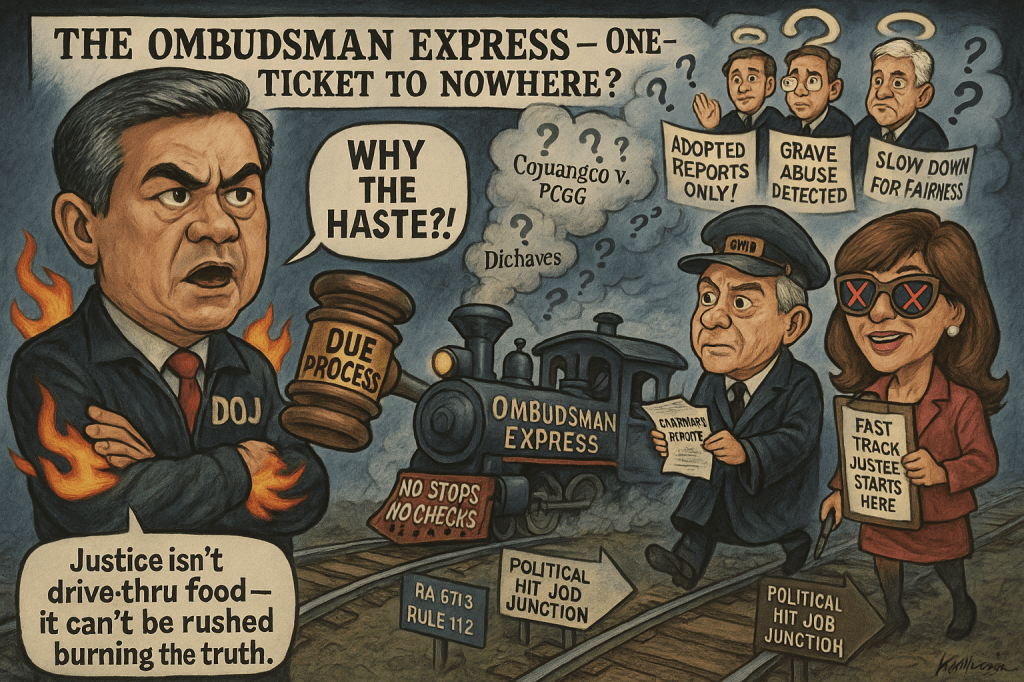
WHEN does the Ombudsman’s quest for accountability morph into a procedural ambush? In Cojuangco v. PCGG (G.R. Nos. 92319-20, October 2, 1990), the Supreme Court laid down a critical marker: investigations, even by powerful bodies like the Ombudsman, must uphold due process and impartiality to avoid bias or haste. Justice Secretary Jesus Crispin Remulla’s fiery challenge to the Ombudsman’s lightning-fast order to probe him and four others over former President Rodrigo Duterte’s arrest channels this principle. With the Ombudsman acting on Senator Imee Marcos’ chairman’s report in a mere six days, Remulla’s blunt question—“Why the haste?”—is no mere jab; it’s a legally loaded demand for fairness in a process teetering on the edge of political weaponization.
Razor-Sharp Legal Takedown: Remulla’s Case Against the Ombudsman’s Overreach
Procedural Blunders: A Shaky Foundation Built on a Chairman’s Whim
Chairman’s Report vs. Committee Report: A Tale of Legitimacy
Remulla’s core grievance—that the Ombudsman hinged its order on a chairman’s report rather than a formal committee report—cuts to the heart of procedural integrity. The Rules of the Senate (Rule X, Sec. 13) (Senate Rules) are clear: a committee report is a formal, collectively vetted document, endorsed by the committee to reflect its official stance. In Balag v. Senate (G.R. No. 234608, 2018), the Supreme Court emphasized that only adopted committee reports, like Nos. 232 and 233, carry the Senate’s official weight. By contrast, a chairman’s report—here, Senator Marcos’ May 2, 2025, submission (Ombudsman Pressed to Charge Execs)—is a preliminary, often unilateral take, not the committee’s gospel. Remulla’s argument that the Ombudsman’s May 6 order (Ombudsman Orders Remulla Brothers), based on this unadopted report, lacks procedural heft is spot-on. It’s like sentencing someone based on a lawyer’s unfiled memo.
Due Process Under Fire: Haste Tramples Fairness
Republic Act No. 6770 (The Ombudsman Act), Sec. 13(1), allows the Ombudsman to act on complaints “in any form,” but this flexibility isn’t a blank check. In Cojuangco v. PCGG (G.R. Nos. 92319-20, 1990), the Supreme Court ruled that investigations must be conducted by an impartial body to uphold due process, transferring a graft probe from the biased PCGG to the Ombudsman for fairness. A chairman’s report, unratified by the committee, likely falls short of the “substantial evidence” standard required for probable cause, as outlined in Rule 112, Sec. 3 of the Rules of Court, which applies suppletorily to Ombudsman proceedings. The Ombudsman’s six-day sprint from Marcos’ report to the order suggests a rushed job, threatening Remulla’s right to a fair preliminary investigation.
Substantive Knockout: Remulla’s Charge of Ombudsman Overreach
Grave Abuse of Discretion: A Judicial Smackdown Waiting to Happen
Remulla’s challenge gains firepower under Dichaves v. Ombudsman (G.R. No. 194897, 2015), where the Supreme Court warned that the Ombudsman’s actions face judicial review for grave abuse of discretion—acting in a “capricious or whimsical” manner. By banking on an unadopted chairman’s report and issuing an order in under a week, the Ombudsman arguably skipped the due diligence needed for probable cause. Dichaves overturned an Ombudsman finding for similar haste, signaling that Remulla’s case could invite a judicial rebuke. The Ombudsman’s speed here isn’t “swift justice”—it’s a reckless sprint that courts may not tolerate.
Ethical Faceplant: Fairness Gets Trampled
Under RA 6713 (Code of Conduct and Ethical Standards), Sec. 5, public officials must act with “justness and sincerity,” ensuring fair processes. The Ombudsman’s Rules of Procedure (Sec. 20) allow it to seek clarification or extra evidence before acting. Yet, its six-day race to issue an order—without confirming the report’s formal status—flouts this duty. Remulla’s public call-out, branding the process “weird,” aligns with RA 6713’s push for transparency, exposing an ethical misstep that could shake public trust. As he quipped, the Ombudsman’s haste “would impress a fast-food drive-thru,” but justice isn’t a Happy Meal.
Shredding the Opposition: Marcos and Martires’ Defenses Collapse
Marcos’ Flimsy Shield: Broad Powers Don’t Excuse Sloppiness
Senator Marcos, backed by Ombudsman Samuel Martires, might lean on RA 6770, Sec. 15(1), which grants the Ombudsman wide-ranging investigative powers over any complaint. Marcos could argue her chairman’s report, tied to the Senate’s probe into Duterte’s arrest, is enough to spark an investigation, given charges like graft and arbitrary detention. But Ombudsman v. Madera (G.R. No. 193336, 2018) pulls the rug out, clarifying that discretion isn’t a license for arbitrariness. Investigations need a reasonable basis for probable cause, and a chairman’s report, unvetted by the committee, doesn’t cut it. Balag v. Senate further undermines Marcos, prioritizing formally adopted reports. Remulla’s critique exposes a procedural dodge that Marcos can’t whitewash.
Martires’ Weak Counter: Sufficiency or Just a Shortcut?
If Martires defends the order by claiming Marcos’ report is enough, Remulla can hit back with Rule 112, Sec. 3, requiring “sufficient grounds” for a preliminary investigation. A chairman’s report, as Remulla called out for being “weird,” lacks the collective scrutiny of a committee report. The Ombudsman’s failure to seek clarification, as allowed under Sec. 20 of its Rules, torpedoes Martires’ position. Cojuangco v. PCGG supports this by emphasizing that investigations must be fair and impartial, a standard the Ombudsman’s hasty order arguably fails to meet. Martires’ broad powers don’t shield him from due process obligations.
Crystal-Clear Breakdown: The Case in Tables
| Flashpoint | Remulla’s Battle Cry | Legal Backbone | Court Precedent |
|---|---|---|---|
| Chairman’s Report Legitimacy | Unadopted, lacks teeth | Senate Rule X, Sec. 13 | Balag v. Senate (2018) |
| Due Process Assault | Hasty order guts evidence vetting | RA 6770, Sec. 13; Rule 112, Sec. 3 | Cojuangco v. PCGG (1990) |
| Grave Abuse of Discretion | Unverified report is reckless | RA 6770, Sec. 15 | Dichaves v. Ombudsman (2015) |
| Ethical Meltdown | Haste betrays fairness | RA 6713, Sec. 5; Ombudsman Rules, Sec. 20 | Ombudsman v. Madera (2018) |
Game-Changing Reforms: Fixing a Broken System
- Ombudsman Reset: Slow Down to Get It Right
Mandate a 15-day cooling-off period for complaints based on preliminary reports, giving the Ombudsman time to verify their formal status. This taps into Sec. 20’s clarification powers and shores up public trust in a process looking shaky. - Congress Steps Up: Tighten the Rules
Amend RA 6770 to define “sufficient evidence,” limiting investigations to formally adopted documents like committee reports. This keeps the Ombudsman’s flexibility intact while slamming the door on procedural overreach. - Supreme Court Power Move: Set the Record Straight
Issue a jurisprudential note declaring that unadopted chairman’s reports can’t single-handedly establish probable cause. This would cement Balag and Cojuangco v. PCGG as guiding stars for agencies and courts, preventing future misfires.
Final Verdict: Remulla’s Fight Is Everyone’s Fight
Remulla’s rebellion against the Ombudsman’s warp-speed order isn’t just a bureaucratic skirmish—it’s a full-throated defense of procedural justice. Backed by RA 6770, RA 6713, and Supreme Court heavyweights like Cojuangco v. PCGG, Dichaves, and Madera, his critique rips the mask off a process that sacrifices substance for speed. Marcos and Martires may cling to the Ombudsman’s broad powers, but their defense implodes under the weight of due process demands. If this order goes unchallenged, it could greenlight a wave of politically charged probes—a nightmare the law was designed to prevent. Remulla’s stand isn’t just his own; it’s a rallying cry for a system that values fairness over flash.
Key Citations:
- G.R. Nos. 92319-20 – Cojuangco v. PCGG
- G.R. No. 234608 – Balag v. Senate
- G.R. No. 194897 – Dichaves v. Ombudsman
- G.R. No. 193336 – Ombudsman v. Madera
- RA 6770
- RA 6713
- Rules of Court, Rule 112
- Senate Rules
- Ombudsman Pressed to Charge Execs
- Ombudsman Orders Remulla Brothers
Disclaimer: This is legal jazz, not gospel. It’s all about interpretation, not absolutes. So, listen closely, but don’t take it as the final word.

- ₱75 Million Heist: Cops Gone Full Bandit

- ₱6.7-Trillion Temptation: The Great Pork Zombie Revival and the “Collegial” Vote-Buying Circus

- ₱1.9 Billion for 382 Units and a Rooftop Pool: Poverty Solved, Next Problem Please

- ₱1.35 Trillion for Education: Bigger Budget, Same Old Thieves’ Banquet

- ₱1 Billion Congressional Seat? Sorry, Sold Out Na Raw — Si Bello Raw Ang Hindi Bumili

- “We Will Take Care of It”: Bersamin’s P52-Billion Love Letter to Corruption

- “Skewed Narrative”? More Like Skewered Taxpayers!

- “Scared to Sign Vouchers” Is Now Official GDP Policy – Welcome to the Philippines’ Permanent Paralysis Economy

- “Robbed by Restitution?” Curlee Discaya’s Tears Over Returning What He Never Earned

- “My Brother the President Is a Junkie”: A Marcos Family Reunion Special

- “Mapipilitan Akong Gawing Zero”: The Day Senator Rodante Marcoleta Confessed to Perjury on National Television and Thought We’d Clap for the Creativity

- “Just Following Orders” Is Dead: How the Hague Just Turned Tokhang’s Finest Into International Fugitives





 KWEBA ni BAROK
Leave a comment