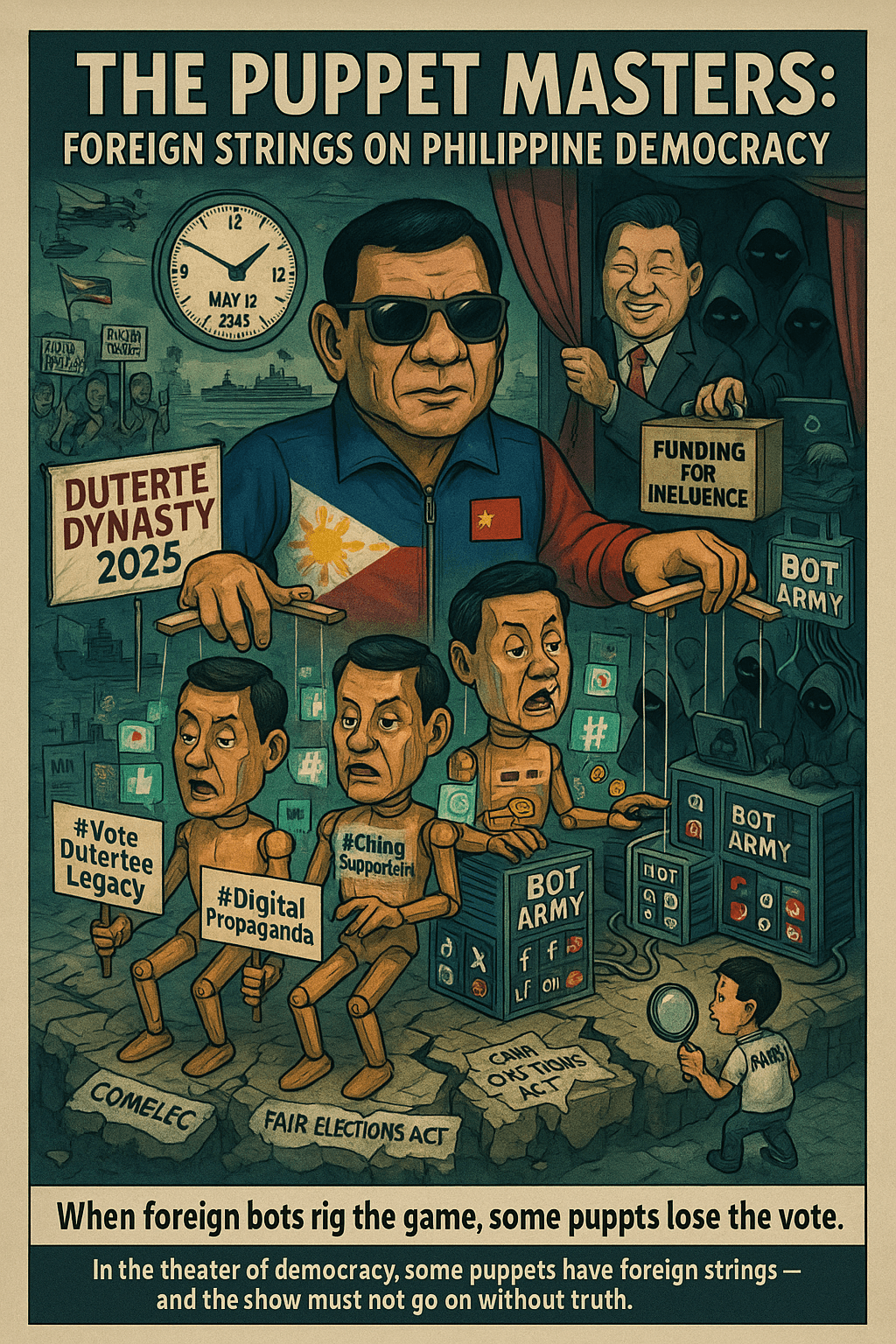
By Louis ‘Barok‘ C. Biraogo — May 12, 2025
Introduction: A Shadow Over Democracy
On May 10, 2025, a bombshell complaint hit the Commission on Elections (Comelec), accusing 15 candidates backed by former President Rodrigo Duterte of reaping the benefits of “China-funded” digital disinformation campaigns in the 2025 Philippine midterm elections. Filed by Dillan Mangilit, a vigilant Filipino voter, the complaint alleges a sophisticated operation involving automated social media accounts, purportedly bankrolled by foreign actors, to amplify Duterte-aligned candidates like Rodrigo Duterte, Paolo “Pulong” Duterte, and Apollo Quiboloy. Armed with forensics logs and a damning Cyabra report exposing bot-driven propaganda, the complaint claims violations of election laws, cybercrime statutes, and the very sovereignty of the Philippines. This analysis rips apart the legal quagmire, skewers potential defenses, probes the political fallout, and demands bold action to safeguard democracy.
Legal Analysis: A Web of Violations
The complaint unveils a tangle of legal breaches, each striking at the heart of Philippine electoral integrity. Below, we dissect the allegations, anticipate defenses, and deliver airtight rebuttals, all anchored in law and precedent.
1. Caught in the Act: Statutory Breaches
- Omnibus Election Code (Batas Pambansa Blg. 881): Foreign Meddling Exposed
- Section 96: The Foreign Cash Ban
This statute slams the door on “any aid or contribution of whatever form or nature” from foreign entities to sway elections Omnibus Election Code. The complaint alleges China-funded digital ops, evidenced by coordinated bot activity, funneled illicit support to Duterte’s candidates. If proven, this triggers Section 96, with penalties of 1–6 years imprisonment, disqualification, and loss of voting rights under Section 264. - Section 261(z)(8): Election Crimes Unmasked
The complaint’s forensics logs and Cyabra’s report… suggest a coordinated effort to manipulate voter perception, potentially meeting the ‘substantial evidence’ threshold required in election cases, as affirmed in Santos v. Comelec (G.R. No. 235058, September 10, 2022), where Comelec’s findings of nuisance candidacy were upheld based on relevant evidence a reasonable mind might accept.
- Section 96: The Foreign Cash Ban
- Comelec Resolution No. 11064: Bots in the Crosshairs
Rolled out on September 26, 2024, this resolution polices digital campaigns, demanding AI transparency and banning “false amplifiers” like bots Comelec Resolution No. 11064. The complaint’s evidence of automated accounts flouting these rules could lead to fines, content takedowns, or criminal charges, cementing Comelec’s iron grip under Article IX-C, Section 2(7) of the 1987 Constitution. - Cybercrime Prevention Act (RA 10175): Digital Felonies
This law cracks down on computer-related fraud, data interference, and illegal access Cybercrime Prevention Act. If the alleged ops involved hacking or platform manipulation, they’d fall under Sections 4(c) or 4(h), facing jail time or hefty fines. The complaint’s push for DOJ, PNP cybercrime division, and DICT probes aligns with this, though nailing cybercrimes demands rigorous digital sleuthing. - Fair Election Act (RA 9006): Leveling the Playing Field
Designed to ensure equitable media access, this Act frowns on unfair campaign tactics Fair Election Act. While rooted in traditional media, its spirit applies to digital platforms via Comelec rules. Bot-driven amplification skews public discourse, violating the Act’s core principles. - 1987 Constitution: Defending the Nation’s Soul
- Article II, Section 7: Sovereignty Under Siege
Foreign election meddling spits in the face of national sovereignty, a bedrock state policy 1987 Constitution. The complaint casts China’s alleged role as a direct attack on democratic legitimacy. - Article III, Section 4: Free Speech on Trial
Candidates might cry free speech, but Gonzales v. Comelec (G.R. No. L-27833) greenlights speech curbs to protect fair elections, a precedent that blesses digital campaign regulations.
- Article II, Section 7: Sovereignty Under Siege
2. Dodging the Bullet: Defenses and Their Demise
The accused will likely scramble for cover with these defenses. We expose their weaknesses and shut them down.
- Defense 1: “Where’s the Proof?”
- Claim: The accused may argue that forensics logs and Cyabra’s report lack direct proof… but Santos v. Comelec (G.R. No. 235058, September 10, 2022) clarifies that Comelec can act on substantial evidence, defined as relevant evidence supporting a reasonable conclusion, as seen in the nuisance candidacy ruling.
- Rebuttal: Comelec’s Article IX-C mandate allows probes based on substantial, not conclusive, evidence. The bots’ 11.8 million views suggest a coordinated effort that, if verified, clears the evidentiary bar. The complaint’s push for DOJ and PNP investigations bolsters this path.
- Defense 2: “Bots Aren’t Contributions!”
- Claim: Candidates might insist that digital amplification isn’t a “contribution” under Section 96, as it’s not cash or directly solicited.
- Rebuttal: The Omnibus Election Code’s broad definition of contributions includes in-kind aid like digital propaganda Prohibited Contributions. Santos v. Comelec (G.R. No. 235058, September 10, 2022) reinforces Comelec’s broad authority under Article IX-C to regulate campaign activities, supporting an expansive interpretation of contributions to include in-kind digital propaganda.
- Defense 3: “You’re Stifling Our Free Speech!”
- Claim: The accused could argue that Resolution No. 11064’s bot ban violates free speech under Article III, Section 4.
- Rebuttal: Gonzales v. Comelec permits speech limits to safeguard elections. Resolution No. 11064 targets manipulative tactics, not content, aligning with global anti-disinformation norms Philippines AI and Social Media Guidelines.
- Defense 4: “Comelec’s Out of Its Lane!”
- Claim: Candidates may challenge Comelec’s jurisdiction, arguing cybercrimes or foreign actors fall under DOJ or international law.
- Rebuttal: Article IX-C, Section 2(3) gives Comelec sole authority over election offenses, including Section 96 breaches. Cybercrime probes can complement, not override, this, as affirmed by Smartmatic v. Comelec (G.R. No. 205357).
Political Fallout: A Nation at the Crossroads
This scandal isn’t just a legal brawl—it’s a geopolitical and domestic powder keg.
1. Tensions with China: A Diplomatic Tightrope
With West Philippine Sea disputes already fraying ties, allegations of China’s electoral meddling pour fuel on the fire. Duterte’s pro-China leanings clash with Marcos Jr.’s Western tilt, and Senator Tolentino’s claims of China-linked troll farms crank up the heat. Marcos’s probe into foreign interference signals a hard line, risking diplomatic blowback Foreign Investment Act.
2. Domestic Drama: Duterte vs. Marcos
The Duterte clan’s Mindanao stronghold makes this a political landmine. Probes could alienate their loyalists, but letting allegations slide undermines Marcos Jr.’s push for electoral credibility. The Cyabra report’s revelation of 7,000 bot-driven engagements highlights the disinformation threat, shaking voter trust Digital Campaigning in 2025.
3. Democracy’s Fragile Trust
Disinformation is a global plague, and the Philippines is bleeding from it. The complaint’s cry of a “threat to democracy” isn’t hyperbole—unpunished foreign meddling could torch the 2025 elections’ legitimacy, eroding public faith in the system.
Battle Plan: Saving the Vote
To crush this digital conspiracy, Comelec and lawmakers must wield precision and resolve.
1. Comelec’s Counterstrike
- Verify the Evidence: Deploy forensic experts to authenticate the complaint’s logs and Cyabra’s data, meeting Mangubat’s standards.
- Launch Probes: Investigate candidates’ campaign finances and digital trails for foreign ties.
- Team Up: Sync with DOJ, PNP’s cybercrime unit, and DICT to trace funding and cybercrimes, leveraging RA 10175 Office of Cybercrime.
- Crack Down: Issue takedowns for rogue accounts and slap violators with sanctions under Resolution No. 11064 and the Omnibus Election Code.
2. Legislative Overhaul
- Anti-Interference Law: Pass a clear statute criminalizing foreign election meddling, plugging gaps in existing laws.
- Digital Campaign Rules: Update RA 9006 to explicitly govern online platforms, codifying Resolution No. 11064.
- Cybercrime Boost: Toughen RA 10175 to target disinformation, with stiffer penalties for foreign-backed ops.
- Transparency Push: Mandate full disclosure of digital campaign activities in candidates’ SOCE Statement of Contributions and Expenses.
3. Beyond the Ballot
- Educate Voters: Roll out campaigns exposing disinformation tactics like bots.
- Global Alliance: Partner with UN or ASEAN to set anti-interference norms, honoring constitutional sovereignty.
Conclusion: Democracy’s Last Stand
The “China-funded” digital ops scandal is a gut punch to Philippine democracy, blending brazen legal violations with geopolitical chess. The Omnibus Election Code, Comelec Resolution No. 11064, and RA 10175 are under assault, but the complaint’s evidence—bot logs and Cyabra’s exposé—holds water if validated. Defenses like “no proof” or “free speech” crumble under the weight of broad election laws and precedents like Gonzales and Mangubat. Politically, this frays Philippines-China ties and pits Duterte’s dynasty against Marcos Jr.’s reform agenda, with voter trust on life support. Comelec must verify evidence, probe hard, and coordinate with agencies, while lawmakers close statutory loopholes. If this digital invasion goes unchecked, the 2025 elections—and Philippine democracy itself—could bleed out.
“When foreign bots rig the game, the people lose the vote.”
Key Citations:
- Omnibus Election Code of the Philippines
- Comelec Resolution No. 11064
- Cybercrime Prevention Act (RA 10175)
- Fair Election Act (RA 9006)
- 1987 Philippine Constitution
- Santos v. Comelec (G.R. No. 235058, September 10, 2022)
- Gonzales v. Comelec, G.R. No. L-27833, April 18, 1969)
- Smartmatic v. Comelec, G.R. No. 205357
- Prohibited Contributions
- Statement of Contributions and Expenses
- Philippines AI and Social Media Guidelines
- Foreign Investment Act
- Digital Campaigning in Eleksyon 2025
- Office of Cybercrime
Disclaimer: This is legal jazz, not gospel. It’s all about interpretation, not absolutes. So, listen closely, but don’t take it as the final word.

- ₱75 Million Heist: Cops Gone Full Bandit

- ₱6.7-Trillion Temptation: The Great Pork Zombie Revival and the “Collegial” Vote-Buying Circus

- ₱1.9 Billion for 382 Units and a Rooftop Pool: Poverty Solved, Next Problem Please

- ₱1.35 Trillion for Education: Bigger Budget, Same Old Thieves’ Banquet

- ₱1 Billion Congressional Seat? Sorry, Sold Out Na Raw — Si Bello Raw Ang Hindi Bumili

- “We Will Take Care of It”: Bersamin’s P52-Billion Love Letter to Corruption

- “Skewed Narrative”? More Like Skewered Taxpayers!

- “Scared to Sign Vouchers” Is Now Official GDP Policy – Welcome to the Philippines’ Permanent Paralysis Economy
- “Robbed by Restitution?” Curlee Discaya’s Tears Over Returning What He Never Earned

- “No Pressure” Luistro? The House Pork Bazaar Exposed
- “My Brother the President Is a Junkie”: A Marcos Family Reunion Special

- “Mapipilitan Akong Gawing Zero”: The Day Senator Rodante Marcoleta Confessed to Perjury on National Television and Thought We’d Clap for the Creativity





 KWEBA ni BAROK
Leave a comment