By Louis ‘Barok‘ C. Biraogo — May 16, 2025
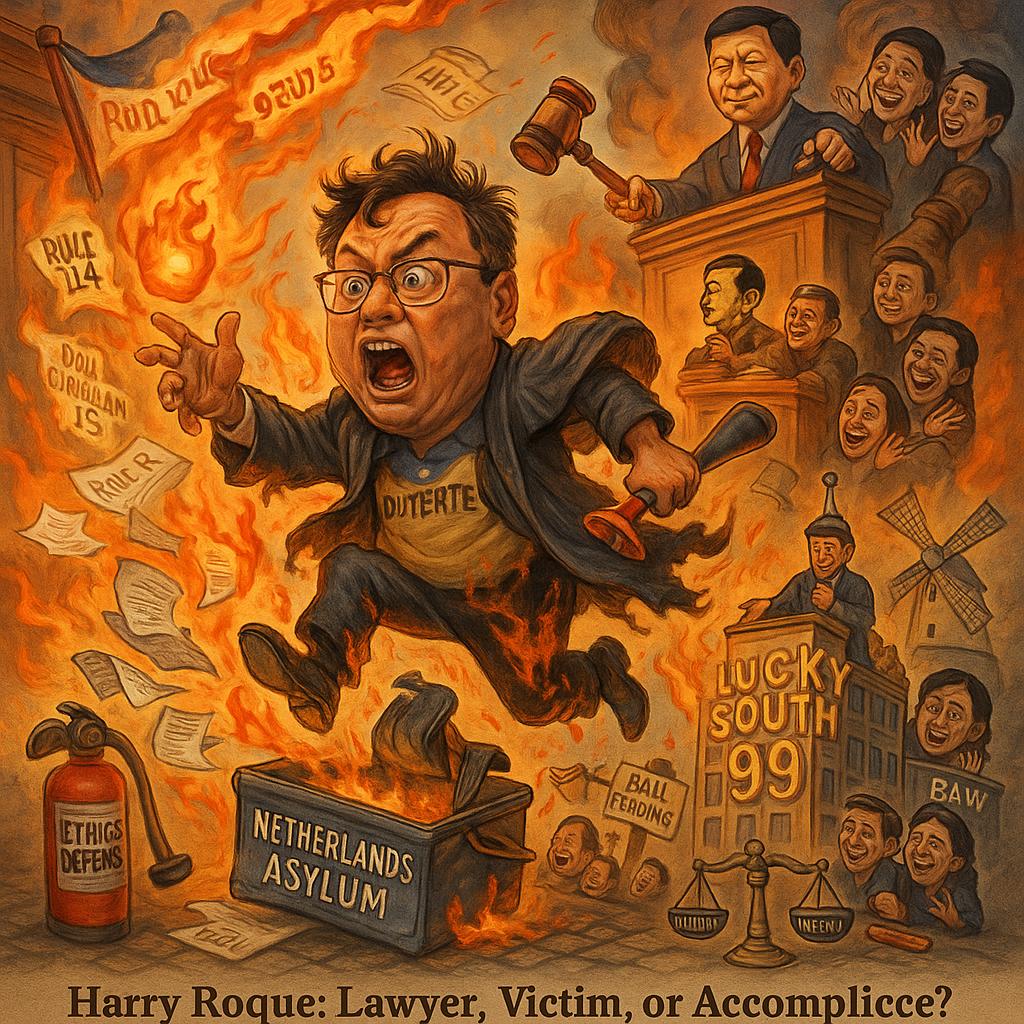
HARRY Roque, once Rodrigo Duterte’s fiery mouthpiece, now faces a non-bailable arrest warrant for qualified human trafficking linked to the notorious Lucky South 99 POGO. The Angeles City Regional Trial Court’s bombshell ruling has sparked a legal and political inferno, with Roque crying foul and seeking asylum in the Netherlands. This Kweba ng Katarungan exposé rips into the charges with razor-sharp legal analysis, probes ethical breaches, and unmasks the political machinations at play, all grounded in statutes, precedents, and hard facts.

The Explosive Case: What’s Roque Accused Of?
Key Allegations
Roque is ensnared in a high-stakes trafficking case under Republic Act No. 9208 (Anti-Trafficking in Persons Act) for his alleged role in Lucky South 99, a POGO hub in Porac, Pampanga, busted for running a scam farm that trafficked workers. The accusations are scorching:
- Whirlwind Corporation Legal Work: Roque lawyered for Whirlwind, which leased property to Lucky South 99, in an ejectment case.
- POGO License Shenanigans: He facilitated Cassandra Ong’s meetings with the Philippine Amusement and Gaming Corporation (Pagcor) to renew Lucky South 99’s license, allegedly fueling trafficking.
- Court’s Verdict: On May 8, 2025, Judge Rene Reyes of Angeles City RTC Branch 118 found probable cause for qualified trafficking under RA 9208, Sections 4(1) and 6(c), issuing warrants for Roque, Ong, Duanren Wu (Whirlwind’s owner), and 46 others Philstar, May 8, 2025.
Non-Bailable Nightmare
Qualified trafficking, a syndicate-driven crime, carries life imprisonment and is non-bailable per Rule 114, Section 7 of the Rules of Court. Roque’s bail plea was shot down, signaling ironclad prima facie evidence.
Roque’s Defiant Stand
Roque denies trafficking, insisting his actions were legit legal services. He’s screaming political persecution, tied to his Duterte loyalty, and has bolted for asylum in the Netherlands, branding the charges “unjust prosecution” Inquirer, May 8, 2025.

Legal Showdown: Can the Charges Stick?

Trafficking Liability: Did Roque Cross the Line?
Substantive Law
- RA 9208, Section 4(1): Trafficking involves “recruitment, transportation, transfer, harboring, or receipt of persons” via fraud or coercion for exploitation (e.g., forced labor).
- Section 6(c): Qualifies trafficking for syndicate or large-scale operations, mandating life imprisonment.
- Roque’s Exposure: Prosecutors claim Roque’s legal work and license facilitation enabled Lucky South 99’s trafficking racket. But proving he directly recruited or harbored workers for exploitation is a steep climb. His lawyerly role, absent hands-on involvement, may dodge the actus reus of trafficking.
Revised Penal Code (RPC)
- Article 17 (Principals): Targets those who commit, induce, or indispensably cooperate in the crime.
- Article 18 (Accomplices): Covers those aiding through prior or simultaneous acts, requiring “community of design” (People v. Tividad G.R. No. L-21469, June 30, 1967).
- Verdict: Roque’s liability depends on whether his legal services were indispensable to trafficking or knowingly aided it. Routine legal advice might not trigger accomplice liability unless prosecutors prove he was in on the trafficking scheme.

Procedural Firefight: Is the Warrant Bulletproof?
- Warrant Legitimacy: DOJ Circular 15 (2024) demands “reasonable certainty of conviction” in preliminary investigations, a tougher hurdle than probable cause. The warrant’s issuance suggests prosecutors presented compelling evidence of Roque’s intent, possibly via documents or witness accounts ABS-CBN News, May 15, 2025.
- Bail Lockout: Rule 114, Section 7 bars bail for capital offenses with strong evidence. The court’s denial screams confidence in the case, but Roque could push for a bail hearing if new evidence undercuts the prosecution.
- Weak Spot: Sparse public details on evidence (e.g., specific emails or financial links) give Roque wiggle room to challenge the case’s foundation.
Ethical Tightrope: Lawyer or Criminal Enabler?
- Code of Professional Responsibility (CPRA):
- Canon 19, Rule 19.01: Lawyers must use honest means in client representation.
- Rule 1.02: No abetting illegal activities.
- Regala v. Sandiganbayan, G.R. No. 105938, September 20, 1996: Lawyers aren’t liable for clients’ crimes without direct involvement or knowledge.
- Analysis: If Roque knew Whirlwind’s lease or Lucky South 99’s operations fueled trafficking, his representation could violate CPRA. But without proof of such knowledge, he’s shielded by zealous advocacy. The prosecution must show he deliberately crossed into criminal territory.

Roque’s Counterattack: Can He Beat the Rap?
Defenses That Could Save Him
- No Criminal Intent: Roque insists he didn’t know about trafficking, leaning on People v. Tividad to argue accomplice liability needs shared intent. If his work was standard legal fare, he may skirt mens rea.
- Procedural Misfire: He could attack the preliminary investigation under DOJ Circular 15, claiming prosecutors didn’t hit the “reasonable certainty” mark. The warrant’s approval, however, suggests this is a long shot.
- Political Hit Job: Roque alleges persecution due to his Duterte ties, comparing his case to Alice Guo’s, where POGO charges moved slower with bail options. This plays better in public than in court unless he proves due process violations.
Holes in the Armor
- Prosecutors likely have evidence (e.g., communications or co-accused testimonies) tying Roque to trafficking, given the warrant’s green light.
- People v. Geronimo, G.R. No. L-1907, November 12, 1950
warns that mere association isn’t enough, but facilitating POGO operations could count as active participation. - Political bias claims are diluted by the nationwide POGO crackdown, which snares multiple players, not just Duterte cronies.

Political Puppet Show: Marcos vs. Duterte Drama
Marcos’ POGO Purge vs. Duterte’s Legacy
Roque’s prosecution dovetails with President Marcos Jr.’s crusade against POGOs, a stark pivot from Duterte’s lax oversight. Roque’s Duterte loyalty and recent role in Duterte’s legal defense team fan flames of political vendetta suspicions Philippine News Agency, May 2025.
Asylum Gambit: Fear or Flight?
Roque’s dash for Dutch asylum, citing “unjust prosecution,” screams either genuine dread of political retribution or a slick dodge Inquirer, May 8, 2025. The lack of a Philippines-Netherlands extradition treaty could stall justice, but Dutch authorities will weigh if the charges are legit or politically tainted.
Big Picture
The POGO crackdown targets trafficking, scams, and laundering, but singling out Roque risks tainting a noble cause with political optics. Inconsistent DOJ handling—Guo’s trial vs. Roque’s swift warrant—feeds perceptions of selective justice.

Case Comparisons: Roque vs. Guo
People v. Geronimo (1950)
- Ruling: Association alone doesn’t make you a trafficker; active participation is key (People v. Geronimo).
- Roque’s Angle: If his legal work was arm’s-length, he’s in the clear. But license facilitation could be seen as enabling exploitation.
Alice Guo’s Saga
- Similarities: Guo’s charged with qualified trafficking for a Bamban POGO, with clearer ties to operations.
- Differences: Guo’s evidence is stronger (ownership links), and her trial allows bail discussions, unlike Roque’s locked-down status.
Roque vs. Guo: Head-to-Head
| Aspect | Harry Roque | Alice Guo |
|---|---|---|
| Charges | Qualified trafficking (RA 9208, Sec. 4(1), 6(c)) | Qualified trafficking (RA 9208) |
| Alleged Role | Legal services, POGO license facilitation | Ownership/operation of Bamban POGO |
| Evidence | Circumstantial (legal work, Pagcor meetings) | Direct (documents, ownership ties) |
| Bail Status | Non-bailable, denied | Bail considered, trial ongoing |
| Political Context | Duterte ally, claims persecution | Local official, less political framing |

Battle Plan: What’s Next?
Prosecution’s Power Moves
- Nail Direct Evidence: Dig up smoking-gun proof (e.g., emails, financial trails) of Roque’s trafficking knowledge.
- Defuse Bias Claims: Ensure transparent evidence handling to squash political hit job narratives.
- Flip Co-Accused: Lean on Ong or others to spill on Roque’s role in the syndicate.
Roque’s Escape Hatch
- Motion to Quash: Attack the information’s specificity under Rule 117, Rules of Court, arguing no clear trafficking acts.
- Bail Push: If fresh evidence (e.g., affidavits proving no intent) surfaces, demand a bail hearing.
- Play the Ethics Card: Frame his work as lawful, citing In re: Algura and CPRA protections.

Final Verdict: Justice or Vendetta?
Roque’s trafficking case is a legal tightrope, testing how far a lawyer’s liability stretches in shady POGO schemes. Prosecutors must prove intent and direct facilitation under RA 9208, a tall order if Roque’s role was purely legal. DOJ Circular 15’s “reasonable certainty” standard bolsters the case but opens avenues for Roque to challenge evidence at trial. Ethically, he risks CPRA violations if trafficking knowledge is proven. Politically, Marcos-Duterte bad blood and Roque’s asylum bid muddy the waters, with no extradition treaty to haul him back. Precedents like Geronimo lean toward narrow liability, but active facilitation could sink Roque. The courtroom, not public opinion, will decide his fate.
Citations:
- Philstar: Court orders arrest of Roque for trafficking, May 8, 2025
- Republic Act No. 9208 (Anti-Trafficking in Persons Act)
- Revised Penal Code, Articles 17–19
- DOJ Circular 15 (2024)
- Rules of Court, Rule 114, Section 7
- Code of Professional Responsibility, Canon 19, Rule 1.02
- Regala v. Sandiganbayan, G.R. No. 105938, September 20, 1996
- People v. Tividad G.R. No. L-21469, June 30, 1967
- People v. Geronimo, G.R. No. L-1907, November 12, 1950
- ABS-CBN News: Court orders Harry Roque’s arrest, May 15, 2025
- Inquirer: Pampanga court issues warrant vs. Cassie Ong, Harry Roque, others, May 8, 2025
- Philippine News Agency: Harry Roque urged to return to PH, May 2025
Disclaimer: This is legal jazz, not gospel. It’s all about interpretation, not absolutes. So, listen closely, but don’t take it as the final word.

- ₱75 Million Heist: Cops Gone Full Bandit

- ₱6.7-Trillion Temptation: The Great Pork Zombie Revival and the “Collegial” Vote-Buying Circus

- ₱1.9 Billion for 382 Units and a Rooftop Pool: Poverty Solved, Next Problem Please

- ₱1.35 Trillion for Education: Bigger Budget, Same Old Thieves’ Banquet

- ₱1 Billion Congressional Seat? Sorry, Sold Out Na Raw — Si Bello Raw Ang Hindi Bumili

- “We Will Take Care of It”: Bersamin’s P52-Billion Love Letter to Corruption

- “Skewed Narrative”? More Like Skewered Taxpayers!

- “Scared to Sign Vouchers” Is Now Official GDP Policy – Welcome to the Philippines’ Permanent Paralysis Economy
- “Robbed by Restitution?” Curlee Discaya’s Tears Over Returning What He Never Earned

- “My Brother the President Is a Junkie”: A Marcos Family Reunion Special

- “Mapipilitan Akong Gawing Zero”: The Day Senator Rodante Marcoleta Confessed to Perjury on National Television and Thought We’d Clap for the Creativity

- “Just Following Orders” Is Dead: How the Hague Just Turned Tokhang’s Finest Into International Fugitives




 KWEBA ni BAROK
Leave a comment