
By Louis ‘Barok‘ C. Biraogo — May 18, 2025
THE impeachment trial of Philippine Vice President Sara Duterte, set to ignite on July 30, 2025, before a Senate moonlighting as an impeachment court, isn’t just a legal proceeding—it’s a political bloodbath. Accused of misusing public funds, betraying public trust, and hurling threats at President Ferdinand Marcos Jr., Duterte faces a Senate so steeped in bias it could double as a dynastic soap opera. The Marcos-Duterte feud, supercharged by the 2025 midterm elections, has turned this trial into a high-stakes showdown where impartiality is a punchline. Writing for Kweba ng Katarungan, we’ll rip apart the legal facade, expose the senators’ conflicts, and call out the systemic rot that makes this trial less about justice and more about power. Buckle up—this is going to be a wild ride.
1. Constitutional Chaos: A System Built for Spectacle
- Impeachment’s Shaky Foundation: A Political Free-for-All
The 1987 Philippine Constitution, Article XI, Sections 2-3 lays out impeachment like a recipe for chaos. Impeachable offenses—culpable violation of the Constitution, treason, bribery, graft, high crimes, or betrayal of public trust—are so vague they’re practically an invitation to political vendettas. Duterte’s charges (fund misuse, betrayal, threats) fit the elastic “betrayal of public trust” mold, but their flimsiness reeks of score-settling. Per Corona v. Senate (2012), betrayal is a “political question,” giving senators carte blanche to convict or acquit based on whim—or loyalty. The House’s 215 votes on February 5, 2025, cleared the Section 3(4) hurdle, but the Senate’s trial role (Section 3(6)), needing 16 of 24 votes for conviction, is a pressure cooker for deal-making, not truth. The Marcos-Duterte feud, with Rodrigo’s ICC detention as kindling, screams dynasty wars, not accountability BBC, May 2025. - Due Process on Life Support: Can This Senate Be Trusted?
Article III, Section 1 promises due process, including an impartial tribunal, but the Senate’s post-2025 election lineup is a political dumpster fire. Duterte allies like Christopher “Bong” Go (26.4M votes) and Ronald “Bato” Dela Rosa (20.2M votes) face off against opposition pitbulls like Bam Aquino (36.3M votes) and Risa Hontiveros Rappler, May 2025. Gutierrez v. House (2011) demanded fairness in impeachment, and Estrada v. Desierto (2001) warned that bias guts due process. With Go’s PDP-Laban loyalty and Hontiveros’s human rights jihad, impartiality is a fantasy. The Senate Impeachment Rules, Rule VII oath of “impartial justice” is a cruel joke when senators eye 2028 elections. Senate President Francis Escudero’s neutrality plea ABS-CBN, Feb 2025 is like asking wolves to play vegan.
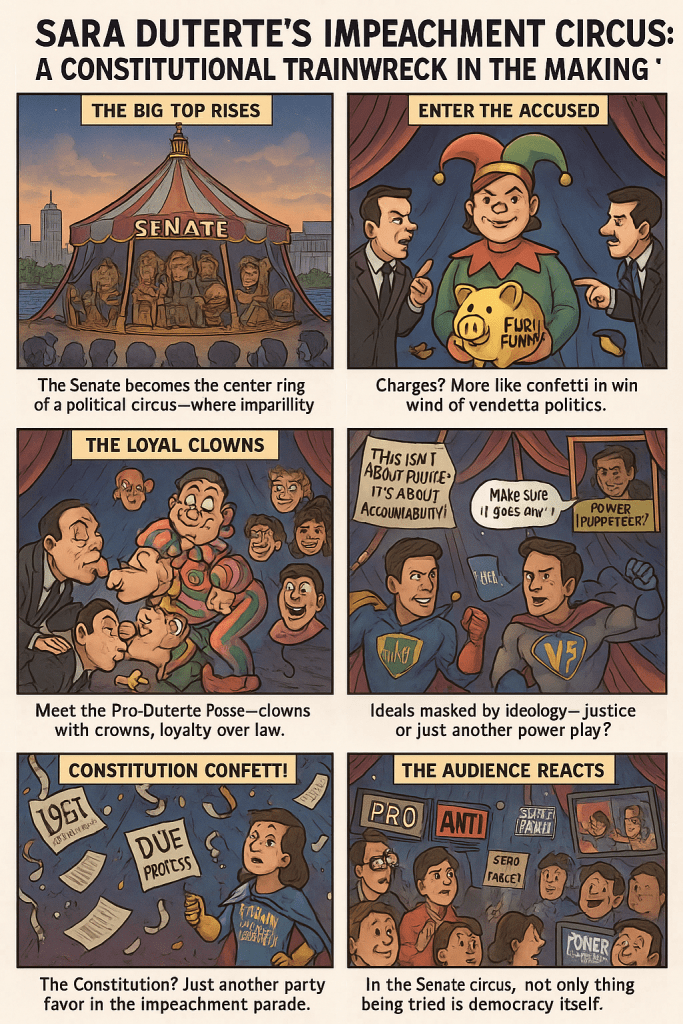
2. Senatorial Shenanigans: Bias So Thick You Could Cut It
Pro-Duterte Posse: Loyalty Trumps Justice
Senators Christopher “Bong” Go, Ronald “Bato” Dela Rosa, Robin Padilla, Rodante Marcoleta, Imee Marcos, Camille Villar, and Erwin Tulfo are tagged as Duterte cheerleaders. Their PDP-Laban ties, Duterte endorsements, or public posturing scream conflict.
- Conflict of Interest: Ethical Standards in Tatters
RA 6713, Section 4(c) forbids conflicts of interest, but Go (ex-Rodrigo aide) and Dela Rosa (ex-PNP chief) are PDP-Laban poster boys, their campaigns fueled by Duterte mania TIME, May 2025. Marcoleta’s vow to defend Duterte (14.9M votes, Duter10 slate) is a conflict so brazen it’s almost performance art. Marcos (13M votes) and Villar (13.3M votes), both Duterte-endorsed, can’t separate loyalty from judgment Rappler, Apr 2025. Section 4(a)’s fairness mandate is DOA when these senators owe their seats to Duterte’s dynasty. Tulfo’s non-signing of the impeachment complaint (16.8M votes) was framed as impartiality GMA News, Feb 2025, but his family’s Duterte ties raise eyebrows. - Impeachment Rules: Marcoleta’s Oath-Shredding Stunt
Senate Impeachment Rules, Rule VII demands an impartiality oath, but Marcoleta’s public defense of Duterte TIME, May 2025 is prejudgment on steroids. Go and Dela Rosa’s PDP-Laban devotion and Padilla’s Duterte worship imply bias, though less explicit. Tulfo’s impartiality pledge aligns with Rule VII, but his non-signing could be spun as pro-Duterte optics. These senators turn the oath into a loyalty pledge, making a mockery of justice. - Criminal Shadows: Unjust Judgments Loom?
Revised Penal Code, Article 204 punishes knowingly unjust judgments. If Go or Marcoleta acquit Duterte despite evidence, their loyalty could flirt with ethical (if not legal) liability. Impeachment’s political shield protects them, but the stench of partiality lingers, exposing a constitutional loophole. - Precedent: Corona’s Weak Defense Crumbles
In Corona v. Senate (2012), Franklin Drilon and Miriam Defensor-Santiago escaped disqualification because their ties lacked explicit prejudgment. Marcoleta’s statement, Go’s aide history, and Dela Rosa’s PNP tenure are smoking guns, far outweighing Corona’s leniency. These senators face stronger recusal grounds, as their bias is practically tattooed on their foreheads.
Anti-Duterte Avengers: Ideology or Impartiality?
Bam Aquino, Francis Pangilinan, and Risa Hontiveros are accused of anti-Duterte bias, driven by their opposition roots and policy critiques.
- Ideological Bias: Fairness Under Fire
RA 6713, Section 4(a) demands fairness, but Aquino and Pangilinan’s Liberal Party credentials (36.3M and rank 5) and Hontiveros’s Akbayan activism scream anti-Duterte Rappler, May 2025. Hontiveros’s drug war takedowns are notorious, though she avoids explicit prejudgment. Ideology alone doesn’t breach RA 6713, per Corona (2012), but Hontiveros’s track record risks perceptions of bias, threatening public trust. - Mitigating Factors: Pledges or PR?
Aquino and Pangilinan’s March 2025 fairness pledges BBC, May 2025 echo Santiago’s Corona defense, dulling disqualification knives. Hontiveros lacks such a shield, making her a bigger target. These pledges smell like political theater in a Senate where ideology fuels votes, casting doubt on their weight.
3. Procedural Nightmares & Political Power Plays
- Disqualification Dead-End: Senate’s Self-Serving Shield
Senate Impeachment Rules, Rule XXIII lets the Senate decide disqualification motions by majority vote. With a pro-Duterte bloc of seven (Go, Dela Rosa, Padilla, Marcoleta, Marcos, Villar, Tulfo), motions against them are toast—senators don’t slit their own throats Rappler, May 2025. Francisco v. House (2003) cements Senate autonomy, so Escudero’s rulings bow to political winds. RA 6713’s call for voluntary inhibition is a pipe dream—Marcoleta’s defiance proves senators choose power over principle. - Supreme Court Sidelines: Political Question Cop-Out
Gutierrez (2011) hints the Supreme Court can intervene for grave abuse, but Francisco’s political question doctrine ties its hands. A Senate ignoring Marcoleta’s bias could spark a petition, but judicial deference to Congress makes relief a long shot. The Marcos-Duterte feud’s grip on justices only dims the odds. - Election Aftershocks: Legitimacy in the Crosshairs
The 2025 elections (97.23% precincts) handed Duterte allies like Go and Dela Rosa massive mandates, signaling public backing Al Jazeera, May 2025. Tulfo’s impartiality-driven non-signing Philstar, Feb 2025 contrasts with Marcoleta’s bias, yet both get pro-Duterte labels, tainting legitimacy. Aquino and Pangilinan’s wins show opposition clout, but their pledges can’t mask a polarized Senate. Duterte needs nine votes to dodge conviction; with seven allies, she’s a whisper from victory, turning the trial into a political poker game.
4. Fixing the Unfixable: Reforms to Salvage Justice
- Ethical Overhaul: Recusal or Bust
The Senate must mandate recusal for clear conflicts, like Marcoleta’s, under RA 6713. The U.S. Senate’s impeachment recusal rules for direct ties (e.g., Trump’s trials) are a blueprint. A binding Senate ethics code with teeth—fines, censure—could curb prejudgment, unlike the current oath’s empty words. - Radical Redesign: Ditch the Senate’s Gavel
An independent impeachment tribunal of retired justices or neutral experts could neuter political bias. The Constitution’s Senate monopoly (Article XI, Section 3(6)) is a dinosaur, assuming senators can play judge. Amending it demands guts, but Corona and Duterte’s trials scream for change. Short-term, a bipartisan panel to screen senator eligibility could limit conflicts. - People Power 2.0: Media and Masses as Guardrails
Rappler and GMA News have called out biases Rappler, Feb 2025, but partisan noise drowns them out. NGOs and legal groups must rally for vote transparency. Public outrage nudged Escudero’s neutrality stance; relentless pressure could force recusals. X’s chaotic discourse can amplify demands, if it sidesteps fake news.
Conclusion: A Trial Doomed to Be a Sham
Sara Duterte’s impeachment trial is a constitutional car crash, careening toward spectacle over substance. The 1987 Constitution’s vague offenses and Senate-centric design breed politicization, while RA 6713’s ethics are a paper tiger against dynastic loyalties. Pro-Duterte senators like Marcoleta, with his shameless prejudgment, and Go, a Duterte loyalist, spit on impartiality, yet Francisco (2003)’s autonomy fetish protects them. Opposition senators like Hontiveros flirt with bias, their pledges a flimsy Band-Aid. Tulfo’s impartiality play is a rare spark, but the Marcos-Duterte feud’s shadow looms large. The 2025 elections, with Duterte’s allies ascendant, rig the game—nine votes to save her are within reach. The Supreme Court, shackled by political questions, won’t intervene. Media and civil society are the last hope, but they’re outmatched by patronage. This trial isn’t about justice; it’s a dynastic drama where the Constitution plays prop, and the public pays the price.
Key Citations:
- 1987 Philippine Constitution, Art. III, Sec. 1; Art. XI, Sec. 2-3
- Senate Rules of Procedure in Impeachment Trials (2011), Rules VII, XXIII
- RA 6713, Sec. 4(a)-(c)
- Revised Penal Code, Art. 204
- Francisco v. House, G.R. No. 160261 (2003)
- Gutierrez v. House, G.R. No. 193459 (2011)
- Corona v. Senate, G.R. No. 200242 (2012)
- Estrada v. Desierto, G.R. No. 146710-15 (2001)
- Rappler: Initial Senate results, 2025
- GMA News: Tulfo on impeachment, 2025
- TIME: Duterte influence, 2025
- ABS-CBN: Escudero’s neutrality, 2025
Disclaimer: This is legal jazz, not gospel. It’s all about interpretation, not absolutes. So, listen closely, but don’t take it as the final word.

- ₱75 Million Heist: Cops Gone Full Bandit

- ₱6.7-Trillion Temptation: The Great Pork Zombie Revival and the “Collegial” Vote-Buying Circus

- ₱1.9 Billion for 382 Units and a Rooftop Pool: Poverty Solved, Next Problem Please

- ₱1.35 Trillion for Education: Bigger Budget, Same Old Thieves’ Banquet

- ₱1 Billion Congressional Seat? Sorry, Sold Out Na Raw — Si Bello Raw Ang Hindi Bumili

- “We Will Take Care of It”: Bersamin’s P52-Billion Love Letter to Corruption

- “Skewed Narrative”? More Like Skewered Taxpayers!

- “Scared to Sign Vouchers” Is Now Official GDP Policy – Welcome to the Philippines’ Permanent Paralysis Economy

- “Robbed by Restitution?” Curlee Discaya’s Tears Over Returning What He Never Earned

- “No Pressure” Luistro? The House Pork Bazaar Exposed
- “My Brother the President Is a Junkie”: A Marcos Family Reunion Special

- “Mapipilitan Akong Gawing Zero”: The Day Senator Rodante Marcoleta Confessed to Perjury on National Television and Thought We’d Clap for the Creativity


 KWEBA ni BAROK
Leave a comment