
By Louis ‘Barok‘ C. Biraogo — May 19, 2025
WHEN millions of overseas Filipino workers scrape together their hard-earned dollars to fund the Overseas Workers Welfare Administration (OWWA), they expect protection—not betrayal. Yet the P1.4-billion land deal orchestrated by recently-fired OWWA chief Arnell Ignacio has done exactly that. As the Department of Migrant Workers (DMW) investigates this scandal, a disturbing pattern of procedural violations and ethical failings has emerged, leaving overseas Filipino workers (OFWs) to wonder: Who’s truly guarding their financial sacrifices? This article exposes how Ignacio’s weak defenses crumble against legal reality and why immediate reforms are essential to prevent another raid on migrant workers’ trust funds.
I. The Glaring Heist: Bypassing the OWWA Board’s Mandate
At the core of this scandal is a brazen violation of Republic Act No. 10801, the OWWA Charter. Section 22(i) unequivocally grants the OWWA Board of Trustees the power to “authorize the purchase and acquisition of real and personal properties.” Section 24(c) tightens the screws, requiring an absolute majority vote for disbursements over P100 million. The P1.4-billion land deal—slated for a halfway house near NAIA Terminal 1—smashes through this threshold. Yet, DMW Secretary Hans Cacdac confirmed the deal sidestepped Board approval, a procedural sin so flagrant it’s practically a neon sign screaming “non-compliance.”
This isn’t a clerical error; it’s a deliberate end-run around governance. The OWWA Board, chaired by the DMW Secretary with Ignacio as Vice Chair, exists to scrutinize high-stakes decisions. Skipping it suggests either incompetence or audacity. The deal, inked in September 2024 using General Appropriations Act (GAA) funds, doesn’t get a free pass—RA 10801’s mandate applies regardless of the money’s source. Ignacio’s move here isn’t a misstep; it’s a statutory slap in the face to the OFWs whose welfare OWWA is sworn to protect.
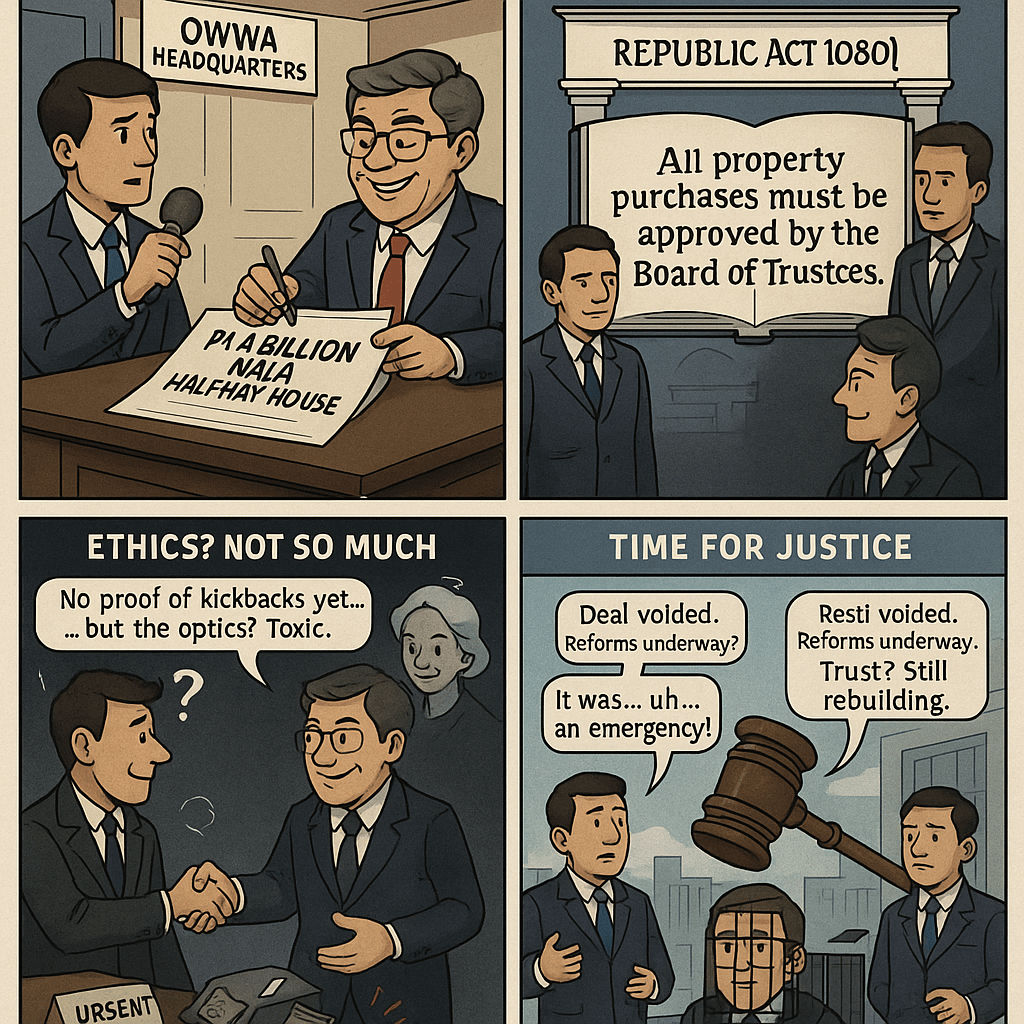
II. Ethical Minefield: Dancing with Villanueva and Regalado’s Shadows
The deal’s ethical stench is as potent as its legal flaws. Republic Act No. 6713, the Code of Conduct and Ethical Standards for Public Officials, sets a high bar. Section 7(a) bars officials from having financial interests in transactions they oversee. Section 7(d) forbids soliciting or accepting benefits tied to their duties. While the news report doesn’t explicitly pin personal gain on Ignacio, the “anomalous” tag and his ouster for “loss of trust and confidence” raise red flags about potential conflicts. If Ignacio had any stake—direct or through cronies—this deal could be his undoing.
The Supreme Court doesn’t play games with ethical breaches. In Filomena L. Villanueva v. People (G.R. No. 237738, 2019), an official was convicted for accepting a P1 million loan from a regulated entity, with the Court ruling that even indirect benefits violate RA 6713. Similarly, Office of the Ombudsman v. Maria Rowena Regalado (G.R. Nos. 208481-82, 2018) saw an immigration officer sacked for soliciting cash, reinforcing zero tolerance for exploiting public office. If Ignacio’s deal smells of personal benefit, these precedents could justify penalties from fines to perpetual disqualification.
Even without a smoking gun, the optics are toxic. A P1.4-billion deal shrouded in secrecy invites suspicions of favoritism or kickbacks. For OWWA, an agency built on OFW sweat, such ethical shadows are a betrayal, reviving memories of the Arroyo-era OFW fund mismanagement that left trust in tatters.
III. Procurement Charade: Why the ‘Emergency’ Excuse Crumbles
The deal’s procurement process—or lack thereof—is a legal dumpster fire. Republic Act No. 12009, the New Government Procurement Act of July 2024, demands competitive bidding or justified exceptions, like negotiated procurement under Section 50 for emergencies or failed biddings. The “anomalous” label suggests Ignacio bypassed these rules, perhaps waving the emergency flag to rush the deal.
But that flag doesn’t fly. RA 10801’s Section 22(k) allows delegation to the Administrator only in “national emergencies” impacting OFW rights—think war or mass repatriation, not a halfway house. No evidence points to a crisis in September 2024, and the DMW’s silence on any emergency claim sinks this defense. Even under RA 12009, emergency procurement requires rigorous documentation and post hoc reporting—steps the ongoing COA and DOJ probes suggest were ignored.
Ignacio might claim GAA funds dodge OWWA’s rules, but that’s a fantasy. RA 10801’s Section 22(i) governs all property purchases, and RA 12009 applies to GAA-funded acquisitions. Without bidding records or Board resolutions, Ignacio’s procurement process is less a procedure than a performance, with public funds as the unwilling audience.
IV. Ignacio’s Flimsy Defenses: A Legal House of Cards
Ignacio’s potential defenses are as sturdy as wet tissue. Let’s tear them apart:
- “I Had Solo Authority”: RA 10801, Section 22(i), demands Board approval for property purchases. Ignacio’s Vice Chair role doesn’t grant a blank check—it binds him to collective oversight. This defense is dead on arrival.
- “GAA Funds Change the Rules”: Nope. Section 22(i) applies universally, and RA 12009 governs GAA funds. The Trust Fund-GAA distinction is irrelevant; the law doesn’t bend for funding sources.
- “It Was an Emergency”: RA 10801’s Section 22(k) limits delegation to national emergencies, and RA 12009’s emergency clause demands documented justification. No crisis, no records, no dice.
- “No Personal Gain”: If true, this might sidestep RA 6713’s conflict rules, but it doesn’t erase procedural violations. Villanueva and Regalado show courts punish process failures, not just profiteering.
- “My Ouster Was Unfair”: RA 10801, Section 10, allows removal for cause, and Garcia v. Executive Secretary (G.R. No. 181316, 2011) upholds presidential discretion. “Loss of trust and confidence” over a P1.4-billion scandal is cause enough.
These defenses aren’t a shield; they’re a sieve, leaking under the weight of statutes and precedent.
V. Fixing the Mess: Accountability and Reforms to Save OWWA
This scandal demands more than finger-pointing—it requires action. Here’s how to clean up and prevent a repeat:
- Void the Deal: Villanueva supports nullifying transactions lacking mandatory approvals. The DMW should push the DOJ to void the contract, recover funds, and probe counterparties for graft under RA 3019.
- Punish the Culprit: Regalado backs dismissal for ethical breaches. Ignacio’s sacking is step one; the Ombudsman should pursue fines, disqualification, or benefit forfeiture if conflicts surface.
- Bolster COA Oversight: The COA’s audit role is pivotal. Mandate real-time reporting for OWWA deals over P100 million, with public summaries to deter future end-runs.
- Mandate Transparency: RA 10801 needs teeth. Congress should require public posting of OWWA Board resolutions within 30 days, aligning with FOI principles to let OFWs see their funds at work.
- Enforce Procurement Rules: RA 12009’s transition period isn’t a free pass. The COA and DOJ should clarify compliance deadlines and penalize agencies dodging bidding rules, using this case as a deterrent.
- Trigger Legislative Audits: Congress should set automatic COA audits for OWWA deals above P500 million, avoiding another Arroyo-era fund disaster where oversight trailed ambition.
Conclusion: A Stab at OFW Trust
The OWWA land deal isn’t just a legal trainwreck; it’s a gut punch to OFWs whose contributions fuel the agency. Ignacio’s flouting of RA 10801’s Board mandate, potential RA 6713 ethical breaches, and RA 12009 procurement failures paint a portrait of reckless governance. His defenses—emergency claims, GAA exemptions, or due process whines—wilt against clear statutes and cases like Villanueva and Regalado. The DMW’s probe, backed by COA and DOJ, must deliver sanctions, from deal nullification to robust reforms. Anything less lets the ghost of past OFW fund scandals haunt anew, leaving overseas workers to bear the cost of bureaucratic betrayal.
Citations:
- RA 10801
- RA 6713
- RA 12009
- Filomena L. Villanueva v. People (2019)
- Office of the Ombudsman v. Maria Rowena Regalado (2018)
- Garcia v. Executive Secretary (2011)
- RA 3019
- FOI Principles
- GMA News Report
Disclaimer: This is legal jazz, not gospel. It’s all about interpretation, not absolutes. So, listen closely, but don’t take it as the final word.

- ₱75 Million Heist: Cops Gone Full Bandit

- ₱6.7-Trillion Temptation: The Great Pork Zombie Revival and the “Collegial” Vote-Buying Circus

- ₱1.9 Billion for 382 Units and a Rooftop Pool: Poverty Solved, Next Problem Please

- ₱1.35 Trillion for Education: Bigger Budget, Same Old Thieves’ Banquet

- ₱1 Billion Congressional Seat? Sorry, Sold Out Na Raw — Si Bello Raw Ang Hindi Bumili

- “We Will Take Care of It”: Bersamin’s P52-Billion Love Letter to Corruption

- “Skewed Narrative”? More Like Skewered Taxpayers!

- “Scared to Sign Vouchers” Is Now Official GDP Policy – Welcome to the Philippines’ Permanent Paralysis Economy
- “Robbed by Restitution?” Curlee Discaya’s Tears Over Returning What He Never Earned

- “No Pressure” Luistro? The House Pork Bazaar Exposed
- “My Brother the President Is a Junkie”: A Marcos Family Reunion Special

- “Mapipilitan Akong Gawing Zero”: The Day Senator Rodante Marcoleta Confessed to Perjury on National Television and Thought We’d Clap for the Creativity



 KWEBA ni BAROK
Leave a comment