
By Louis ‘Barok‘ C. Biraogo — May 21, 2025
The Philippines’ party-list system, birthed by Republic Act No. 7941, was designed as a lifeline for the marginalized—laborers, peasants, and indigenous communities meant to find a voice in Congress. Instead, it’s been transformed into a dynastic playground where elites like the Cardemas and Tulfos dress up as “sectoral heroes” while consolidating power. Duterte Youth and ACT-CIS are the poster children for this travesty, exploiting legal loopholes, manipulating nominations, and sidelining genuine representation. The 2025 elections, with both groups snagging three seats each, prove the system is not just flawed—it’s a full-blown mockery of democracy. Here’s how these dynasties have turned a constitutional promise into a masterclass in political corruption, and why it’s time to dismantle their game.
From Grassroots to Grift: The Elite Takeover Blueprint
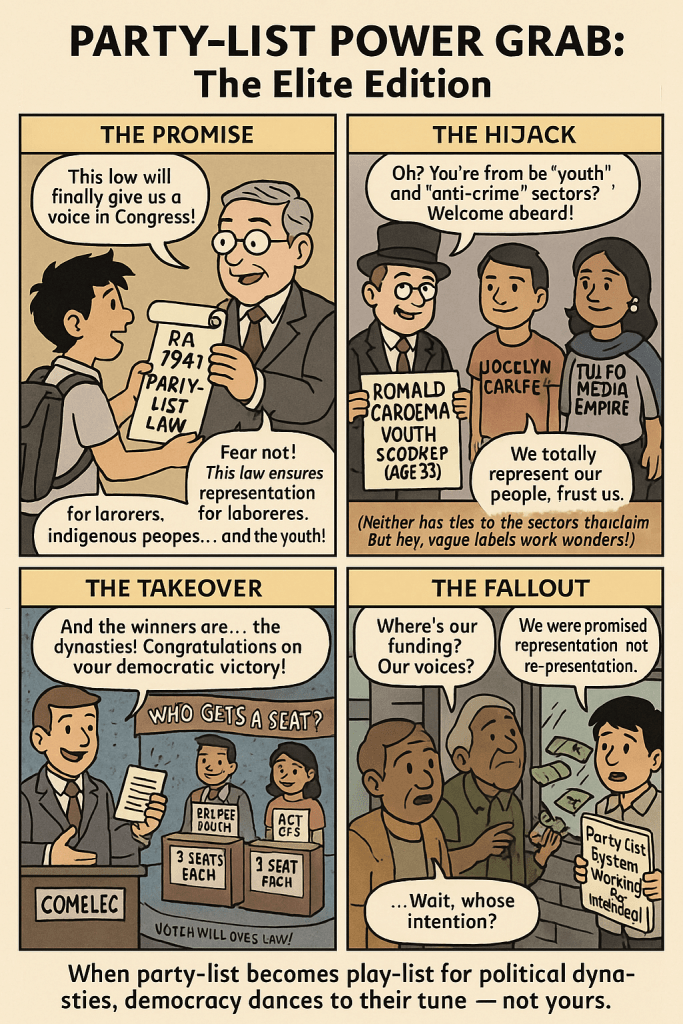
The recipe for hijacking a party-list is deceptively simple. Step one: Pick a vague, populist label to mask your elite status. Duterte Youth claims to represent “youth,” despite leaders well past the age limit. ACT-CIS hides behind “anti-crime and terrorism,” a cause so broad it’s meaningless, perfectly aligned with their media empire’s sensationalism. Step two: Install family members or loyalists as nominees, regardless of their connection to the sector. Step three: Deploy political machinery—name recall, regional strongholds, and elite networks—to steamroll votes. Both groups have mastered this playbook, turning a system for the powerless into a dynastic power grab.
Duterte Youth, led by Ronald Cardema and his wife Ducielle, is a blatant extension of the Duterte political machine. Ronald, a former Duterte administration official, was disqualified in 2019 for being over 30, the youth sector age limit, after falsifying his nomination papers. Ducielle Marie Suarez-Cardema stepped in, securing a seat in 2020 despite her own questionable youth credentials. By 2025, their daughter Drixie Mae Cardema is believed to hold the congressional seat, inferred from the Cardema family’s pattern of nominee swapping, though not explicitly confirmed in public records. Their strategy? Nominee swapping to dodge disqualifications, all while riding the Duterte name’s clout in Davao.
ACT-CIS, meanwhile, is the Tulfo dynasty’s political front, masquerading as a grassroots movement. Led by Erwin Tulfo, a former DSWD secretary, and Jocelyn Tulfo, wife of Senator Raffy Tulfo, the group leverages the Tulfo media empire’s name recognition to push a vague “anti-crime” agenda. Nominees like Jocelyn and Edvic Go Yap (brother of Benguet Rep. Eric Yap) have no ties to marginalized communities. Instead, they rely on the Tulfos’ media dominance and Quezon City base to dominate polls, securing three seats in 2025, as reported by Rappler.
Comparison Table: Duterte Youth vs. ACT-CIS Tactics
| Aspect | Duterte Youth | ACT-CIS |
|---|---|---|
| Claimed Sector | Youth | Anti-crime, community involvement |
| Key Figures | Ronald Cardema, Ducielle Cardema, Drixie Mae Cardema | Erwin Tulfo, Jocelyn Tulfo, Edvic Go Yap |
| Dynastic Ties | Linked to Duterte family (Harold James Duterte as nominee) | Tulfo media dynasty, ties to Senator Raffy Tulfo |
| Nominee Swapping | Ronald disqualified, replaced by Ducielle, then Drixie Mae | Jocelyn and Edvic as proxies for Tulfo family interests |
| Political Machinery | Duterte name, Davao stronghold | Tulfo media empire, Quezon City base |
| Legal Violations | Misrepresentation, failure to meet publication requirements (GMA News) | Nominees not from marginalized sectors |
Legal Loopholes and Constitutional Con Jobs
RA 7941 mandates that party-list nominees be “bona fide members” of the marginalized sectors they represent. Duterte Youth and ACT-CIS laugh in the face of this requirement. The Cardemas, with their elite connections and history of red-tagging student activists, have no credible ties to the youth sector. ACT-CIS’s nominees, like Jocelyn Tulfo, trade on media fame, not lived experience of oppression. Yet both groups exploit the Supreme Court’s BANAT vs. COMELEC (G.R. No. 179271, 2009) ruling, which loosened restrictions by allowing major parties’ sectoral wings to participate, opening the door for dynasties to infiltrate the system.
Both have faced disqualification cases, but the Commission on Elections (Comelec) is maddeningly toothless. Duterte Youth’s 2019 registration remains under scrutiny for failing publication and hearing requirements, with a pending petition arguing it’s not a legitimate youth representative. Comelec’s response? Greenlight their runs in 2019, 2022, and 2025, securing three seats in the latest election. ACT-CIS skates by with no serious challenges to its nominees’ lack of sectoral ties, despite their dynastic connections. The BANAT loophole lets them thrive, as Comelec prioritizes “voter will” over legal compliance.
Damning Comparison 1: Claim vs. Reality
- Duterte Youth Claim: Represents the youth, advocating for nationalism and discipline.
- Reality: Led by overaged elites (Ronald Cardema was 34 in 2019) tied to the Duterte dynasty, not grassroots youth movements Philstar.
Damning Comparison 2: Claim vs. Reality
- ACT-CIS Claim: Champions the “oppressed” through anti-crime advocacy.
- Reality: A Tulfo family vehicle, with nominees like Jocelyn Tulfo and Edvic Go Yap representing media and political elites, not victims of crime Rappler.
Damning Comparison 3: Claim vs. Reality
- Both Claim: Grassroots support drives their success.
- Reality: Votes stem from regional strongholds (Davao for Duterte Youth, Quezon City for ACT-CIS) and name recognition, not sectoral advocacy ABS-CBN News.
Stealing Seats, Sidelining the Marginalized
The fallout from this dynastic takeover is catastrophic. In 2025, Duterte Youth and ACT-CIS each clinched three seats, tying with Akbayan for the maximum allowed, as reported by PNA. That’s six seats meant for marginalized voices now occupied by dynastic proxies. Genuine party-lists like Akbayan and Gabriela, with proven records of advocating for workers and women, are forced to compete with groups that funnel resources to elite agendas. Akbayan’s legislative wins include labor rights and universal healthcare, while Gabriela has driven anti-violence laws. Duterte Youth, by contrast, pushes mandatory ROTC and red-tagging, aligning with the Duterte family’s authoritarian streak. ACT-CIS’s “anti-crime” bills parrot the Tulfo media narrative, offering little for actual victims.
This distortion robs marginalized sectors of funding and influence. Party-list groups receive government allocations, but when dynasties control these seats, resources flow to their political bases. A 2022 Kontra Daya study found 67% of party-lists were linked to clans or corporations, siphoning support from the poor. Duterte Youth and ACT-CIS don’t just dilute representation; they weaponize it to advance their patrons’ interests, from Duterte’s federalism push to the Tulfos’ senatorial ambitions.
Infographic: Political Connections vs. Genuine Party-Lists
| Party-List | Political Connections | Sectoral Advocacy | Legislative Impact |
|---|---|---|---|
| Duterte Youth | Duterte family, Cardema clan | Nominal youth advocacy | Supports ROTC, red-tagging |
| ACT-CIS | Tulfo media dynasty, Yap family | Vague anti-crime stance | Media-driven bills, minimal impact |
| Akbayan | None, grassroots-based | Labor, human rights | Universal healthcare, labor laws |
| Gabriela | None, women’s movement | Women’s rights, anti-violence | Anti-VAWC laws, gender equity |
A Rogues’ Gallery: Timeline of Legal Violations
- 2019: Ronald Cardema disqualified for age misrepresentation; Ducielle takes his place. Petition filed alleging invalid registration GMA News.
- 2020: Comelec grants Ducielle’s proclamation despite pending cases.
- 2022: Duterte Youth wins again; Drixie Mae Cardema assumes seat. ACT-CIS’s nominees face no serious challenges.
- 2025: Both secure three seats each, but Duterte Youth’s proclamation is suspended pending a 2019 petition Rappler.
Smashing the Dynastic Sandbox: Urgent Reforms
The party-list system isn’t broken; it’s been hijacked. To reclaim it, Congress must enact these reforms:
- Anti-Dynasty Firewalls: Ban nominees with immediate family ties to elected officials or candidates, per the 1987 Constitution’s anti-dynasty clause. No more Cardemas or Tulfos.
- Sectoral Means Testing: Require nominees to prove lived experience in their claimed sector through verifiable records, not affidavits.
- Transparent Funding: Mandate audited, public disclosure of party-list funding and expenditures to expose elite backing.
- Swift Disqualification: Automatically deregister groups with multiple election violations, like misrepresentation or nominee swapping.
Comelec’s George Garcia is right to demand amendments PNA, but his words are empty without action. The system’s flaws are no secret—Kontra Daya and legal experts have long called it a perversion of its original intent. Yet Duterte Youth and ACT-CIS thrive, turning Congress into a dynastic echo chamber. If the Philippines wants a party-list system that serves the marginalized, it’s time to slam the door on loopholes and enforce the law.
Sources:
- Republic Act No. 7941
- PNA on Comelec’s Amendment Push
- GMA News on Duterte Youth Petition
- Philstar on Duterte Youth Controversies
- Rappler on 2025 Party-List Results
- ABS-CBN News on Party-List Race
- Kontra Daya on Party-List Abuse
- BANAT vs. COMELEC (G.R. No. 179271, 2009)

- “Forthwith” to Farce: How the Senate is Killing Impeachment—And Why Enrile’s Right (Even If You Can’t Trust Him)
- “HINDI AKO NAG-RESIGN!”

- “I’m calling you from my new Globe SIM. Send load!”

- “Mahiya Naman Kayo!” Marcos’ Anti-Corruption Vow Faces a Flood of Doubt

- “Meow, I’m calling you from my new Globe SIM!”

- “No Special Jail for Crooks!” Boying Remulla Slams VIP Perks for Flood Scammers

- “PLUNDER IS OVERRATED”? TRY AGAIN — IT’S A CALCULATED KILL SHOT

- “Several Lifetimes,” Said Fajardo — Translation: “I’m Not Spending Even One More Day on This Circus”

- “Shimenet”: The Term That Broke the Internet and the Budget
- “We Did Not Yield”: Marcos’s Stand and the Soul of Filipino Sovereignty

- “We Gather Light to Scatter”: A Tribute to Edgardo Bautista Espiritu

- $150M for Kaufman to Spin a Sinking Narrative






 KWEBA ni BAROK
Leave a comment