By Louis ‘Barok‘ C. Biraogo — May 21, 2025
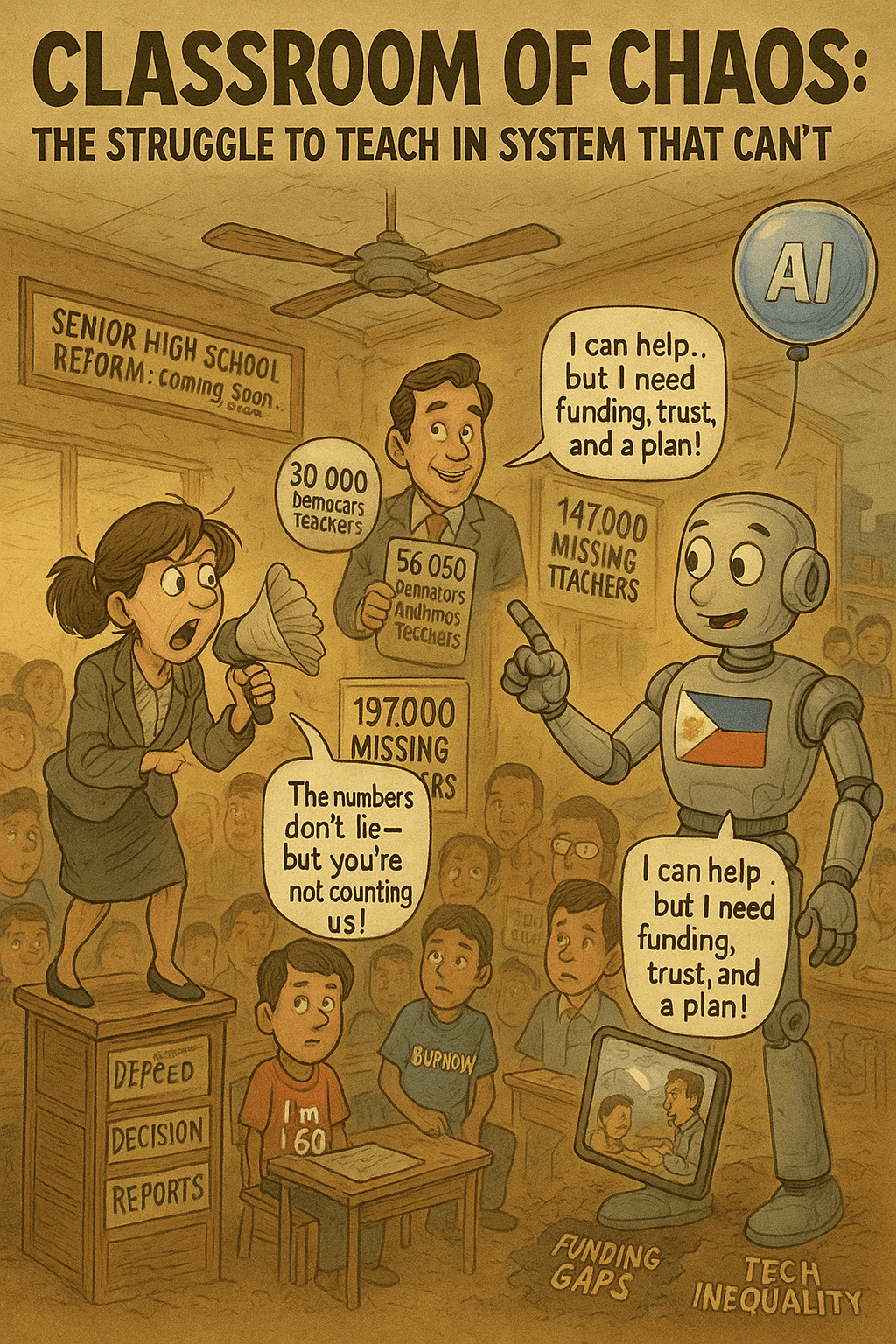
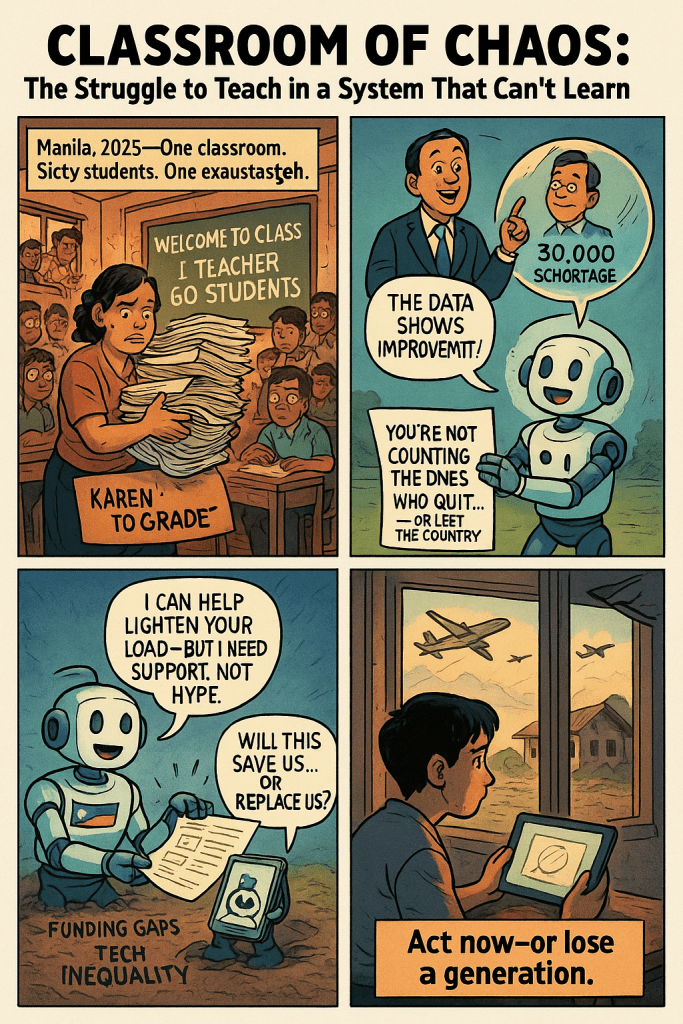
IN A Manila high school, 60 students cram into a classroom built for 30. Their teacher, Karen, a composite of countless educators, spends sleepless nights grading papers instead of inspiring minds. The Department of Education (DepEd) claims a 30,000-teacher shortage, even after approving 16,000 new positions for 2025. Unions, however, scream catastrophe, pegging the deficit at 147,000. This isn’t a mere gap—it’s a systemic collapse threatening a generation’s future. Artificial intelligence could be a lifeline, but only if deployed with urgency, ethics, and a fierce commitment to human dignity over tech fantasies.
Cracks in the Foundation: Why the System is Failing
The numbers paint a dire picture. DepEd’s optimistic estimate of a 30,000-teacher shortage—down from 56,050—assumes 20,000 new hires in 2025 will suffice. Yet unions, like those cited in Education International, report a staggering 147,000-teacher deficit, reflecting overcrowded classrooms, especially in high-poverty areas where ratios hit 1:60. The discrepancy isn’t just data—it’s a chasm between DepEd’s projections and the grim reality of teacher attrition. Thousands flee annually for better pay abroad or due to burnout from over 50 administrative tasks, as noted in Philstar. DepEd’s Order No. 02 s. 2024 aims to slash this red tape, but sluggish implementation leaves teachers like Maria buried in paperwork.
Funding is the crisis’s breaking point. The Philippines allocates just 3.4% of GDP to education, well below UNESCO’s 6% benchmark, as highlighted by Education International. This creates a P15.4 billion gap to hire 56,050 teachers, ignoring the 159,000-classroom shortage. Bureaucratic gridlock worsens the mess: only 16,000 of 20,000 planned 2025 positions are approved, with 4,000 still pending. Recruitment, launched in October 2024, falters as qualified applicants dwindle, lured by opportunities in the U.S. or Middle East. Rural schools, especially in regions like Mindanao, suffer most, with students often sharing one teacher across multiple subjects. This isn’t just inequity—it’s a betrayal of the poorest.
AI: Salvation or Snake Oil?
Can AI stem the tide? Globally, it’s already making waves. In the U.S., platforms like AllCourse use AI to streamline teacher recruitment, cutting hiring times Devlin Peck. In South Carolina, hybrid classrooms blend AI tools with human teaching, easing workloads while boosting engagement EPI. In the Philippines, AI could transform DepEd’s crumbling system in three critical ways:
- Lightening the Load: Eighty-four percent of teachers lack time for administrative tasks like grading, which AI can automate Devlin Peck. Tools like BookBaker’s lesson libraries could streamline planning, freeing teachers for instruction.
- Reaching the Unreachable: Virtual teaching assistants, deployed in rural areas with acute shortages, could deliver lessons via tablets, ensuring access to quality content in places where teachers are scarce.
- Empowering Educators: The rushed Senior High School (SHS) curriculum reform, with 841 pilot schools launching in 2025, demands robust training. AI-curated libraries could help teachers master new subjects like General Science, especially in under-resourced rural areas.
But AI isn’t a silver bullet. Critics fear job losses, a real concern when a Teacher 1 earns just P30,000 monthly—barely competitive with overseas salaries Philstar. Yet South Carolina’s hybrid model shows AI augments, not replaces, teachers. Cost is another barrier. Implementing AI demands investment, daunting with a stretched budget. Public-private partnerships, like India’s edtech experiments, could help but risk prioritizing profit over equity without strict oversight.
A Roadmap to Recovery: Blending AI with Human Grit
To tackle this crisis, the Philippines needs a bold, two-pronged strategy: rapid AI deployment to stabilize the system and long-term reforms to fix its roots. Here’s the plan:
Short-Term (2025–2026):
- Automate and Accelerate: Prioritize AI for grading and administrative tasks, aligning with DepEd Order No. 02 s. 2024. Partner with edtech firms to deploy virtual assistants in 35 rural SHS pilot schools, targeting curriculum gaps. Fast-track hiring for the 16,000 approved positions, streamlining DBM approvals for the remaining 4,000.
- Test and Learn: Launch AI pilots in 100 high-shortage schools, focusing on workload relief and student outcomes. Use SHS pilot data to measure impact and ensure scalability.
Long-Term (2027–2030):
- AI Oversight Task Force: Create a national body to ensure ethical AI use, prioritizing data privacy and bias mitigation. Embed AI literacy in teacher training, building on the SHS pilot to prepare educators for hybrid classrooms.
- Rebuild the System: Boost education spending to 6% of GDP, tying increases to AI adoption and teacher retention metrics. Offer incentives like loan forgiveness or housing subsidies to halt the teacher exodus.
Policy Levers:
- Lawmakers must tie funding to outcomes, like smaller class sizes or better test scores. A P15.4 billion supplemental budget could hire 56,050 teachers, amplified by AI’s efficiency. Public-private partnerships should be incentivized with tax breaks, ensuring rural schools aren’t sidelined.
A Cry for the Future: Act Now or Lose a Generation
Karen’s voice echoes: “I love teaching, but I’m breaking. I want to inspire my students, not just survive.” Her struggle is the Philippines’ struggle—a nation where overflowing classrooms and exhausted teachers dim millions of dreams. AI isn’t the whole answer, but it’s a vital bridge. It can grade papers, teach in remote villages, and give teachers like Karen a fighting chance while the government tackles deeper fixes: competitive pay, swift hiring, and a budget that honors education as a right. The stakes are stark—fail now, and a generation pays. Lawmakers, DepEd, and tech innovators must act, not for technology’s sake, but for the children packed into sweltering classrooms, yearning for a chance to learn.
Citations
- Devlin Peck. (2025)
- Economic Policy Institute. (2025)
- Education International. (2024, December)
- Philippine Information Agency. (2024, October 29)
- DepEd Order No. 02 s. 2024
- Philstar Global. (2023, March 29)
- Philstar Global. (2024, September 10)
- Rappler. (2023, August)

- ₱75 Million Heist: Cops Gone Full Bandit

- ₱6.7-Trillion Temptation: The Great Pork Zombie Revival and the “Collegial” Vote-Buying Circus

- ₱1.9 Billion for 382 Units and a Rooftop Pool: Poverty Solved, Next Problem Please

- ₱1.35 Trillion for Education: Bigger Budget, Same Old Thieves’ Banquet

- ₱1 Billion Congressional Seat? Sorry, Sold Out Na Raw — Si Bello Raw Ang Hindi Bumili

- “We Will Take Care of It”: Bersamin’s P52-Billion Love Letter to Corruption

- “Skewed Narrative”? More Like Skewered Taxpayers!

- “Scared to Sign Vouchers” Is Now Official GDP Policy – Welcome to the Philippines’ Permanent Paralysis Economy
- “Robbed by Restitution?” Curlee Discaya’s Tears Over Returning What He Never Earned

- “My Brother the President Is a Junkie”: A Marcos Family Reunion Special

- “Mapipilitan Akong Gawing Zero”: The Day Senator Rodante Marcoleta Confessed to Perjury on National Television and Thought We’d Clap for the Creativity

- “Just Following Orders” Is Dead: How the Hague Just Turned Tokhang’s Finest Into International Fugitives





 KWEBA ni BAROK
Leave a comment