
By Louis ‘Barok‘ C. Biraogo — May 23, 2025
IN A Davao City alley, a mother clutches a faded photo of her son, one of the 6,000 to 30,000 erased by Rodrigo Duterte’s “war on drugs.” When President Ferdinand Marcos Jr. vowed to “choose the law” over friendship, greenlighting Duterte’s March 12, 2025, arrest by the International Criminal Court (ICC), he cast himself as justice’s champion. Yet, this move reeks of realpolitik, timed amid a vicious Marcos-Duterte feud and the 2025 midterms. Is Marcos wielding the law as a sword against a rival, or is he finally answering the cries of the bereaved? This is no mere trial—it’s a clash of dynasties, a test of sovereignty, and a plea for the dead to be heard.
The Law as a Weapon: Marcos’ Legal Tightrope
Marcos’ claim to prioritize law over loyalty rests on the Philippines’ obligations to the ICC, despite its 2019 withdrawal from the Rome Statute. The ICC retains jurisdiction over crimes from 2011 to 2019, covering Duterte’s drug war as mayor and president ICC: Situation in the Philippines. The Philippine Supreme Court’s 2021 ruling mandates cooperation for pre-withdrawal cases GMA News: Marcos Admin on ICC Jurisdiction, and Marcos’ compliance with Interpol’s red notice for Duterte’s arrest aligns with this. Legally, he’s on solid ground: the ICC’s warrant, issued February 10, 2025, for crimes against humanity under Article 7, demands action NYT: Duterte’s ICC Arrest Explained.
But the cracks are glaring. Duterte’s allies, like @bobitiglao on X, call it an “ICC kidnapping” enabled by Marcos, arguing the Philippines’ withdrawal nullifies ICC authority . They echo South Africa’s 2015 defiance in shielding Sudan’s Omar al-Bashir, where sovereignty trumped ICC demands. Marcos could have stalled, as Kenya did with Uhuru Kenyatta’s case, yet he acted swiftly. This suggests political calculus, not just legal duty. Is he a servant of justice or a strategist eliminating a foe? Likely both—Marcos may uphold the law while savoring its political dividends.
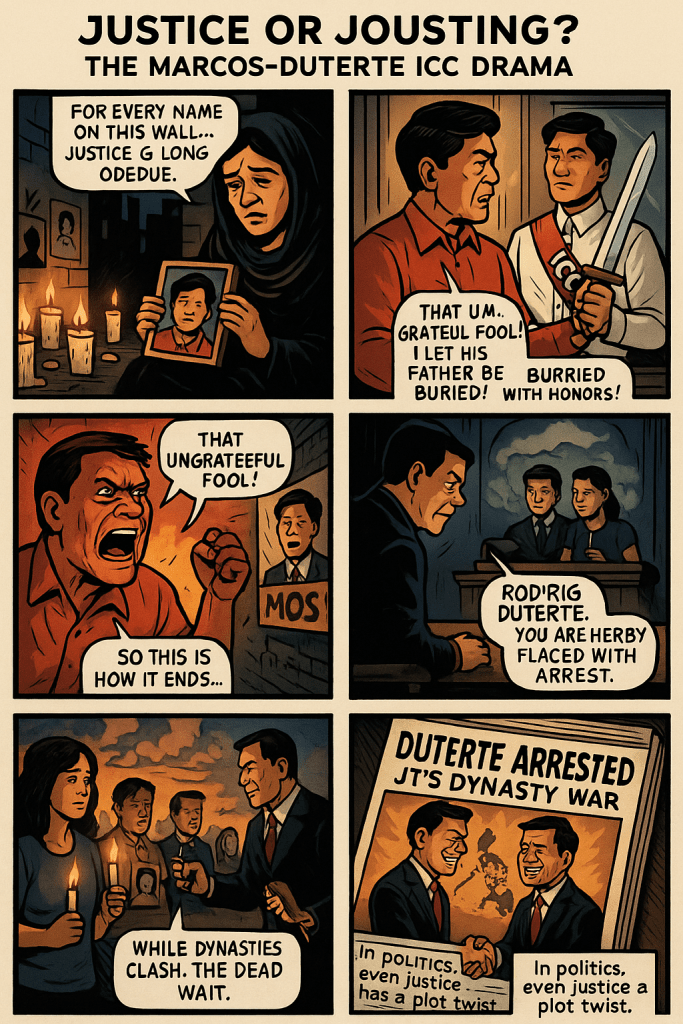
Dynastic Betrayal: A Game of Thrones in Manila
The Marcos-Duterte saga is a political bloodbath dressed as governance. Their 2022 UniTeam alliance—Marcos as president, Sara Duterte as vice president—crumbled by 2024 when Sara quit as education secretary Reuters: Marcos-Duterte Alliance Crumbles. Her chilling admission of ordering Marcos’ assassination if she were killed, coupled with Duterte’s drug-use accusations against Marcos, turned allies into enemies. Mayor Sebastian Duterte’s curses at Marcos during Davao’s Araw ng Dabaw on March 18, 2025, sealed the rift The Conversation: Duterte’s Arrest Shakes Dynastic Politics.
Duterte’s arrest, weeks before the May 2025 midterms, smells of strategy. The elections saw Marcos’ allies lose Senate ground while Dutertes held local strongholds BBC: Philippines Election Results. Sara’s July 2025 impeachment trial looms, with her camp accusing Marcos of orchestrating a vendetta. His podcast plea for reconciliation—“I need friends, not enemies” Reuters: Marcos Open to Reconciling—feels like a feint, not a truce. Like his father’s 1972 martial law, which crushed rivals under “order,” Marcos Jr. cloaks power plays in principle. The Dutertes’ lament—that Marcos betrayed their patriarch’s gesture of allowing Marcos Sr.’s burial—evokes a dynastic tragedy where loyalty is a myth.
Graves Unmarked: The Drug War’s Human Toll
For victims’ families, Duterte’s arrest is a faint hope amid unrelenting grief. Human Rights Watch estimates 6,000 to 30,000 deaths in the drug war, many from extrajudicial killings HRW: Duterte Arrested. Amnesty International recounts cases like Efren Morillo, a Manila shopkeeper shot by masked gunmen, his family denied justice Amnesty: Duterte’s ICC Appearance. The ICC’s focus on Duterte offers symbolic redress, but its narrow scope—crimes against humanity from 2011 to 2019—leaves police, vigilantes, and local officials untouched. Marcos’ failure to push domestic probes suggests a selective justice, appeasing global allies while shielding local power brokers.
The ICC’s impact risks being theatrical without systemic change. Kenya’s collapsed case against Kenyatta, derailed by witness tampering, warns of limits when states don’t fully cooperate JusticeInfo: ICC’s Performative Paradox. For families waiting in Davao’s shadows, justice remains a distant promise unless Marcos confronts the broader impunity.
A Nation Split, a Court on Trial: Public and Global Ripples
The Philippines is a house divided. Duterte’s Davao base hails him as a crime-busting hero, with X posts like Rigoberto Tiglao’s decrying a “sovereignty violation” . Human rights advocates, echoed by Richard Heydarian’s “Game of Thrones” quip, see a historic step . This mirrors class and regional divides, amplified by the midterms’ mixed results, which weakened Marcos’ Senate grip BBC: Election Results. Protests loom, signaling unrest if Sara’s impeachment fuels Duterte loyalists.
Globally, Duterte’s case is a litmus test for the ICC. Criticized for targeting African states, the court gains credibility by pursuing a non-African leader Reuters: Duterte’s Arrest Bolsters ICC. Yet, Duterte’s allies frame it as Western meddling, echoing African critiques Verfassungsblog: ICC Politicization. If Marcos’ cooperation is seen as a power grab, the ICC’s legitimacy could falter, turning a justice milestone into a geopolitical flashpoint.
Breaking the Cycle: A Roadmap Beyond Vengeance
To Marcos: Launch domestic trials for drug war perpetrators—police, vigilantes, officials—to counter “foreign interference” claims. Emulate South Africa’s Truth and Reconciliation Commission to foster transparency and heal divides.
To the ICC: Expand the probe to include lower-level actors, ensuring the case isn’t seen as a political hit. Clear jurisdictional communication, as in Kenya’s case, could blunt sovereignty critiques.
To the Public: Demand an independent ombudsman to oversee ICC cooperation, preventing future leaders from weaponizing international law. Amplify victims’ voices through civil society to keep justice human, not dynastic.
Justice or Score-Settling?
Marcos’ ICC gambit is a high-stakes dance of law, power, and betrayal. For every weeping mother in Davao, Duterte’s arrest offers a sliver of hope—but only if it transcends the Marcos-Duterte vendetta. The Philippines must choose: a future where the law lifts the powerless, or a cycle where dynasties wield it to bury rivals. Justice isn’t a headline; it’s a debt to the dead, demanding truth over trials.

- “Forthwith” to Farce: How the Senate is Killing Impeachment—And Why Enrile’s Right (Even If You Can’t Trust Him)

- “HINDI AKO NAG-RESIGN!”

- “I’m calling you from my new Globe SIM. Send load!”

- “Mahiya Naman Kayo!” Marcos’ Anti-Corruption Vow Faces a Flood of Doubt

- “Meow, I’m calling you from my new Globe SIM!”

- “No Special Jail for Crooks!” Boying Remulla Slams VIP Perks for Flood Scammers

- “PLUNDER IS OVERRATED”? TRY AGAIN — IT’S A CALCULATED KILL SHOT

- “Several Lifetimes,” Said Fajardo — Translation: “I’m Not Spending Even One More Day on This Circus”

- “Shimenet”: The Term That Broke the Internet and the Budget

- “We Did Not Yield”: Marcos’s Stand and the Soul of Filipino Sovereignty

- “We Gather Light to Scatter”: A Tribute to Edgardo Bautista Espiritu

- $150M for Kaufman to Spin a Sinking Narrative


 KWEBA ni BAROK
Leave a comment