
By Louis ‘Barok‘ C. Biraogo — May 23, 2025
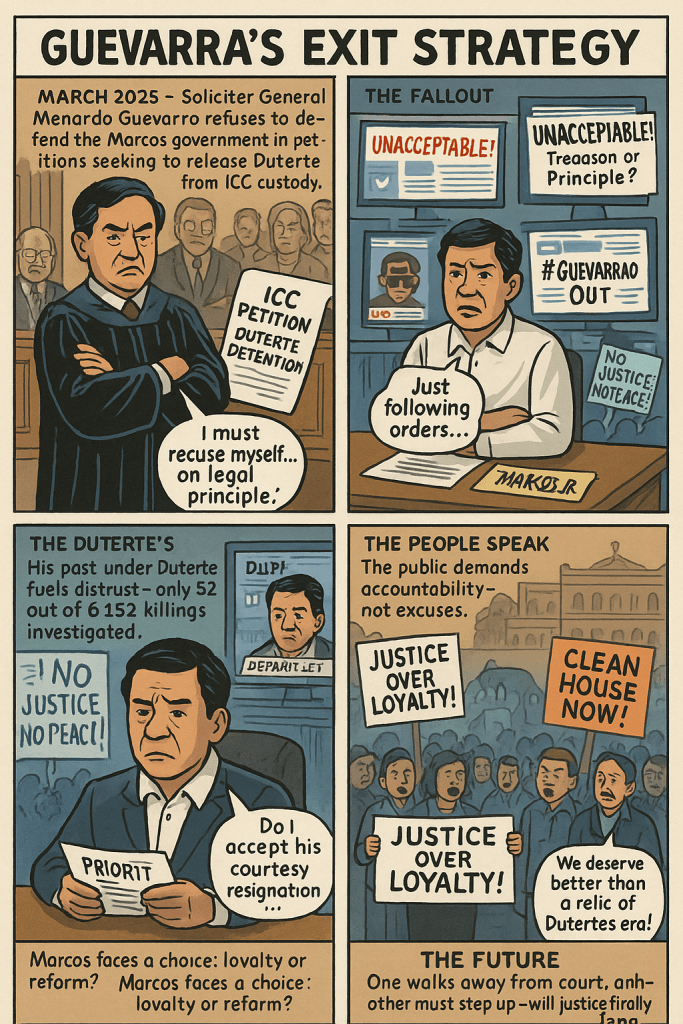
IN March 2025, Solicitor General Menardo Guevarra dropped a bombshell: he refused to defend the Marcos administration in Supreme Court petitions seeking to free former President Rodrigo Duterte from International Criminal Court (ICC) detention. Framed as a stand on legal principle, this recusal sparked outrage, with critics from legal giants to X users branding it a betrayal of his constitutional oath. Now, as Guevarra offers his courtesy resignation amid President Ferdinand Marcos Jr.’s post-election Cabinet shake-up, the Philippines faces a defining question: should Marcos sever ties with a skilled but divisive figure? In a nation battered by impunity, Guevarra’s sidestep isn’t just a legal maneuver—it’s a dangerous fracture in public trust that demands decisive action.
The Shadow of Scandal: Guevarra’s Troubled Tenure
Guevarra’s record as Solicitor General and former Duterte-era Justice Secretary is a battleground of competence and controversy. His March 2025 recusal from defending the government in habeas corpus petitions tied to Duterte’s ICC arrest is the epicenter of criticism. Retired Supreme Court Justice Antonio Carpio labeled his stance “untenable,” arguing that the Solicitor General must defend the government’s position, no exceptions. Senator Leila de Lima demanded his resignation, charging that his refusal undermines Marcos’s ICC cooperation. On X, @nolsricafort called it “nothing short of a betrayal of his sworn constitutional duty,” a sentiment echoing public fury. Philstar: Justice Carpio SolGen’s position has become untenable; GMA News: Amid decision to be recused De Lima urges Guevarra to resign; X: @nolsricafort
Worse, Guevarra’s past as Justice Secretary under Duterte fuels distrust. A House inquiry revealed a mere 52 of 6,252 drug war-related extrajudicial killings were investigated—a 0.8% prosecution rate that critics like @iMPACTPH2019 argue reeks of inaction or complicity. X user @IpeLustre even suggested Guevarra faces ICC indictment for allegedly covering up these killings. Accusations of bias also linger, with @datumx11 claiming Guevarra targeted de Lima in appeals against her acquittals, hinting at personal vendettas. A Court of Appeals order, noted by de Lima on X, further spotlighted his alleged misconduct in granting state witness status to criminals. X: @iMPACTPH2019; X: @IpeLustre; X: @datumx11; X: @manayleila
Yet, Guevarra’s defenders highlight his legal prowess. In May 2025, he secured a Supreme Court victory lifting the temporary restraining order on the No-Contact Apprehension Policy (NCAP), citing 833,097 traffic violations and rising accidents to argue for “traffic discipline.” But these wins pale against the perception that Guevarra dodges moral accountability, especially in human rights cases, leaving a legacy tainted by suspicion. Manila Bulletin: SolGen Guevarra to submit his courtesy resignation
Loyalty vs. Principle: The Resignation Debate
Case for Cutting Ties
Guevarra’s recusal fractures the administration’s unity at a critical moment. Marcos’s call for courtesy resignations, per the Philippine Daily Inquirer, was to “realign government with the people’s expectations” post-2025 midterms. Guevarra’s refusal to defend the government’s ICC stance signals disloyalty, clashing with Marcos’s mandate for cohesion. Public backlash on X, like @AlexBNFC’s call for resignation to preserve Guevarra’s legacy, reflects a view that his actions dishonor his office. Accepting his resignation lets Marcos appoint a Solicitor General aligned with ICC cooperation and free from Duterte’s shadow, signaling accountability to a public weary of excuses. Philippine Daily Inquirer: SolGen Menardo Guevarra to resign as ordered by Marcos; X: @AlexBNFC
Case for Keeping Guevarra
Guevarra’s legal expertise is a rare asset. A veteran of multiple administrations, his recusal—rooted in the OSG’s consistent anti-ICC jurisdiction stance—can be seen as principled, not disloyal. Marcos’s trust, affirmed by Malacañang’s March 2025 statement against seeking his resignation, underscores his value. The Manila Times noted Marcos’s reluctance to let him go, citing stability in ongoing cases like NCAP and ICC litigation. Replacing him risks disruption during a volatile post-election period. Philippine News Agency: PBBM still trusts SolGen says Palace; Manila Times: Marcos won’t let Guevarra go – Palace; Rappler: SolGen opts out of defending Marcos in Duterte petition vs ICC arrest
Still, contradictions cloud the picture. While Malacañang publicly backs Guevarra, The Manila Times reported Palace “twits” urging him to “assess himself,” hinting at unease. This mixed messaging reveals Marcos’s dilemma: balancing Guevarra’s skills against mounting public and political pressure. Manila Times: Palace twits SolGen on recusal
Sever the Cord: Why Marcos Must Act
Marcos must accept Guevarra’s resignation. The Solicitor General’s role is to be the government’s legal sword and shield, not a selective advocate who picks battles based on personal principles. Guevarra’s recusal, however legally defensible, broadcasts a devastating message: the nation’s top lawyer can opt out when it suits him. With only 52 of 6,252 drug war killings investigated, public trust in justice is already on life support. Guevarra’s Duterte-era ties and perceived foot-dragging amplify suspicions of shielding allies. Marcos cannot afford a Solicitor General whose actions fuel cynicism about accountability. Accepting the resignation would show the public that Marcos prioritizes justice over loyalty to a tainted figure, aligning with the post-election mandate for results, not excuses.
Rebuilding Trust: Blueprint for a New Solicitor General
The next Solicitor General must restore faith in the office. Marcos should prioritize:
- Ironclad Commitment to Justice: The appointee must fully back the government’s ICC cooperation, ensuring no recusal undermines Marcos’s human rights stance.
- Transparency on Human Rights: Public reporting on drug war investigations is essential to address the 0.8% prosecution rate and counter perceptions of impunity.
- Impartiality Without Agenda: The candidate must be free of bias allegations, unlike Guevarra’s perceived targeting of de Lima, to ensure fair legal representation.
- Spotless Ethical Record: A clean break from Duterte-era controversies is non-negotiable, signaling a new chapter of accountability.
A Nation’s Cry for Justice
The Philippines teeters on the edge of a reckoning. With the ICC probing Duterte’s drug war, the Solicitor General’s role is a beacon for justice—or a lightning rod for distrust. Guevarra’s expertise is undeniable, but his recusal and checkered past cast him as a relic of an era Marcos must transcend. By accepting his resignation, Marcos can affirm that no one—not even a legal luminary—is above accountability. The Philippines deserves a Solicitor General who champions the law, not loopholes, and fights for justice, not just for victory in court.

- ₱75 Million Heist: Cops Gone Full Bandit

- ₱6.7-Trillion Temptation: The Great Pork Zombie Revival and the “Collegial” Vote-Buying Circus

- ₱1.9 Billion for 382 Units and a Rooftop Pool: Poverty Solved, Next Problem Please

- ₱1.35 Trillion for Education: Bigger Budget, Same Old Thieves’ Banquet

- ₱1 Billion Congressional Seat? Sorry, Sold Out Na Raw — Si Bello Raw Ang Hindi Bumili

- “We Will Take Care of It”: Bersamin’s P52-Billion Love Letter to Corruption
- “Skewed Narrative”? More Like Skewered Taxpayers!

- “Scared to Sign Vouchers” Is Now Official GDP Policy – Welcome to the Philippines’ Permanent Paralysis Economy

- “Robbed by Restitution?” Curlee Discaya’s Tears Over Returning What He Never Earned

- “No Pressure” Luistro? The House Pork Bazaar Exposed
- “My Brother the President Is a Junkie”: A Marcos Family Reunion Special

- “Mapipilitan Akong Gawing Zero”: The Day Senator Rodante Marcoleta Confessed to Perjury on National Television and Thought We’d Clap for the Creativity



 KWEBA ni BAROK
Leave a comment