By Louis ‘Barok‘ C. Biraogo — May 23, 2025
THE voice on the podcast was calm, almost casual, as it uttered the words that could redefine a nation:
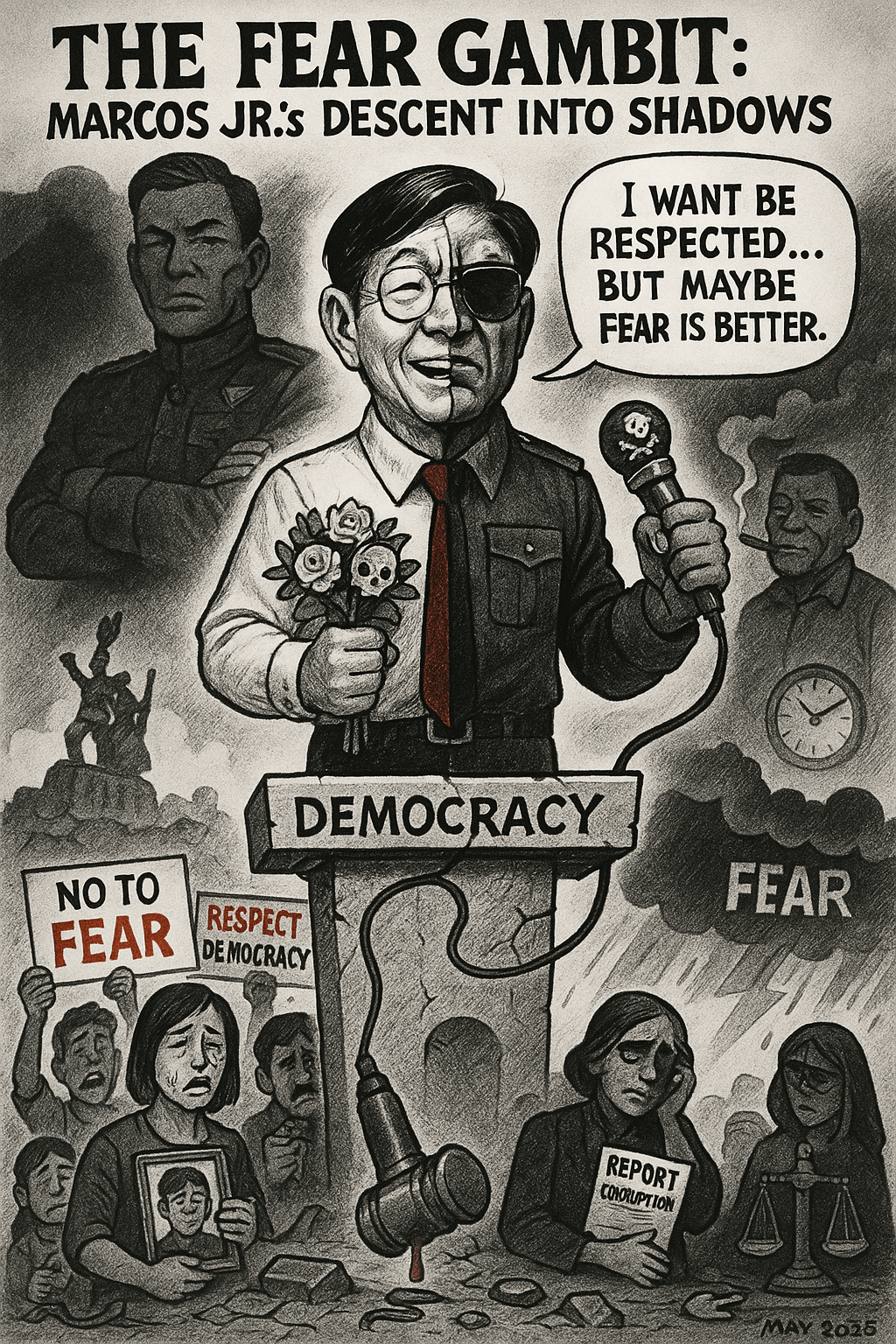
“I want to be respected, but maybe fear is better.“
In that moment, Philippine President Bongbong Marcos Jr. shed his carefully crafted ‘Mr. Nice Guy’ persona, revealing something far darker. It’s May 2025, and Marcos is wounded—bureaucratic paralysis, a crushing midterm loss, and whispers of weakness dog his administration. Now, with that one sentence, he’s invoking the specters of his dictator father and Duterte’s ruthless rule. The Philippines knows where this path leads. The only question is: Will the world pay attention before it’s too late?
A Nation Teetering: The Turbulent Backdrop of Marcos’ Pivot
Marcos Jr.’s presidency, now at its midpoint, is besieged by inherited chaos and fresh wounds. The Philippines battles entrenched corruption and bureaucratic paralysis, with the BTI 2024 Philippines Country Report decrying an “inefficient bureaucracy” and “weak institutional autonomy” that choke investment and governance. The May 2025 midterm elections, where Marcos’ allies secured only six of 12 Senate seats, exposed public frustration with sluggish services and soaring costs, slashing his approval rating from 45% to 30% between September 2024 and February 2025 Rappler, 2025. Tensions with the Duterte dynasty—marked by Vice President Sara Duterte’s impeachment and her father’s arrest by the International Criminal Court—further weaken his grip.
Marcos’ conciliatory image, a deliberate foil to Duterte’s iron-fisted rule, is now seen as a liability. Duterte’s “war on drugs” left 12,000 to 30,000 dead, often without due process Human Rights Watch, 2022. Yet, Marcos Jr.’s statement, delivered in the BBM Podcast, evokes his father’s martial law era (1972-1986), which jailed 70,000, tortured 34,000, and killed 3,240. The specter of fear-based rule casts a long shadow over his intentions.

Weighing the Scales: Can Fear Deliver, or Will It Destroy?
The Case for Fear: A Shortcut to Order?
Supporters argue that fear could jolt the Philippines’ lethargic governance into action. Bureaucratic delays, like stalled infrastructure projects and misallocated funds, thrive under Marcos’ leniency Philstar, 2025. Marcos himself lamented officials exploiting his kindness, suggesting fear could deter corruption and enforce discipline GMA News, 2025. His anti-drug policies, less brutal than Duterte’s but criticized for weak enforcement, could gain traction with a tougher stance. Duterte’s 82% approval in 2019 for his bloody drug war shows fear can resonate with a public craving decisive action. Marcos, reeling from electoral losses, may see fear as a way to project strength and deliver results.
The Case Against Fear: A Recipe for Ruin
Yet, fear’s allure is a trap. The Philippines’ history under Marcos Sr. proves its cost: martial law crushed dissent but sparked the 1986 People Power Revolution Inquirer, 2025. Duterte’s regime, with its extrajudicial killings, eroded democratic norms, leaving a legacy of impunity Human Rights Watch, 2022. UN reports note Marcos Jr.’s failure to address these abuses, while 42 media attacks since 2022 signal ongoing intimidation. The BTI 2024 report warns of “authoritarian leadership styles” undermining judicial independence and media freedom. Fear risks alienating civil society, as seen in Duterte’s fractured protests, and could inflame resentment among citizens like the Manila mother I met, whose son was killed in a 2017 drug raid, forever scarred by fear-based rule.
The Fallout: A Nation and Its Allies at Risk
Domestic Peril: Shattering Trust and Silencing Voices
Embracing fear could devastate public trust, already fragile after economic woes and Marcos’ midterm defeats. The Philippines’ vibrant civil society and media, battered under Duterte, face renewed threats. A judiciary stacked with Marcos appointees lacks the independence to check executive overreach East Asia Forum, 2024. Fear could silence whistleblowers and activists, stifling accountability. Picture a Davao teacher, too afraid to report local corruption—this chilling effect could paralyze civic engagement, undermining the democratic fabric.
Global Backlash: Alienating Democratic Allies
Internationally, Marcos’ shift threatens ties with Western allies like the United States, who see the Philippines as a democratic counterweight in Asia. His pro-U.S. stance, a break from Duterte’s China pivot, has earned goodwill, but fear-based governance could draw parallels to Modi’s India or Erdogan’s Turkey, where democratic erosion has strained relations. The BTI 2024 report notes Marcos’ weak human rights record, risking Manila’s credibility in ASEAN and beyond.
A Better Way: Reforms Over Repression
Marcos must reject fear and champion reforms that blend efficiency with accountability. First, depoliticize appointments to curb patronage, addressing the BTI 2024 report’s critique of presidential overreach in administrative posts. Second, boost transparency by publicizing anti-corruption measures, rebuilding trust without intimidation. Third, engage civil society through town halls or digital platforms, tapping the Philippines’ “youthful, global, and digital” energy. Duterte’s fear-driven failures—marked by resentment, not results—show the peril of coercion. A Manila vendor, whose brother vanished in a 2018 drug raid, told me, “Fear breaks us; we need leaders who listen.” Respect, rooted in empathy and accountability, is the harder but surer path.
Global Echoes: Marcos in the Populist Mirror
Marcos’ pivot mirrors global populist trends. Modi’s India, with its media crackdowns, scores poorly on BTI’s authoritarianism metrics, yet faces growing dissent. Duterte’s fear-based rule, while initially popular, fractured institutions. Marcos risks a similar fate: short-term gains undone by long-term unrest. The BTI 2024 report underscores that sustainable governance demands respect, not repression.
The Verdict: Democracy or Dictatorship?
Marcos stands at a precipice. His frustration with governance failures is real, but fear is a false savior. The Philippines, scarred by his father’s tyranny and Duterte’s bloodshed, cannot endure another era of intimidation. By choosing respect—through reforms, transparency, and dialogue—Marcos can honor the 1986 People Power legacy. Fear may tempt with quick fixes, but it risks his legacy and the nation’s soul. Will he lead with courage or cower to coercion? The world is watching, and Filipinos deserve a choice for freedom over fear.
Key Citations
- ABS-CBN News: Marcos Jr wants respect but considers fear more effective
- GMA News Online: Marcos on graft prefers fear over respect
- Philstar: Marcos at midterm considers fear better than respect
- Inquirer: Marcos on erring officials prefers fear to respect
- Human Rights Watch: Marcos Jr.’s contempt for Philippine press
- East Asia Forum: Marcos-Duterte power struggle in the Philippines
- BTI 2024 Philippines Country Report
- Rappler: Marcos’ reset message post-midterm election

 KWEBA ni BAROK
Leave a comment