
By Louis ‘Barok‘ C. Biraogo — May 24, 2025
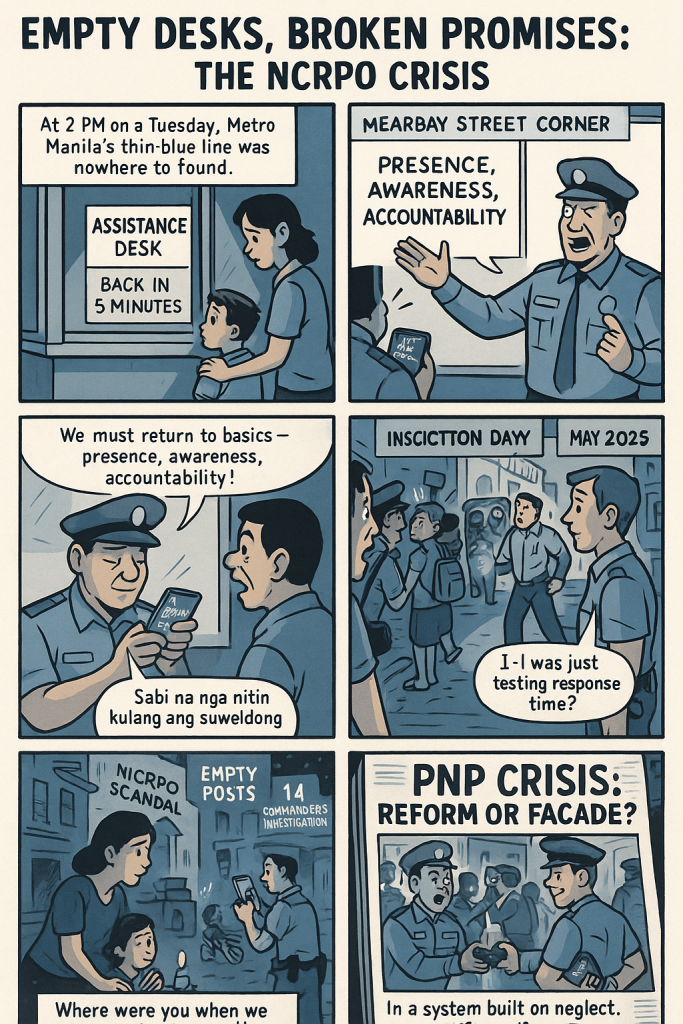
THE police assistance desk sits empty at 2 PM on a Tuesday afternoon in Quezon City. Down the street, another officer scrolls through mobile games while his post remains unmanned. This isn’t an isolated incident—it’s the norm that 13 million Metro Manila residents have learned to accept. But on May 17-18, 2025, surprise inspections by the National Capital Region Police Office finally pulled back the curtain on a public safety crisis that has been hiding in plain sight. With 14 commanders now under investigation and Major General Anthony Aberin promising a purge of negligent officers, the Philippine National Police faces a moment of reckoning that could determine whether millions of Filipinos can ever truly feel safe in their own city.
I. Unmasking a Broken System: The NCRPO’s Systemic Collapse
The NCRPO’s investigation into 14 commanders is a glaring symptom of deeper malaise within Philippine law enforcement. Metro Manila, the nation’s economic and cultural heart, mirrors the PNP’s chronic struggles: accountability deficits, eroded public trust, and a culture of impunity. Scandals like the 2020 “mañanita” fiasco, where then-NCRPO chief Debold Sinas flouted COVID-19 protocols, or 2024 extortion allegations tied to POGO raids, underscore a recurring pattern of misconduct. The Commission on Human Rights’ ongoing probes into police abuses further highlight an institution struggling to uphold its mandate.
The inspections’ focus on areas frequented by foreign nationals amplifies the stakes. Metro Manila’s tourism hubs, like Makati and Intramuros, are vital to the Philippines’ $8.6-billion tourism economy (2024 data). Unmanned posts in these zones not only deter visitors but signal a national security vulnerability, as lax policing could embolden criminal networks. For marginalized communities in places like Tondo or Payatas, the absence of police presence is even more dire. A mother in Quezon City, waiting at an empty PAD to report a robbery, embodies the human cost of this neglect—her safety sacrificed to a system that fails to show up.
II. Scandals at the Core: Leadership, Culture, and Hollow Promises
Aberin’s Vow: Reform or Damage Control?
Maj. Gen. Anthony Aberin’s promise to remove negligent commanders and institutionalize inspections carries moral weight but sidesteps the crisis’s scale. His “Triple-A Policy Strategy” (presence, awareness, accountability) and “Five Reminders” aim to enforce discipline, yet their failure to prevent widespread lapses—14 commanders across five districts—suggests a gap between policy and execution. Deploying junior officers to fill vacant posts is a Band-Aid on a deeper wound: a leadership structure that allowed complacency to fester under Aberin’s watch. His call that “discipline begins at the top” is apt, but the question remains: is he confronting systemic rot, or merely containing a crisis that reflects his own oversight failures? ABS-CBN News reports his firm stance, but public skepticism lingers.
Officers Adrift: A Culture of Games Over Duty
The image of officers playing mobile games on duty is a damning indictment of the NCRPO’s cultural decay. This isn’t mere distraction—it signals a profound lack of training, morale, and accountability. The PNP’s PHP2-billion modernization budget prioritizes equipment over ethics, leaving officers unprepared for the ethical demands of urban policing. Low salaries (PHP29,000 monthly for entry-level officers, or $500) and high-pressure environments breed disengagement, but the root issue is impunity. When commanders fail to supervise, and officers face no repercussions for neglecting duty, complacency thrives. Past scandals, like the 2024 POGO extortion case, echo this pattern of ethical lapses, pointing to a culture that tolerates misconduct.
“Back to Basics”: A Slogan Masquerading as Reform?
The PNP’s “back to basics” program, championed by chief Gen. Rommel Marbil, seeks to refocus officers on core duties like crime prevention. Aberin’s reliance on this framework during the inspections underscores its importance, yet the violations—unmanned desks, abandoned posts, distracted officers—expose its ineffectiveness. Without clear metrics, regular audits, or consequences, the program risks being mere rhetoric. GMA Network notes the program’s emphasis, but its failure to prevent such widespread lapses suggests a disconnect. For residents of Manila’s poorest barrios, this gap isn’t academic—it’s a daily threat to their safety.
III. The Human Toll: Vulnerable Communities Left Exposed
The NCRPO’s failures ripple through Metro Manila’s most vulnerable corners. In slums like Payatas, where crime thrives amid poverty, an unmanned PAD means no recourse for a vendor robbed at knifepoint. In tourist hubs like Intramuros, the absence of police deters visitors, threatening a tourism sector that employs millions. Public trust, already battered by years of scandals—from Duterte-era extrajudicial killings to recent extortion allegations—erodes further with each empty post. X posts from GMA News and ABS-CBN News, with thousands of views, amplify public outrage, reflecting a city fed up with a police force that prioritizes games over duty.
IV. Charting a Path Forward: Bold Reforms for a Failing Force
Immediate Fixes: Restoring Trust and Visibility
- Unpredictable Inspections: Expand surprise “red teaming” operations across all shifts, targeting PADs and crime-prone areas to keep officers vigilant.
- Transparency Dashboards: Launch a public online portal tracking patrol compliance, including PAD staffing and response times, to empower communities to demand accountability.
- Swift Accountability: Expedite investigations of the 14 commanders and 28 officers, ensuring due process but prioritizing removal of negligent personnel to deter future lapses.
Long-Term Overhaul: Rebuilding a Culture of Duty
- Ethics-First Training: Revamp PNP training with mandatory ethics and community engagement modules, using real-world scenarios to instill professionalism.
- Merit-Based Promotions: Link promotions to measurable outcomes like patrol compliance and community feedback, incentivizing commanders to prioritize supervision.
- Officer Welfare: Boost morale through higher salaries, mental health support, and reduced overtime, fostering pride in service.
Structural Change: Breaking the Cycle of Impunity
- Civilian Oversight Board: Create an independent civilian body, inspired by models in Canada or South Africa, to audit NCRPO operations and investigate misconduct. This could prevent scandals like the 2020 mañanita or 2024 POGO raid from escalating.
- Legislative Backing: Secure congressional funding to sustain oversight and training reforms, redirecting the PHP2-billion modernization budget toward human capital.
V. A Nation at a Crossroads: Can the PNP Rise to the Challenge?
The NCRPO’s crisis is not just about 14 negligent commanders or empty desks—it’s a litmus test for whether the Philippines can reform institutions crippled by complacency. Aberin’s pledges are a step forward, but without systemic change—rigorous training, transparent accountability, and independent oversight—the PNP will remain a force where officers choose games over duty. For the vendor in Tondo, the tourist in Makati, and the nation watching, the message is clear: a police force that fails to show up cannot be trusted to protect. The Philippines must seize this moment to rebuild not just its police, but the promise of a safer, more just society.

- ₱75 Million Heist: Cops Gone Full Bandit

- ₱6.7-Trillion Temptation: The Great Pork Zombie Revival and the “Collegial” Vote-Buying Circus

- ₱1.9 Billion for 382 Units and a Rooftop Pool: Poverty Solved, Next Problem Please

- ₱1.35 Trillion for Education: Bigger Budget, Same Old Thieves’ Banquet

- ₱1 Billion Congressional Seat? Sorry, Sold Out Na Raw — Si Bello Raw Ang Hindi Bumili

- “We Will Take Care of It”: Bersamin’s P52-Billion Love Letter to Corruption

- “Skewed Narrative”? More Like Skewered Taxpayers!

- “Scared to Sign Vouchers” Is Now Official GDP Policy – Welcome to the Philippines’ Permanent Paralysis Economy
- “Robbed by Restitution?” Curlee Discaya’s Tears Over Returning What He Never Earned

- “My Brother the President Is a Junkie”: A Marcos Family Reunion Special

- “Mapipilitan Akong Gawing Zero”: The Day Senator Rodante Marcoleta Confessed to Perjury on National Television and Thought We’d Clap for the Creativity

- “Just Following Orders” Is Dead: How the Hague Just Turned Tokhang’s Finest Into International Fugitives


 KWEBA ni BAROK
Leave a comment