Why Marcos Must Choose Integrity Over Loyalty
By Louis ‘Barok‘ C. Biraogo — May 25, 2025
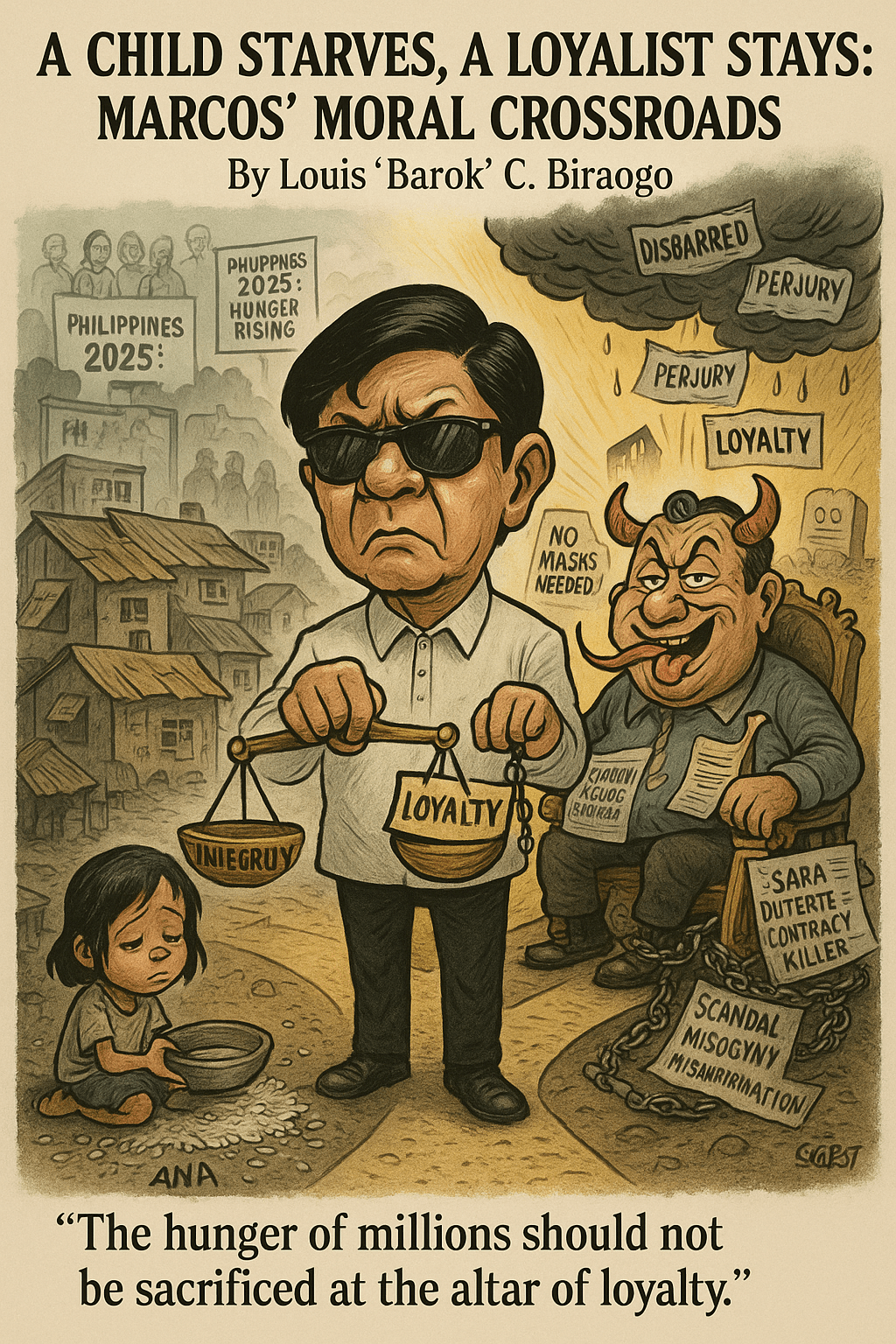
IN A cramped Manila slum, 10-year-old Ana clutches a bowl of watery porridge from the “Batang Busog, Malusog” feeding program, a flicker of hope in her hungry eyes. But the man behind the program, Larry Gadon—Presidential Adviser for Poverty Alleviation under Ferdinand Marcos Jr.—has a darker legacy. Just two years ago, Gadon unleashed a tirade of misogynistic abuse so vile that the Philippine Supreme Court disbarred him unanimously, calling his behavior “indisputably scandalous.” Ana deserves a meal, but she also deserves a government that doesn’t entrust her future to a man whose moral compass has long been shattered.
As a journalist who has been exposing the human cost of bad governance, I’ve seen how poverty demands not just policy but moral leadership. Gadon’s tenure, marred by scandal, misinformation, and political vendettas, betrays that principle. President Marcos, now navigating a 2025 cabinet reshuffle, faces a choice: cling to a polarizing loyalist or prioritize the millions like Ana who need real solutions. Retaining Gadon risks not only the administration’s integrity but the very fight against poverty itself. Marcos must act decisively—remove Gadon, replace him with a credible expert, and restore trust in a government that has too often failed its most vulnerable.
A Tenure Defined by Scandal, Not Solutions
Gadon’s appointment in June 2023 as Presidential Adviser for Poverty Alleviation raised eyebrows from the start. Just days after his swearing-in, the Supreme Court disbarred him for profane remarks against journalist Raissa Robles, a unanimous 15-0 ruling that underscored his history of misogyny. This wasn’t an isolated lapse: Gadon had already been suspended for spreading COVID-19 misinformation—claiming masks were ineffective—and for falsely alleging that former President Benigno Aquino III died of HIV/AIDS. In 2024, the Supreme Court found him guilty of gross misconduct for perjury, fining him ₱150,000. This is the man Marcos chose to lead the fight against poverty—a man whose own record embodies what I’ve often called “moral vacuity.”
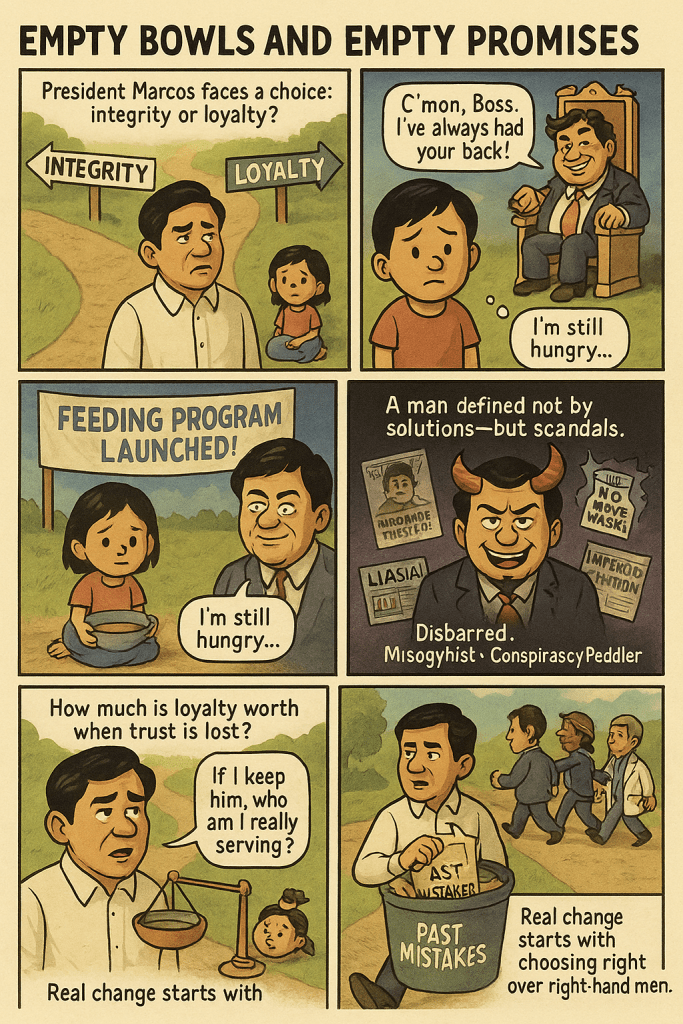
Gadon’s policy impact offers little redemption. His flagship “Batang Busog, Malusog” program aimed to tackle child malnutrition, a noble goal in a country where millions go hungry. Yet nearly two years later, there are no measurable breakthroughs. An X post on May 14, 2025, from user YesYesYo13 noted a “dramatic rise of self-rated poverty and hunger” during Gadon’s tenure, a sentiment echoing broader public discontent. While not a formal statistic, it reflects a stark reality: Gadon’s initiatives have failed to stem the tide of desperation. In a nation where 46% of families rated themselves poor in 2024, according to Social Weather Stations, the absence of progress under Gadon is a betrayal of the hungry children he was meant to serve. His legacy, as I see it, is one of empty plates and emptier promises.
Worse, Gadon’s partisanship undermines any claim to credibility. His role should be singular—alleviating poverty—but he has instead played political attack dog. In November 2024, he filed a disbarment case against Vice President Sara Duterte, alleging she made “contract killer” claims, following earlier impeachment campaigns against figures like Chief Justice Maria Lourdes Sereno. These actions reveal a man more interested in settling scores than solving hunger. Poverty alleviation demands focus, not vendettas. Gadon’s distractions mirror the elite hypocrisy Kweba ni Barok has long exposed—leaders who preach virtue while practicing vice.
The Cost of Keeping Gadon
Marcos’ 2025 cabinet reshuffle, initiated after the midterm elections, was meant to signal accountability. The President ordered courtesy resignations from all officials under his office, including Gadon, who complied on May 22 after initial resistance. Yet as of May 25, Gadon’s fate remains unclear. Retaining him would send a chilling message: misconduct doesn’t matter. The Palace has already defended Gadon once, arguing in 2023 that his role doesn’t require legal practice. But poverty alleviation isn’t just about technical qualifications—it’s about trust. How can Filipinos trust a government that elevates a disbarred lawyer with a history of lies and abuse to champion their cause?
Economists have warned that this reshuffle must prioritize “reform-oriented technocrats” to maintain economic continuity. Gadon is the antithesis of that vision. His polarizing presence distracts from the urgent work of poverty reduction, an opportunity cost the Philippines cannot afford. In sub-Saharan Africa, I’ve seen how programs like World Bicycle Relief—distributing bikes to cut school commutes—can transform lives with simple, focused interventions. In contrast, Gadon’s tenure offers noise: constitutional reform proposals that critics see as power grabs, impeachment crusades, and a feeding program with no proven impact. Marcos cannot rebuild trust while clinging to a figure who embodies distrust.
A Path Forward for Marcos
Marcos has a chance to correct this misstep, and he must seize it. First, Gadon must be replaced with a poverty expert untainted by scandal—an economist or NGO leader with a proven track record. The Philippines is home to countless advocates who have spent decades fighting poverty without resorting to misogyny or misinformation. They deserve a seat at the table.
Second, Marcos should order a transparent audit of the Office of the Presidential Adviser for Poverty Alleviation (OPAPA). Programs like “Batang Busog, Malusog” must be evaluated with data-driven metrics: malnutrition rates, school attendance, MSME growth. Filipinos deserve to know if their tax pesos are feeding children or fueling a loyalist’s ego.
Finally, Marcos must restore public trust by distancing himself from figures like Gadon. Through my investigative work, I’ve witnessed how leaders who overlook ethical breaches—such as the corrupt Cambodian officials I documented—undermine public trust in government institutions. Gadon’s retention risks a similar “disruption” to the Philippines’ economic and social progress. Marcos cannot claim to champion accountability while shielding a man who embodies its opposite.
Poverty Demands Moral Leadership
Ana, the girl in the Manila slum, doesn’t know Gadon’s name. She doesn’t know he was disbarred for cursing a journalist, or that he falsely claimed a president died of AIDS. But she feels the hunger his programs failed to ease. Her story, like that of Abel Moyo in a Lanseria shantytown dreaming of a bicycle, reminds us that poverty demands more than loyalty—it demands integrity.
Marcos has a chance to show the world that his administration values the poor over the powerful. Removing Gadon isn’t just a political necessity; it’s a moral imperative. Let Ana’s empty bowl be a wake-up call: the Philippines cannot afford to entrust its most vulnerable to a man who has already failed them.


 KWEBA ni BAROK
Leave a comment