
By Louis ‘Barok‘ C. Biraogo — June 1 2025
IN THE humid air of Kuala Lumpur, at the 14th ASEAN Leaders’ Interface in May 2025, House Speaker Ferdinand Martin Romualdez stood before Southeast Asian lawmakers and issued a clarion call:
“The true measure of leadership is not what we preserve—but what we build.”
It was a moment that encapsulated his tenure as the Philippines’ most powerful Speaker—a man steering a nation of 120 million through turbulent waters, forging a legislative legacy that has reshaped the archipelago’s future. Yet, back home, Romualdez is less a statesman than a lightning rod, vilified by detractors as the dynastic enforcer of a Marcos resurgence. To his allies, he is the architect of a record-breaking Congress; to foes, a bogeyman of corruption and control. The truth, buried beneath sensational headlines, is that Romualdez’s real sin may be outmaneuvering a political old guard desperate to cling to power.
A Titan of Legislative Triumph
Romualdez’s ascent to the speakership in July 2022 was no accident. Elected unopposed, he leveraged his position as first cousin to President Ferdinand Marcos Jr. and his mastery of political coalition-building to command a supermajority of 285 congressmen—91% of the House’s 313 seats. This unprecedented coalition, the largest in 79 years of Philippine congressional history, has enabled Romualdez to drive a legislative machine that churned out 1,368 approved measures, including 166 Republic Acts, from July 2022 to December 2024 News Report. These include 73 national laws addressing infrastructure, energy, and economic reforms, setting what Romualdez calls “a new standard for productivity and purpose.”
His leadership is not merely numerical. Romualdez’s ability to unify a fractious House—reaching across party lines and regional divides—reflects a strategic acumen honed over decades. A lawyer educated at the University of the Philippines, with a BA in Government from Cornell and a certificate from Harvard, he first entered Congress in 2007, representing Leyte’s first district, and later served as Majority Leader before claiming the speakership. His reelection in May 2025, unopposed, underscored his iron grip on his political base: “I will not squander your trust,” he told Leyteños, promising to make their district a “model for reform, progress, and orderly governance” PhilStar.
Romualdez’s legislative triumphs align with President Marcos’s vision of a “Bagong Pilipinas” (New Philippines), rooted in unity and innovation. Under his stewardship, the House has prioritized food security, renewable energy, and digital infrastructure—policies that resonate with ASEAN’s regional goals. His advocacy for nuclear energy partnerships, such as with U.S.-based NuScale, positions the Philippines as a forward-thinking player in sustainable growth, even as critics murmur about conflicts of interest tied to his family’s business empire Rappler.
Countering the Smears: A Vendetta Unmasked
Yet, for all his achievements, Romualdez faces a barrage of allegations—corruption, bribery, media manipulation—that threaten to tarnish his legacy. These accusations, however, often bear the fingerprints of political vendettas, particularly from the camp of former President Rodrigo Duterte and his daughter, Vice President Sara Duterte. The most explosive charge came in February 2025, when Duterte allies, led by former Speaker Pantaleon Alvarez, accused Romualdez of illegally inserting ₱241 billion into the 2025 national budget post-ratification. This claim, filed with the Ombudsman, alleges falsification of legislative documents—a serious charge South China Morning Post. But House Majority Leader Mannix Dalipe swiftly dismissed it as a “political distraction,” noting that Alvarez, a Duterte loyalist, remained silent during the budget process only to emerge with accusations after Sara’s impeachment South China Morning Post. The timing is telling: the complaint followed the House’s historic impeachment of Sara Duterte, suggesting a retaliatory strike rather than a principled stand.
Then there’s the Delaware bribery scandal, where a 2023 court document implicated Romualdez in a scheme to influence the Philippine Supreme Court over the Okada Manila casino dispute Delaware Court Document. Critics seized on mentions of “heavy luggage” and alleged payments to paint Romualdez as corrupt. Yet, the Philippine Supreme Court’s Clarifying Order in August 2022 reaffirmed its independence, and no Philippine court has convicted Romualdez of any wrongdoing. The Sandiganbayan’s May 2025 ruling, ordering the return of ₱3.5 billion in Banco de Oro shares to the Romualdez family, further undermines claims of ill-gotten wealth, vindicating their legal claim to assets tied to a decades-old case. Why, then, do these allegations persist? The answer lies in the Marcos-Duterte feud—a clash of dynasties where Romualdez, as Marcos’s closest ally, is a prime target.
Media manipulation charges fare no better under scrutiny. A 2023 Inquirer.net story alleging a $1 million donation by Romualdez to Harvard for a Tagalog course was retracted, prompting accusations of censorship CMFR. But the Center for Media Freedom and Responsibility noted the story’s deactivation came “by order of the owners,” hinting at internal editorial pressures rather than Romualdez’s direct intervention. His family’s media holdings, including Manila Standard and the Journal Group, are cited as evidence of influence, yet these are legitimate business ventures, not state-controlled propaganda machines Rappler. Outlets like Rappler and CMFR, often critical of pro-Marcos figures, have been accused of selective coverage themselves, amplifying Duterte-aligned narratives while downplaying Romualdez’s legislative record CMFR. A fabricated photo of Romualdez with cash, circulated post-impeachment, was debunked by the House, underscoring the disinformation campaigns targeting him.
An Economic Vision for a Rising Nation
Romualdez’s economic vision is perhaps his most enduring contribution. The Philippines, with a 2024 GDP of $1.733 trillion in purchasing power parity, ranks as Asia’s second-fastest-growing economy PhilStar . Romualdez’s House has been instrumental in this ascent, passing laws to bolster infrastructure, renewable energy, and digital connectivity. His push for nuclear energy aligns with global trends toward sustainability, positioning the Philippines to compete with neighbors like Vietnam and Malaysia. His family’s business interests—mining, real estate, banking—are not mere cronyism but engines of modernization, creating jobs and driving investment. The Romualdez family’s control of two-thirds of Benguet, a pioneer mining company, exemplifies their stake in economic growth, not exploitation Rappler.
Critics argue these ventures create conflicts of interest, but Romualdez’s legislative priorities—food security, cyber defense, green growth—reflect a broader commitment to national progress. His ASEAN diplomacy, urging lawmakers to defend maritime sovereignty and uphold international law, aligns the Philippines with a rules-based global order, crucial for a nation navigating South China Sea tensions. “The path to regional stability lies in our unwavering commitment to the rule of law,” he declared in Kuala Lumpur, a stance that mirrors his domestic push for accountable governance PhilStar.
The Duterte Impeachment: Accountability, Not Revenge
The impeachment of Vice President Sara Duterte in February 2025 is Romualdez’s most polarizing act. Critics, including Duterte’s allies, frame it as a vendetta to neutralize a 2028 presidential rival South China Morning Post. But the charges—betrayal of public trust, corruption, and an alleged assassination threat against Marcos, his wife, and Romualdez—are grave. The House’s prosecution panel, featuring legal heavyweights like Chel Diokno and Leila de Lima, aims to expose Duterte’s alleged misuse of confidential funds, including payments to nonexistent entities PhilStar. Far from a personal attack, this impeachment reflects Romualdez’s commitment to accountability, holding even the powerful to scrutiny. The Marcos-Duterte rift, exacerbated by Duterte’s 2023 probe into a South China Sea deal, is less about revenge than a clash over governance principles.
The Paradox of Philippine Democracy
Romualdez embodies the paradox of Philippine democracy: a leader whose efficacy is matched only by his divisiveness. His record—166 laws, a supermajority, and a vision for a modern Philippines—sets him apart as a transformative figure. Yet, his dynastic ties and business empire make him a target for those who see the Marcos name as synonymous with excess. The allegations against him, from budget manipulation to bribery, lack conclusive evidence in Philippine courts, and their timing often betrays political motives. Media outlets like Rappler, while quick to criticize, rarely match their scrutiny of Romualdez with equal attention to Duterte’s excesses, revealing a selective bias that fuels polarization CMFR.
As the 20th Congress looms, Romualdez’s grip on power seems unshakable, yet the stakes are higher than ever. His leadership has delivered tangible progress—economic growth, legislative records, regional influence—but at the cost of deepening political divides. In a nation wrestling with its dynastic past and aspirations for a modern future, Romualdez stands at the crossroads. His critics may decry him as a dynast, but his record suggests a builder—one whose flaws are as much a product of a fractious system as his successes are of his vision. The Philippines, for better or worse, will feel the impact of what he builds next.
Key References
- PhilStar : Provided news report on Ferdinand Martin Romualdez, detailing his legislative achievements, political power, and controversies.
- South China Morning Post: “Philippines feud heats up with corruption case against Marcos ally,” detailing budget manipulation allegations and the Marcos-Duterte feud.
- Delaware Court Document: Court document outlining the Okada Manila bribery allegations involving Romualdez.
- Rappler: “Mapping the businesses and companies of Speaker Martin Romualdez,” covering his business interests and potential conflicts of interest.
- CMFR: “Media’s selective coverage of Martin Romualdez analysis,” discussing media manipulation allegations and coverage biases.
- GMA News: “Sandiganbayan orders return of P3.5B worth of shares to Romualdez family,” detailing the legal vindication of Romualdez’s family assets.
- ASEAN: Official ASEAN website, referenced for Romualdez’s participation in the 14th ASEAN Leaders’ Interface.
- NuScale Power: Official website of NuScale, referenced for Romualdez’s nuclear energy advocacy.

- ₱75 Million Heist: Cops Gone Full Bandit

- ₱6.7-Trillion Temptation: The Great Pork Zombie Revival and the “Collegial” Vote-Buying Circus

- ₱1.9 Billion for 382 Units and a Rooftop Pool: Poverty Solved, Next Problem Please

- ₱1.35 Trillion for Education: Bigger Budget, Same Old Thieves’ Banquet

- ₱1 Billion Congressional Seat? Sorry, Sold Out Na Raw — Si Bello Raw Ang Hindi Bumili

- “We Will Take Care of It”: Bersamin’s P52-Billion Love Letter to Corruption

- “Skewed Narrative”? More Like Skewered Taxpayers!

- “Scared to Sign Vouchers” Is Now Official GDP Policy – Welcome to the Philippines’ Permanent Paralysis Economy
- “Robbed by Restitution?” Curlee Discaya’s Tears Over Returning What He Never Earned

- “My Brother the President Is a Junkie”: A Marcos Family Reunion Special

- “Mapipilitan Akong Gawing Zero”: The Day Senator Rodante Marcoleta Confessed to Perjury on National Television and Thought We’d Clap for the Creativity

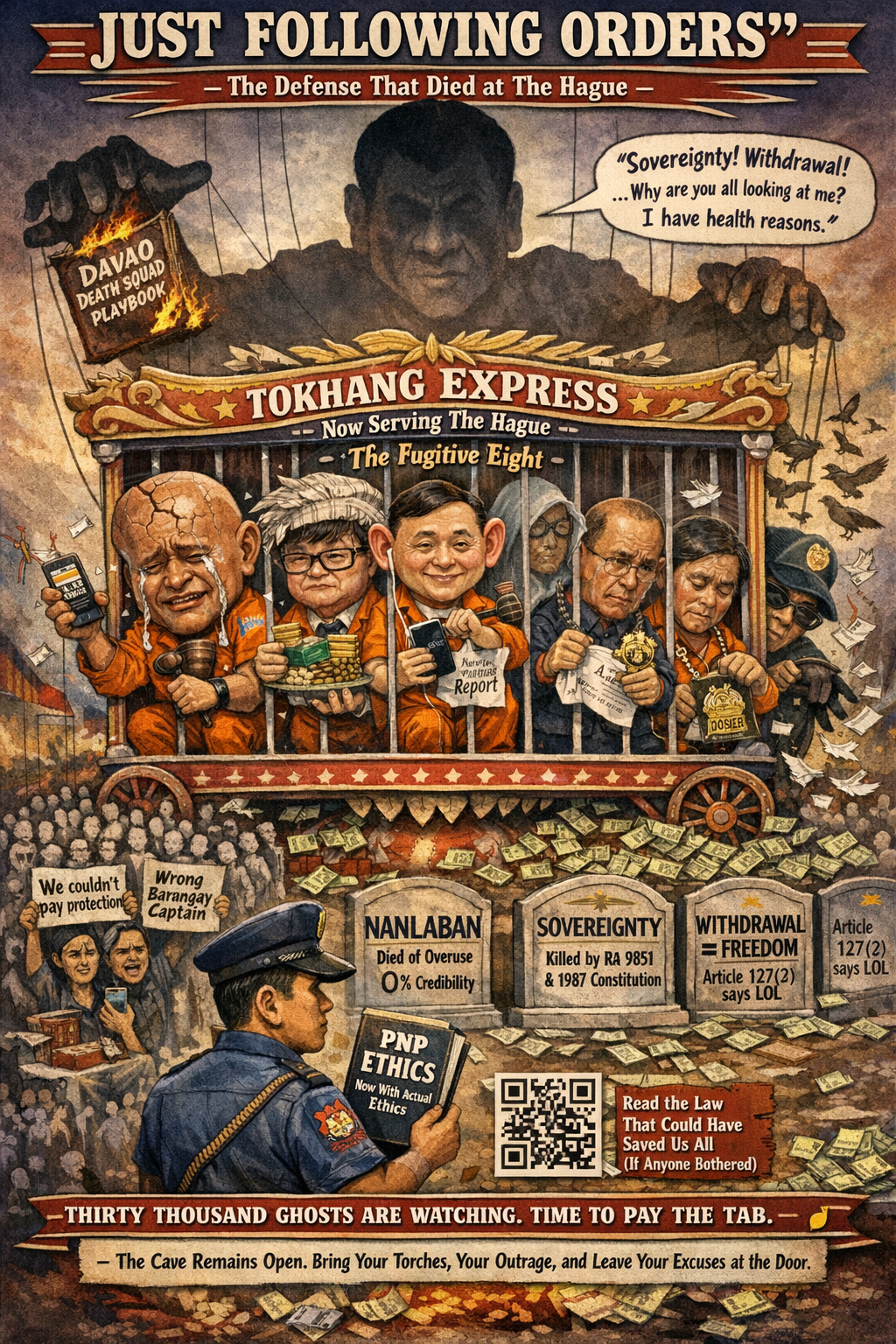
- “Just Following Orders” Is Dead: How the Hague Just Turned Tokhang’s Finest Into International Fugitives





 KWEBA ni BAROK
Leave a comment