
By Louis ‘Barok‘ C. Biraogo — June 2, 2025
THE impeachment of Vice President Sara Duterte teeters on a constitutional precipice, ensnared in a maelstrom of legal ambiguity and political brinkmanship. As the 19th Congress barrels toward its June 13, 2025, adjournment, the Senate faces a daunting question: can it carry the trial into the 20th Congress without shattering constitutional norms? With charges of betrayal of public trust, graft, and alleged assassination threats fueling a national firestorm, the stakes are seismic. This is no mere legal exercise—it’s a high-stakes constitutional thriller where the fate of a vice presidency, and perhaps the 2028 presidential race, hangs in the balance.
The Constitutional Time Bomb
The 1987 Constitution is the battleground for this crisis, with its provisions serving as both sword and shield. Article XI, Section 3(5) declares that “no impeachment proceedings shall be initiated against the same official more than once within a period of one year,” a safeguard against relentless political attacks. Duterte was impeached by the House on February 5, 2025, with a resounding 215 votes, clearing the one-third threshold (102 votes) required to initiate under Section 3(1). The Senate, vested with sole authority to try impeachment cases under Section 3(6), must secure a two-thirds vote (16 of 24 senators) for conviction—a verdict that would oust Duterte and bar her from public office forever.
But here’s where it gets tricky: the 19th Congress adjourns in 11 days, and the trial, delayed to June 11 by Senate President Francis Escudero, may not conclude in time Philippine News Agency, 2025. Atty. Romulo Macalintal warns that restarting the trial in the 20th Congress could be construed as a new proceeding, potentially violating the one-year bar. Duterte’s Supreme Court petition, a desperate “Hail Mary,” seeks to nullify the complaint on these grounds. If the Senate presses forward, will it trigger a constitutional crisis? Or will the Court, wary of Article XI, Section 3(7)’s declaration that Senate decisions are “final and executory,” refuse to intervene?
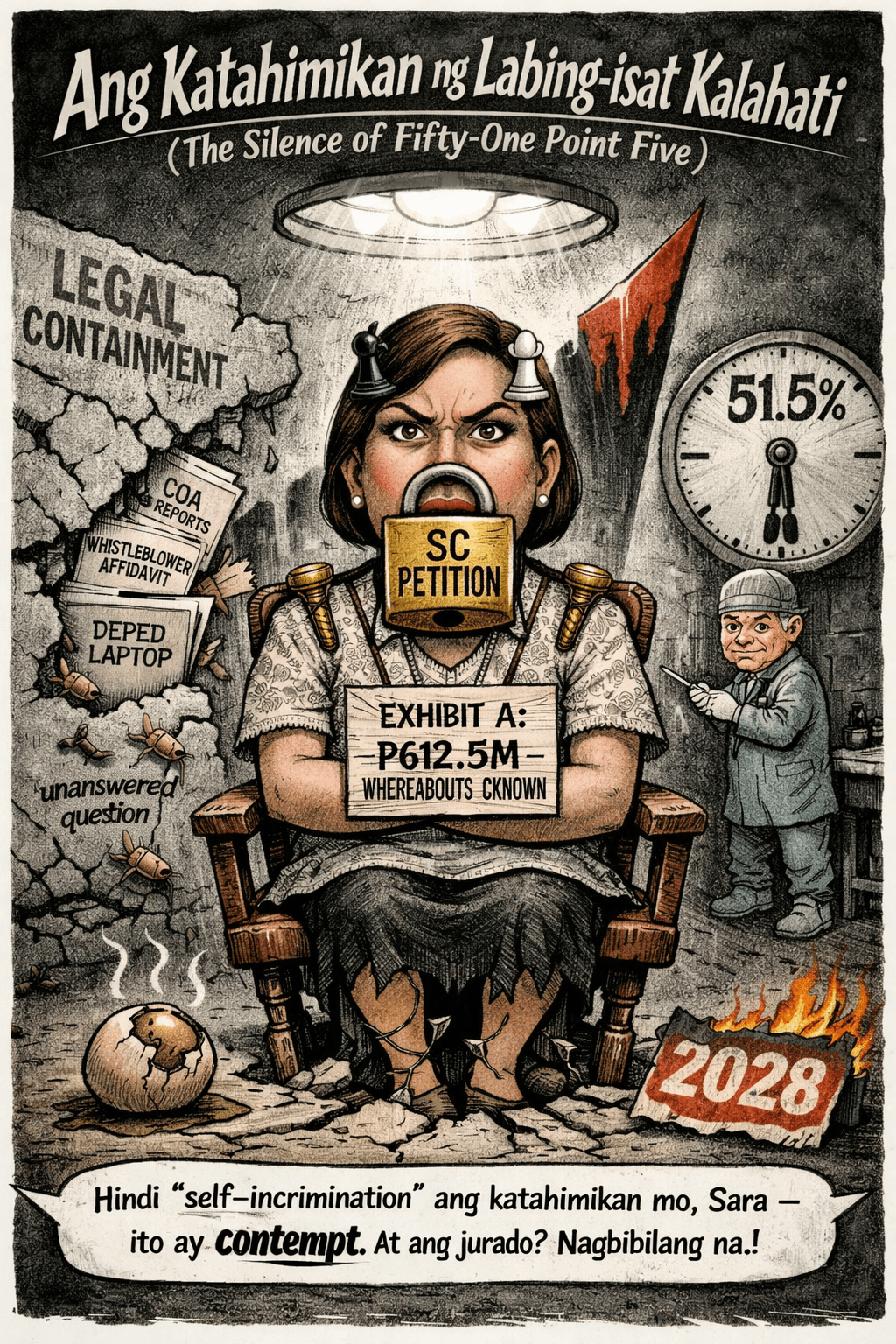
The charges are explosive. Duterte faces accusations of misusing ₱612.5 million in confidential funds from her time at the Department of Education and the Office of the Vice President, violating Republic Act 6713’s ethical standards for public officials, which demand integrity and transparency. More damning are her livestreamed remarks about hiring an assassin to target President Ferdinand Marcos Jr., First Lady Liza Marcos, and House Speaker Martin Romualdez—allegations framed as betrayal of public trust and high crimes. These charges, if proven, could ignite a political inferno, but their survival hinges on the Senate’s ability to navigate the congressional transition.
Senate vs. Itself
The Senate’s own rules are a legal landmine. Section 124, Rule XLIV states: “All pending matters and proceedings shall terminate upon the expiration of one Congress, but may be taken up by the succeeding Congress, as if presented for the first time.” Cited by Macalintal and Senator-elect Vicente Sotto III, this rule suggests the trial dies on June 13, 2025, unless the 20th Congress restarts it. But restarting it as a “new” proceeding risks colliding with the one-year bar, as Duterte’s camp argues it would constitute a second initiation.
Yet, the Senate’s role as an impeachment court complicates this. In Arnault v. Nazareno (1950), the Supreme Court described the Senate as a “continuing body” due to its staggered six-year terms, with only one-third of seats renewed biennially. This continuity, some argue, allows the Senate to carry impeachment trials across Congresses, distinct from legislative matters. House prosecutors like Rep.-elect Leila de Lima and Lorenz Defensor bolster this view, citing U.S. precedents where impeachment trials (e.g., Bill Clinton, John Pickering) spanned congressional terms without issue. They argue the Senate’s judicial function under Article XI, Section 3(6) supersedes Rule XLIV, as impeachment is not mere “pending business” but a constitutional mandate.
Duterte’s defense sees Rule XLIV as a guillotine. If the trial restarts, she could challenge the Senate’s jurisdiction, forcing a vote that would expose her support among senators. Needing just nine votes to block conviction, her allies, like Sen. Ronald dela Rosa, claim a “Duterte bloc” commands this threshold in the 20th Congress. A jurisdictional vote could become a political litmus test, revealing whether her base holds or crumbles.
The Shadow of Garcillano
The Supreme Court’s 2008 ruling in Garcillano v. House looms large. The Court held that unfinished legislative matters, including impeachment complaints, do not automatically carry over between Congresses, as each Congress is a distinct entity. This aligns with Balag v. Senate (2018), which clarified that pending proceedings terminate at a Congress’s end, requiring reintroduction. Applied to Duterte’s case, these precedents suggest the trial halts on June 13 unless the 20th Congress re-adopts the articles. But Francisco v. House (2003) defines “initiation” as the House’s filing and referral of a complaint, which occurred in February 2025. Since the Senate only tries cases, restarting the trial may not trigger the one-year bar, as no new House action is required.
This nuance is a double-edged sword. If the Senate restarts the trial, Duterte could argue it’s a de facto new proceeding, inviting Supreme Court scrutiny. Yet, the Court’s reluctance to review impeachment processes, rooted in Article XI, Section 3(7), may leave the Senate’s decision unchecked. Can the Senate defy its own rules to assert continuity? Will the Supreme Court break its silence on impeachment judicial review, risking a clash with the legislature? The answers could reshape Philippine constitutional law.
Political Dynamite
The impeachment is a political slugfest as much as a legal one. The collapse of the UniTeam alliance between Marcos and Duterte has turned allies into adversaries. Sandro Marcos, the President’s son, signed the impeachment complaint, signaling betrayal. Duterte’s resignation from Lakas-CMD and her inflammatory “bloodbath” remarks—demanding a trial she predicts will be chaotic—have escalated tensions Reuters, 2025. Her father, former President Rodrigo Duterte, detained in The Hague, retains a 63% trust rating Pulse Asia, 2025, bolstering her political capital.
Escudero’s postponement of the trial to June 11 is a tactical maneuver, squeezing the 19th Congress’s timeline Philippine News Agency, 2025. Critics like Senate Minority Leader Koko Pimentel argue it defies the Constitution’s “forthwith” mandate to try impeachment cases promptly. With only two days before adjournment, the delay could be a deliberate stall, giving Duterte’s allies time to rally or forcing the trial into the 20th Congress, where new senators might tilt the scales. A Social Weather Stations survey shows 89% of Filipinos want Duterte to face the charges, adding public pressure.
The 20th Congress introduces a wildcard: 12 new senators, potentially shifting the balance. Dela Rosa’s claim of nine-plus votes for acquittal suggests Duterte’s camp banks on loyalty from Mindanao and her father’s base. If she secures these votes, conviction becomes impossible. But a rushed trial risks due process violations—new senators joining mid-trial could face accusations of bias, undermining the verdict’s legitimacy under RA 6713.
Ethical and Procedural Landmines
The charges are a legal and ethical minefield. The alleged misuse of ₱612.5 million in confidential funds implicates RA 6713, which mandates transparency and accountability. House prosecutor Rep. Luistro’s probe into “ghost expenses” and cash envelopes paints a picture of systemic corruption. The assassination threat charge, stemming from Duterte’s livestream, is graver, potentially constituting a “high crime” under Article XI, Section 2. Yet, her defense could argue these remarks were hyperbolic, raising questions about intent and evidence.
Due process concerns loom. If the trial spills into the 20th Congress, new senators hearing only part of the evidence could compromise fairness. While the Constitution doesn’t mandate senator continuity, Francisco v. House (2003) emphasizes procedural integrity, warning against “chaos and theatrics.” Duterte’s call for a “bloodbath” trial risks turning a solemn process into a circus, potentially alienating senators and the public.
Blueprint for Stability
The Senate must act to avoid a constitutional quagmire:
- Clarify Senate Rules: Amend Rule XLIV to exempt impeachment trials from termination, aligning with Arnault’s “continuing body” principle.
- Uphold Procedural Integrity: Heed Francisco’s call to resist politicization. Rushing or stalling the trial undermines public trust, as seen in the 2001 Estrada impeachment crisis.
- Judicial Restraint: The Supreme Court should balance restraint with resolving constitutional ambiguities, avoiding a clash with the Senate.
Brink of History
With 11 days left, the 19th Congress races against its own expiration—and the fate of a vice presidency hangs in the balance. Will Duterte’s trial survive the constitutional gauntlet, or vanish into the abyss of Senate rules? As the clock ticks, the nation watches, breathless, for the next chapter in this legal thriller.
Key References
- 1987 Constitution of the Philippines, Article XI, Sections 2, 3(1), 3(5), 3(6), 3(7).
- Senate Rules, Section 124, Rule XLIV.
- Arnault v. Nazareno (G.R. No. L-3820, 1950).
- Garcillano v. House (G.R. No. 170338, 2008).
- Balag v. Senate (G.R. No. 234608, 2018).
- Francisco v. House (G.R. No. 160261, 2003).
- Republic Act 6713.
- Philippine News Agency: Senate to Start Duterte Impeachment Trial.
- Reuters: Philippines VP Duterte Challenges Impeachment.
- Pulse Asia: Trust Ratings Survey.
- Social Weather Stations: Public Opinion on Impeachment.
Ggg

- ₱75 Million Heist: Cops Gone Full Bandit

- ₱6.7-Trillion Temptation: The Great Pork Zombie Revival and the “Collegial” Vote-Buying Circus

- ₱1.9 Billion for 382 Units and a Rooftop Pool: Poverty Solved, Next Problem Please

- ₱1.35 Trillion for Education: Bigger Budget, Same Old Thieves’ Banquet

- ₱1 Billion Congressional Seat? Sorry, Sold Out Na Raw — Si Bello Raw Ang Hindi Bumili

- “We Will Take Care of It”: Bersamin’s P52-Billion Love Letter to Corruption

- “Skewed Narrative”? More Like Skewered Taxpayers!

- “Scared to Sign Vouchers” Is Now Official GDP Policy – Welcome to the Philippines’ Permanent Paralysis Economy

- “Robbed by Restitution?” Curlee Discaya’s Tears Over Returning What He Never Earned

- “No Pressure” Luistro? The House Pork Bazaar Exposed

- “My Brother the President Is a Junkie”: A Marcos Family Reunion Special

- “Mapipilitan Akong Gawing Zero”: The Day Senator Rodante Marcoleta Confessed to Perjury on National Television and Thought We’d Clap for the Creativity




 KWEBA ni BAROK
Leave a comment