By Louis ‘Barok‘ C. Biraogo — June 12, 2025
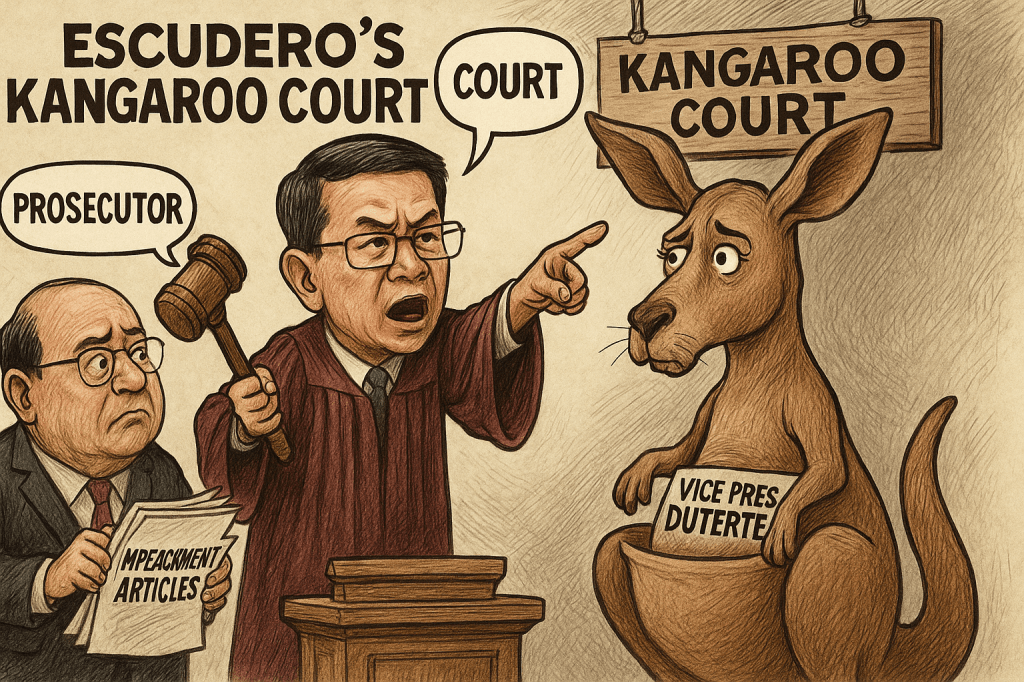
THE Senate’s decision to remand Vice President Sara Duterte’s impeachment articles back to the House of Representatives is not a mere procedural misstep—it’s a constitutional travesty, executed with the subtlety of a wrecking ball in a cathedral. Senate President Francis “Chiz” Escudero, donning the robes of a self-appointed judicial overlord, proclaims the Senate a “court” and the House a subservient “prosecutor,” demanding compliance in a move dripping with political chicanery. This isn’t justice; it’s a legislative slaughterhouse, where constitutional safeguards are gutted, and accountability bleeds out. Let’s dissect this farce with a constitutional scalpel, exposing the Senate’s overreach, ethical decay, and the existential threat to Philippine democracy.
Dismantling Escudero’s Assertions: A Hierarchy Built on Sand
The Hierarchy Myth—Senate as “Court,” House as “Prosecutor”
Escudero’s assertion that the Senate is “the court” and the House merely “the prosecutor” is a legal fiction so fragile it crumbles under the 1987 Constitution’s weight. Article XI, Section 3 clearly delineates roles: the House holds the “exclusive power to initiate all cases of impeachment” Sec. 3(1), while the Senate has the “sole power to try and decide” Sec. 3(6). These are co-equal functions, not a judicial hierarchy where the Senate reigns supreme over the House like a monarch over a peasant.
The Supreme Court’s ruling in Francisco v. House of Representatives (G.R. No. 160261, November 10, 2003) demolishes Escudero’s fantasy. Addressing the one-year bar on impeachment complaints, the Court affirmed the House’s initiation power as constitutionally sacrosanct, subject only to judicial review for grave abuse of discretion, not Senate oversight. The Senate doesn’t get to play constitutional gatekeeper, editing the House’s work like a professor red-penning a term paper. UP law professor Paolo Tamase hits the mark: remanding the case “violates constitutional structure” because the House and Senate are “constitutionally equal” despite distinct roles Rappler, June 11, 2025. Escudero’s attempt to elevate the Senate above the House isn’t just misguided—it’s a power grab cloaked in judicial pretense.
Kweba ng Katarungan – Sidebar
Remand Power: A Constitutional Overreach
The Senate’s unprecedented remand—demanding the House certify “no constitutional violations” and commit to pursuing the case in the 20th Congress—lacks any constitutional footing. Article XI, Section 3(6) mandates the Senate to “try and decide” impeachment cases, not return them for a rewrite. Rep. Ysabel Maria Zamora is unequivocal: “No remand exists in the Constitution” GMA News, June 11, 2025. This isn’t a suggestion; it’s a command, reinforced by the doctrine of expressio unius est exclusio alterius—the Constitution’s explicit grant of trial powers excludes invented powers like remanding.
Contrast this with Gutierrez v. House (G.R. No. 193459, February 15, 2011), where the Supreme Court refused to meddle in the House’s impeachment process against Ombudsman Merceditas Gutierrez, upholding the chambers’ distinct roles. The Court didn’t permit the House to be second-guessed, yet Escudero’s Senate assumes it can dictate terms, creating a “ping-pong” accountability void, as Tamase warns Rappler, June 11, 2025. This isn’t governance; it’s a legislative shell game, timed to stall justice until the 19th Congress expires on June 13, 2025, leaving Duterte’s trial in limbo.
Exposing the Senate’s Legal Hoax: A Constitutional Takedown
Procedural Violations: Ignoring “Try and Decide”
The Senate’s remand flouts Article XI, Section 3(6)’s mandate to “try and decide” impeachment cases. The Constitution doesn’t authorize the Senate to act as a constitutional auditor, returning the House’s work for revisions. House prosecutor Joel Chua calls dismissing or remanding without a trial “unconstitutional,” as the Senate’s duty is to conduct a full trial, not evade it Tribune, June 4, 2025. The 18-5 vote to remand, led by Duterte allies like Senators Ronald “Bato” dela Rosa and Alan Peter Cayetano, sidesteps this obligation, transforming the Senate into a political firewall rather than an impartial court.
The expressio unius principle leaves no room for ambiguity: the Senate’s powers are exhaustive, limited to trying and deciding. Remanding is a fabricated authority, akin to a judge rewriting the prosecution’s case instead of hearing it. Legal expert Dante Gatmaytan underscores that only the Supreme Court can review the House’s actions for constitutionality Rappler, June 11, 2025. By assuming this role, the Senate isn’t just overstepping—it’s trampling the separation of powers.
Due Process: Delay as a Weapon
The Constitution requires impeachment trials to proceed “forthwith” once articles are transmitted Article XI, Sec. 3(4). Escudero’s claim that a brief delay has “no negative effect” is a masterclass in denial. The remand, timed days before the 19th Congress ends, risks derailing the trial, as 12 senators’ terms expire on June 30, 2025, potentially resetting the process in the 20th Congress Rappler, June 10, 2025. This isn’t a hiccup; it’s a calculated stall.
In Carpio-Morales v. Binay (G.R. Nos. 217126-27, November 10, 2015), the Supreme Court stressed that timely resolution is a due process cornerstone, ensuring fairness and public trust. By remanding the case, the Senate violates this principle, leaving Duterte’s fate—and public accountability—in a constitutional purgatory. Issuing a summons to Duterte on June 11, 2025, only to follow with a remand, is a cruel tease, mocking the mandate for swift justice.
Ethical Bloodletting: The Senate’s Political Stench
Senator-Judges’ Bias: A Kangaroo Court in Maroon Robes
The Senate’s 18-5 vote reeks of bias, driven by Duterte loyalists like Senators Dela Rosa and Bong Go, who’ve pushed to dismiss or delay the case. Dela Rosa’s motion to junk the impeachment outright was a blatant prejudgment, violating the Code of Judicial Conduct’s impartiality standards (Canon 3, Code of Judicial Conduct). Senator-judges are sworn to act as impartial arbiters, yet Dela Rosa and Go’s actions scream advocacy. Their refusal to recuse themselves, despite clear allegiance to Duterte, echoes the ethical lapses during Joseph Estrada’s 2000 impeachment trial, which sparked the Second EDSA Revolution Wikipedia, Impeachment in the Philippines.
Christian Monsod, a 1987 Constitution framer, warned that draft resolutions to “kill” the trial—circulated before the Senate convened—betray bad faith Tribune, June 4, 2025. These senators aren’t judging; they’re rigging the process to shield their ally, turning the impeachment court into a political fortress.
Bad Faith: Escudero’s “Neutrality” Charade
Escudero’s claim of “neutrality” is laughable when 18 senators, many tied to Duterte’s political machine, voted to remand. Rappler labels this a “perilous precedent,” and they’re understating it—it’s institutional sabotage, cloaked in procedural jargon Rappler, June 11, 2025. The Senate’s demand that the House certify “no constitutional violations” is a trap, forcing the House to either admit fault or defy the Senate, both eroding its autonomy. This isn’t neutrality; it’s a power play to gut accountability, orchestrated by a Senate prioritizing political survival over constitutional duty.
Supreme Court Showdown: The Last Line of Defense
Judicial Review: A Certiorari-Worthy Abuse
The Senate’s remand is a certiorari-worthy abuse of discretion, ripe for Supreme Court intervention. In Estrada v. Desierto (G.R. No. 146710-15, March 2, 2001), the Court clarified that while impeachment is a political question, procedural violations are justiciable. The Senate’s unauthorized remand—lacking a constitutional basis—crosses this line, inviting the Court to strike it down. Dante Gatmaytan’s assertion that only the Supreme Court can judge the House’s actions reinforces this Rappler, June 11, 2025. The House prosecutors’ planned certiorari petition, hinted by Rep. Joel Chua, could force the Court to clarify the Senate’s boundaries, restoring constitutional order.
Precedent Risk: A Legislative Shell Game
Allowing the remand risks turning impeachment into a legislative ping-pong match, as Tamase warns. If the Senate can return cases at will, public officials could evade accountability indefinitely, bouncing between chambers until political winds shift. This dystopian future undermines Article XI, Section 1’s purpose: ensuring public officers are accountable. The Supreme Court must intervene to prevent this precedent from entrenching a system where elites dodge justice through procedural gamesmanship.
Recommendations with Teeth: Fighting Back Against the Farce
- House Rebellion: The House must reject the Senate’s remand, asserting its constitutional power to initiate impeachment. Defiance upholds its co-equal status and forces the Senate to fulfill its “try and decide” mandate. Rep. Zamora’s stance is a blueprint: call the Senate’s bluff and demand a trial GMA News, June 11, 2025.
- Supreme Court Petition: House prosecutors should file an expedited petition for certiorari and prohibition, challenging the remand as an unconstitutional overreach. Citing Francisco v. House and Gutierrez v. House, they can argue the Senate’s action violates the separation of powers. Time is critical with the 19th Congress’s end looming.
- Public Mobilization: The public must take to the streets, as during EDSA II, to demand accountability. Oposa v. Factoran (G.R. No. 101083, July 30, 1993) invokes “intergenerational justice,” framing this fight as a duty to future generations. Protests outside the Senate could pressure senator-judges to abandon their games. As X posts urge, “Tara na sa senado bukas!”—the people are ready .
Conclusion: A Democracy on the Brink
The Senate’s remand of Sara Duterte’s impeachment articles isn’t a procedural glitch—it’s a constitutional assault, driven by a Senate loyal to political alliances over the rule of law. Escudero’s “court vs. prosecutor” analogy is a farcical distortion, and the 18-5 vote exposes a Senate rotting from bias and bad faith. The House must stand firm, the Supreme Court must intervene, and the people must rise to defend the Constitution. Otherwise, impeachment becomes a hollow ritual, and accountability a fading dream, lost in the Senate’s maroon-robed farce.
Key Citations
- Constitutional Provisions:
- Supreme Court Cases:
- Francisco v. House of Representatives (G.R. No. 160261, November 10, 2003)
- Gutierrez v. House (G.R. No. 193459, February 15, 2011)
- Carpio-Morales v. Binay (G.R. Nos. 217126-27, November 10, 2015)
- Estrada v. Desierto (G.R. No. 146710-15, March 2, 2001)
- Oposa v. Factoran (G.R. No. 101083, July 30, 1993)
- News and Commentary:
- GMA News, “Escudero: House has to abide by impeach court’s order on VP Sara’s case,” June 11, 2025
- Rappler, “Remanding Sara impeachment articles to House unconstitutional — experts,” June 11, 2025
- Rappler, “Which senators voted to remand impeachment articles against Sara Duterte?,” June 10, 2025
- Tribune, “House prosecutors: Senate move to junk Sara impeachment is unconstitutional,” June 4, 2025
- Other Sources:
Disclaimer: This is legal jazz, not gospel. It’s all about interpretation, not absolutes. So, listen closely, but don’t take it as the final word.

- ₱75 Million Heist: Cops Gone Full Bandit

- ₱6.7-Trillion Temptation: The Great Pork Zombie Revival and the “Collegial” Vote-Buying Circus

- ₱1.9 Billion for 382 Units and a Rooftop Pool: Poverty Solved, Next Problem Please

- ₱1.35 Trillion for Education: Bigger Budget, Same Old Thieves’ Banquet

- ₱1 Billion Congressional Seat? Sorry, Sold Out Na Raw — Si Bello Raw Ang Hindi Bumili

- “We Will Take Care of It”: Bersamin’s P52-Billion Love Letter to Corruption

- “Skewed Narrative”? More Like Skewered Taxpayers!

- “Scared to Sign Vouchers” Is Now Official GDP Policy – Welcome to the Philippines’ Permanent Paralysis Economy

- “Robbed by Restitution?” Curlee Discaya’s Tears Over Returning What He Never Earned

- “No Pressure” Luistro? The House Pork Bazaar Exposed

- “My Brother the President Is a Junkie”: A Marcos Family Reunion Special

- “Mapipilitan Akong Gawing Zero”: The Day Senator Rodante Marcoleta Confessed to Perjury on National Television and Thought We’d Clap for the Creativity






 KWEBA ni BAROK
Leave a comment