
By Louis ‘Barok‘ C. Biraogo — June 15, 2024
RODRIGO Duterte, the self-styled “Punisher” of Manila, now pleads for mercy from the International Criminal Court (ICC), painting himself as a frail octogenarian too feeble to threaten justice. But can the Court trust a man who turned Philippine streets into killing fields, leaving over 6,200 dead in his brutal drug war? His appeal for interim release to an undisclosed country, unopposed by the prosecution, is a legal and moral tightrope. The Hague’s decision will test whether international law bends to the powerful or holds them accountable. Behind the legal filings lies a chilling calculus: one man’s freedom versus the cries of thousands of graves.
The Illusion of Impotence
Duterte’s defense, led by Nicolas Kaufman, leans heavily on Article 60 of the Rome Statute, which permits interim release if detention is unnecessary to ensure trial appearance, prevent obstruction, or stop further crimes. Kaufman argues Duterte poses no flight risk, won’t obstruct justice, and is unlikely to reoffend, citing his agreement to avoid public engagement, internet use, and contact beyond family. An undisclosed host country’s “advance and principled agreement” to monitor him supposedly seals the deal. Yet, this narrative unravels under scrutiny.
Duterte’s claim of diminished influence is a calculated lie. Elected mayor of Davao City in 2025, he retains a political machine that commands loyalty and fear. His drug war, which the ICC alleges killed over 6,200, was executed with ruthless efficiency, suggesting a man capable of wielding power even from afar. Article 58(1)(b), which justifies detention to prevent flight or obstruction, looms large. How can the ICC ignore the risk of a former president with a loyal base and a history of alleged witness intimidation? The prosecution’s non-opposition is deafeningly silent, raising questions of pragmatism or surrender. As one victim’s family stated in a public letter to the ICC, “He silenced us with bullets; now he seeks freedom with words” Human Rights Watch, 2025.
Contrast this with ICC precedents like Laurent Gbagbo and Jean-Pierre Bemba. Gbagbo, detained for seven years before conditional release in 2019, faced charges after his case weakened ICC, Gbagbo Case. Bemba’s 2018 release followed an overturned conviction ICC, Bemba Case. Both involved lesser charges or advanced proceedings, unlike Duterte’s Article 5 (crimes against humanity) case, where evidence—421 documents, nine photos, 16 hours of audio-video—points to murder, torture, and rape Manila Bulletin, 2025. Releasing an Article 5 defendant before charges are confirmed is unprecedented, risking a signal that the ICC bows to high-profile suspects.
The secrecy of the host country’s identity further erodes trust. While the ICC has release agreements with Belgium and Argentina ICC, Cooperation Agreements, the redacted filings obscure accountability. Without transparency, how can the Court ensure compliance with Article 58(1)(b)’s mandates? The defense’s assurances ring hollow against Duterte’s history of defiance, including the Philippines’ 2019 withdrawal from the Rome Statute Al Jazeera, 2019.
“He claims he’s powerless, yet his shadow still casts fear over Davao. The ICC must not mistake his age for innocence.”
– Drug war widow, testimony to Human Rights Watch, 2025
Justice on Probation
The defense’s humanitarian argument—Duterte’s age (80) and declining health—paints a sympathetic portrait, but it’s a smokescreen. ICC Rule 118(2) requires “exceptional circumstances” for pre-trial release, and age alone doesn’t suffice when weighed against 6,200 alleged murders. The Paul Gicheru case (2021) saw release for lesser Article 70 charges, not crimes against humanity ICC, Gicheru Case. International tribunals rarely grant such leniency for mass atrocities, as seen in the Slobodan Milošević case (ICTY), where health issues didn’t justify release ICTY, Milošević Case. Duterte’s team offers no concrete medical evidence, only vague claims of frailty. Is this a plea for compassion or a ploy to evade justice?
The prosecution’s non-opposition is a baffling contradiction. Their silence on Article 58(1)(b) risks suggests either confidence in the host country’s controls or a strategic retreat. Yet, the evidence—8,000 pages, videos, and photos—paints a damning picture of Duterte’s role as an “indirect co-perpetrator” in murders from 2011 to 2019 Philstar, 2025. Why not challenge a release that could embolden other strongmen? The Philippine government’s sudden cooperation, after years of ICC defiance under Duterte and Marcos Jr., smells of backroom deals Reuters, 2025. Who benefits from this shift? Marcos Jr.’s administration, keen to distance itself from Duterte’s legacy, may see his exile as a political win, but at what cost to justice?
“The prosecution’s silence is a betrayal of the dead. If they won’t fight for us, who will?”
— Anonymous victim’s mother, ICC submission, June 2025 Manila Bulletin, 2025
The Ghosts of Davao
The voices of drug war victims’ families are hauntingly sidelined. Testimonies submitted to the ICC describe ongoing threats from Duterte’s allies, with one widow reporting, “His men still watch us; his release will silence us forever” Human Rights Watch, 2025. These families, representing thousands killed in extrajudicial executions, argue that Duterte’s influence persists, mayor or not. The ICC’s failure to prioritize their safety risks further eroding trust in international justice. Article 68(1) mandates victim protection, yet the Court seems poised to prioritize one man’s comfort over collective trauma.
The broader stakes are existential. Releasing Duterte could signal the ICC’s weakness against powerful defendants, especially from the Global South, where the Court already faces bias accusations UNA-UK, 2018. Conversely, flexibility might show pragmatic justice, balancing rights with accountability. But without strict conditions—public host country disclosure, robust monitoring, and no-contact orders—the ICC risks complicity in Duterte’s potential to intimidate from afar.
The ICC’s Dilemma
The Court faces a high-stakes choice: uphold detention to affirm its resolve or grant release and risk appearing toothless. Political pressure is palpable. The Philippines’ cooperation suggests a deal, possibly to stabilize Marcos Jr.’s regime or secure international favor EconoTimes, 2025. Yet, the ICC’s credibility hinges on resisting such pressures. Denying release reinforces deterrence but may fuel narratives of Western bias. Granting it, without transparency, undermines the Court’s moral authority.
Recommendations
The ICC must navigate this minefield with precision:
- Demand Transparency: Require full disclosure of the host country’s identity and monitoring mechanisms to ensure compliance with Article 58(1)(b). Secrecy breeds distrust.
- Reject Age as a Blanket Excuse: Under ICC Rule 118(2), age alone isn’t “exceptional.” Demand medical evidence and weigh it against the gravity of 6,200+ deaths.
- Protect Victims: Impose strict no-contact orders and ensure the host country enforces them, safeguarding families under Article 68(1).
- Set a Precedent: Deny release unless risks are demonstrably negligible, signaling that Article 5 defendants face unwavering scrutiny.
Conclusion
Rodrigo Duterte’s plea for interim release is a test of the ICC’s soul. Will it uphold justice for the ghosts of Davao, or will it grant a warlord’s gambit for freedom? The prosecution’s silence and the host country’s secrecy cast shadows over the proceedings. The Court must act decisively, prioritizing transparency, victim safety, and the weight of 6,200 lives over one man’s claims of frailty. Anything less risks turning The Hague into a stage for the powerful to rewrite their sins.
“The ICC stands at a crossroads: will it chain the Punisher or hand him the key to walk free?”
– Kweba ng Katarungan, June 13, 2025
Key Citations
- Rome Statute of the International Criminal Court. United Nations Office of the High Commissioner for Human Rights, 1998.
- Duterte seeks ICC interim release; prosecution does not oppose. Manila Bulletin, June 13, 2025.
- Philippines’ Duterte seeks interim ICC release to undisclosed country. Reuters, June 13, 2025.
- Duterte requests ICC for temporary release. Philstar, June 13, 2025.
- Duterte Seeks ICC Interim Release to Third Country Citing Age, No Flight Risk. EconoTimes, June 13, 2025.
- ICC Pre-Trial Chamber A grants interim release to Paul Gicheru. International Criminal Court, February 2021.
- ICC, Gbagbo Case. International Criminal Court, 2011–2019.
- ICC, Bemba Case. International Criminal Court, 2008–2018.
- ICC, Cooperation Agreements. International Criminal Court.
- Philippines officially out of the International Criminal Court. Al Jazeera, March 17, 2019.
- ICC rejects Philippines’ appeal against Duterte drug war probe. The Diplomat, July 19, 2023.
- Rules of Procedure and Evidence. International Criminal Court, 2024.
- Slobodan Milošević Case. International Criminal Tribunal for the former Yugoslavia (ICTY).
- Human Rights Watch. Cited for victim testimonies, 2025.
Disclaimer: This is legal jazz, not gospel. It’s all about interpretation, not absolutes. So, listen closely, but don’t take it as the final word.

- ₱75 Million Heist: Cops Gone Full Bandit

- ₱6.7-Trillion Temptation: The Great Pork Zombie Revival and the “Collegial” Vote-Buying Circus

- ₱1.9 Billion for 382 Units and a Rooftop Pool: Poverty Solved, Next Problem Please

- ₱1.35 Trillion for Education: Bigger Budget, Same Old Thieves’ Banquet

- ₱1 Billion Congressional Seat? Sorry, Sold Out Na Raw — Si Bello Raw Ang Hindi Bumili

- “We Will Take Care of It”: Bersamin’s P52-Billion Love Letter to Corruption

- “Skewed Narrative”? More Like Skewered Taxpayers!

- “Scared to Sign Vouchers” Is Now Official GDP Policy – Welcome to the Philippines’ Permanent Paralysis Economy

- “Robbed by Restitution?” Curlee Discaya’s Tears Over Returning What He Never Earned

- “My Brother the President Is a Junkie”: A Marcos Family Reunion Special

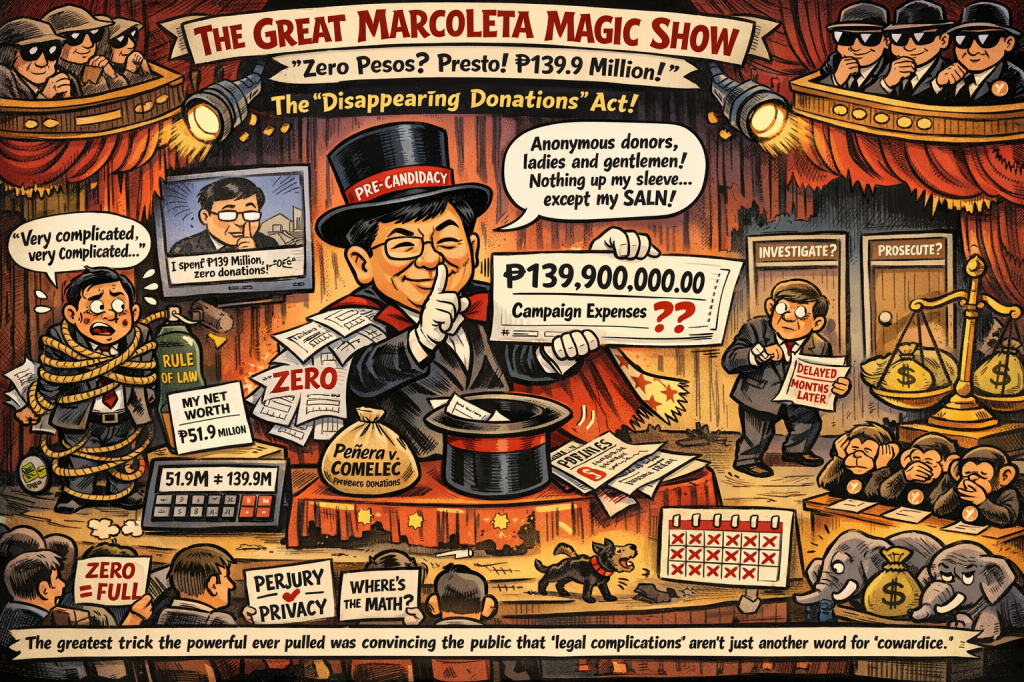
- “Mapipilitan Akong Gawing Zero”: The Day Senator Rodante Marcoleta Confessed to Perjury on National Television and Thought We’d Clap for the Creativity

- “Just Following Orders” Is Dead: How the Hague Just Turned Tokhang’s Finest Into International Fugitives


 KWEBA ni BAROK
Leave a comment