By Louis ‘Barok‘ C. Biraogo — June 17, 2025
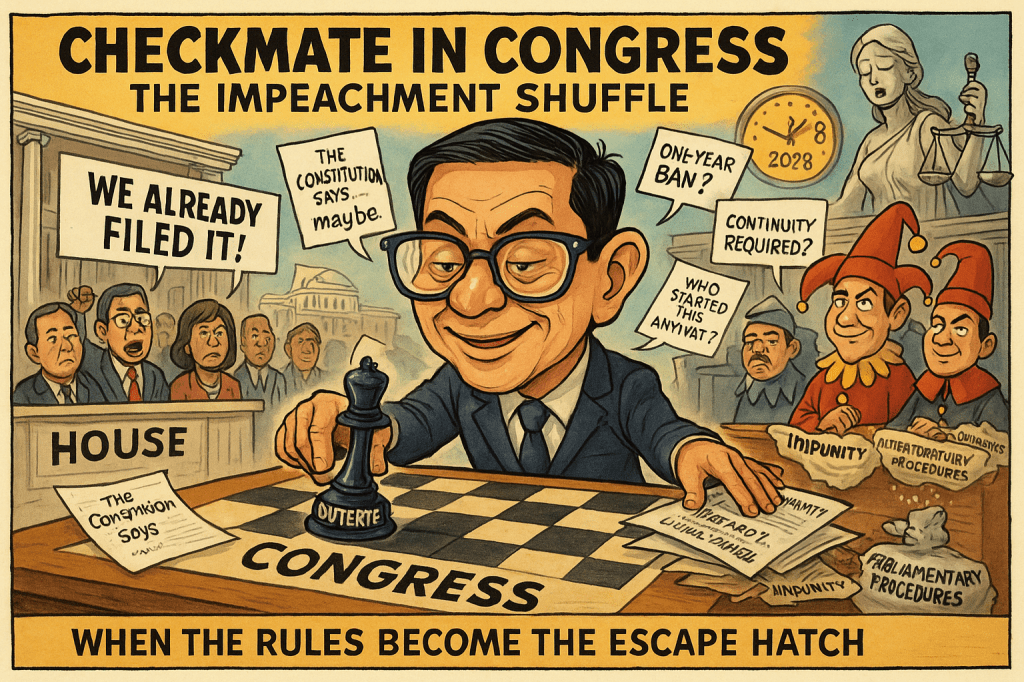
THE impeachment saga of Vice President Sara Duterte has erupted into a constitutional inferno, with Senate President Francis Escudero’s audacious moves sparking fierce debate. His decision to remand the articles of impeachment back to the House, draped in demands for certifications, teeters between procedural genius and outright sabotage. Below, we carve through the legal thicket, exposing every constitutional flaw, procedural sleight, and political power play with the precision of a scalpel and the intensity of a courtroom thriller.
1. Constitutional Chaos Unleashed: Is Escudero’s Play Legit or a Stall?
Senate President Escudero claims the 19th Congress cannot shackle the 20th Congress, demanding the latter certify its intent to pursue Duterte’s impeachment while the former confirms compliance with the one-year ban Article XI, Section 3(5). This move, cloaked in constitutional piety, raises a burning question: is it a safeguard of due process or a calculated delay to shield Duterte?
- Escudero’s Power Grab: He argues each House is a sovereign entity under Article VI, Section 1, and the 20th Congress must explicitly endorse the impeachment to reflect its mandate. This aligns with parliamentary norms where a new Congress isn’t bound by its predecessor, especially amid the Duterte-Marcos feud fueling this saga East Asia Forum.
- The Constitutional Counterstrike: The Constitution imposes no re-certification requirement. Francisco v. House (2003) establishes impeachment as a continuous process, with initiation at filing and referral. The Estrada impeachment’s seamless transition across terms reinforces this. Legal scholars like Paolo Tamase argue the remand usurps the House’s initiation power, violating the Constitution’s structure Rappler.
Verdict: Escudero’s demand for certification is a legal stretch, unsupported by precedent. It smells like a stall tactic, exploiting congressional transitions to delay justice.
2. Procedural Sabotage or Senate Prerogative? The Remand’s Dark Side
On June 10, 2025, the Senate, led by Senator Alan Peter Cayetano, voted 18-5 to remand the articles, citing “constitutional infirmities” AP News. This move clashes with Article XI, Section 3(6), which mandates the Senate “shall forthwith proceed” to try impeachment cases. Is this a legitimate exercise of Senate discretion or a deliberate derailment?
- Escudero’s Defense: The Senate’s “sole power to try” grants broad procedural leeway, including demanding certifications to ensure compliance with the one-year ban and the 20th Congress’s jurisdiction Philippine News Agency. Escudero frames this as a shield against constitutional flaws.
- The House’s Rebellion: Gutierrez v. House (2011) cautions against Senate overreach into the House’s initiation role. The “forthwith proceed” mandate implies urgency, not bureaucratic roadblocks. The Integrated Bar of the Philippines (IBP) and experts label the remand unconstitutional, arguing it delays the trial without legal basis Inquirer. The House’s refusal to accept the returned articles, pending clarification, signals a constitutional standoff AP News.
Verdict: The remand exploits an opaque area of Senate discretion but skirts the edge of unconstitutionality. By imposing unprecedented hurdles, Escudero risks turning the Senate into an impeachment gatekeeper.
3. One-Year Ban Smokescreen: A Flimsy Excuse to Delay?
Escudero’s fear that consolidating multiple complaints violates the one-year ban Article XI, Section 3(5) is a cornerstone of his remand rationale. But does this argument hold up under scrutiny?
- Escudero’s Alarm: Multiple complaints filed in December 2024 could be construed as multiple “initiations,” breaching the constitutional limit. He demands the 19th Congress certify compliance to clear the air.
- The Legal Reality: Francisco v. House (2003) defines initiation as the filing and referral of a complaint to the Committee on Justice. Only one complaint was endorsed on February 5, 2025, within the 10-session-day rule New York Times. The Office of the Solicitor General (OSG) and House prosecutors assert that consolidation into one proceeding complies with the Constitution Rappler.
Verdict: Escudero’s one-year ban concern is a distraction. The House’s process aligns with Francisco, rendering the certification demand a pretext for delay.
4. Ethical Landmines: Political Puppetry in the Senate?
The 18-5 remand vote, driven by Duterte allies like Senators Ronald “Bato” Dela Rosa, Christopher “Bong” Go, and Imee Marcos Rappler, raises a stench of political favoritism. Is the Senate protecting one of its own?
- Conflict of Interest Exposed: The dominance of Duterte-aligned senators in the vote undermines the Senate’s impartiality as an impeachment court. The Duterte-Marcos rift adds fuel to suspicions of bias East Asia Forum. Escudero’s insistence on formal “pleadings” and certifications piles on red tape, potentially stalling the process until Duterte’s term nears its end.
- Eroding Public Trust: Public protests for and against Duterte reflect a polarized nation Al Jazeera. If the Senate can derail impeachments through procedural tricks, it risks turning a constitutional safeguard into a partisan weapon.
Verdict: The remand’s optics scream political theater. While Escudero’s procedural demands are technically defensible, the Duterte-aligned voting bloc suggests a deeper agenda to shield the Vice President.
5. Doomsday Scenarios: What Happens if This Implodes?
If this constitutional standoff persists, the consequences could reshape Philippine democracy.
- Impeachment’s Death Knell: If the 20th Congress balks or the House rejects the remand, the impeachment could collapse, as seen in the Estrada trial’s abandonment post-EDSA II. This would render Duterte untouchable, signaling that procedural delays can neuter accountability.
- Supreme Court Showdown: Unlike the U.S., where Nixon v. U.S. (1993) deemed impeachment non-justiciable, Philippine courts are bolder. Gutierrez v. House (2011) shows judicial willingness to intervene in procedural violations. A House petition could force a ruling on the remand’s legality, but it risks dragging the judiciary into a political maelstrom.
- Public Uprising: With trust in institutions fraying, a stalled impeachment could ignite mass protests, as seen in January 2025 Al Jazeera. Failure to hold Duterte accountable could cement perceptions of elite impunity.
Verdict: A derailed impeachment would gut the Constitution’s accountability mechanisms. Supreme Court intervention is a risky but plausible path to resolution.
6. Taming the Constitutional Circus: A Path Forward
To break this deadlock, decisive action is needed:
- House Strategy: Call Escudero’s bluff. Submit a joint certification from the 19th and 20th Congresses, affirming compliance with the one-year ban and intent to prosecute. This forces the Senate to act or expose its obstruction.
- Senate Reform: Adopt explicit rules for cross-Congress impeachments, ensuring continuity and transparency. Recusal of biased senators would bolster credibility.
- Public Power: Mobilize through protests and media to demand accountability. A vigilant public can pressure both chambers to uphold the Constitution over partisan loyalties.
7. The Ticking Clock: Accountability on the Brink
Escudero’s remand is either a masterstroke of procedural caution or a constitutional crime dressed in legal jargon. By exploiting congressional transitions and demanding certifications, the Senate risks reducing impeachment to a hollow ritual. If this tactic prevails, no official will ever face true accountability. The Constitution’s checks and balances teeter on the edge, and the public watches as the clock ticks toward justice—or impunity.
Key Citations
- 1987 Philippine Constitution, Article XI, Section 3 and Article VI, Section 1.
- Francisco v. House of Representatives (2003).
- Gutierrez v. House of Representatives (2011).
- Inquirer: Escudero: 20th House must say if it still wants to pursue case, June 2025.
- Rappler: Senate Remanding Sara Duterte Impeachment Articles Unconstitutional, June 2025.
- Rappler: List of Senators Who Voted to Remand, June 2025.
- Rappler: House Defense Against Duterte’s Claim, February 2025.
- AP News: Senate Returns Duterte Impeachment Case, June 10, 2025.
- Inquirer: Senate Sends Back Impeachment Articles, June 2025.
- Philippine News Agency: Senate Remands VP Duterte Case, June 2025.
- New York Times: Duterte Impeached, February 5, 2025.
- East Asia Forum: Duterte’s Impeachment Spectacle, February 25, 2025.
- Al Jazeera: Protests Over Duterte Impeachment, January 31, 2025.
Disclaimer: This is legal jazz, not gospel. It’s all about interpretation, not absolutes. So, listen closely, but don’t take it as the final word.

- “Forthwith” to Farce: How the Senate is Killing Impeachment—And Why Enrile’s Right (Even If You Can’t Trust Him)

- “HINDI AKO NAG-RESIGN!”

- “I’m calling you from my new Globe SIM. Send load!”

- “Mahiya Naman Kayo!” Marcos’ Anti-Corruption Vow Faces a Flood of Doubt

- “Meow, I’m calling you from my new Globe SIM!”

- “No Special Jail for Crooks!” Boying Remulla Slams VIP Perks for Flood Scammers

- “PLUNDER IS OVERRATED”? TRY AGAIN — IT’S A CALCULATED KILL SHOT

- “Several Lifetimes,” Said Fajardo — Translation: “I’m Not Spending Even One More Day on This Circus”

- “Shimenet”: The Term That Broke the Internet and the Budget

- “We Did Not Yield”: Marcos’s Stand and the Soul of Filipino Sovereignty

- “We Gather Light to Scatter”: A Tribute to Edgardo Bautista Espiritu

- $150M for Kaufman to Spin a Sinking Narrative







 KWEBA ni BAROK
Leave a comment