By Louis ‘Barok‘ Biraogo — June 19, 2025
A Flicker of Hope in Pavia’s Darkness
In Barangay Aganan, Pavia, Maria Lunesa’s sari-sari store hums with fragile hope. Her refrigerator, vital for milk and sodas, often falls silent during ILECO I’s frequent outages. “When the power dies, my livelihood fades,” she murmurs, gazing at a new MORE Electric and Power Corporation pole rising against the Iloilo sky. A Supreme Court ruling last week, dated May 20, 2025, and received June 13, jolted this quiet town, affirming Republic Act No. 11918. The decision hands MORE Power, led by billionaire Enrique Razon Jr., the right to expand into 15 Iloilo towns and Passi City, challenging the grip of struggling electric cooperatives. For Maria, it’s a promise of light. But will this corporate surge deliver reliable power or merely swap one monopoly for another?
Constitutional Clash: Rewiring the Energy Landscape
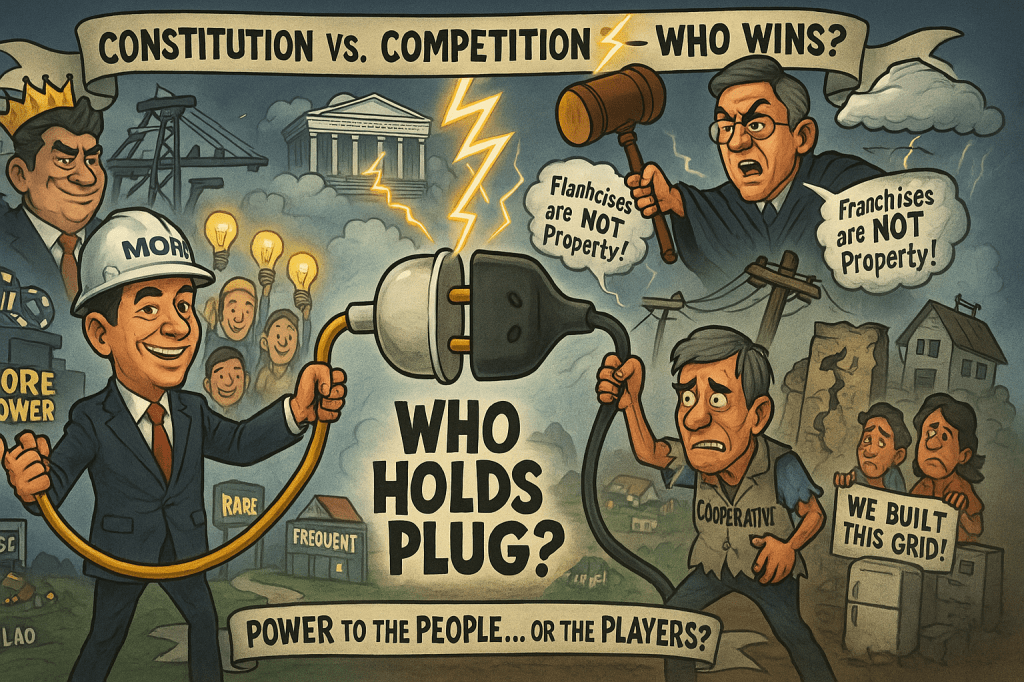
The Supreme Court’s decision (G.R. No. 264260, July 2024) is a legal lightning strike, reshaping Philippine energy policy through Article XII, Section 11 of the 1987 Constitution, which bans exclusive franchises for public utilities. Penned by Justice Rodil V. Zalameda, the ruling upholds RA 11918, expanding MORE Power’s reach into ILECO’s domain. “Franchises are state privileges, not private fiefdoms,” Zalameda declared, emphasizing competition as a cornerstone of consumer welfare under the Electric Power Industry Reform Act (EPIRA, RA 9136).
The ruling sparks a constitutional showdown: private property rights versus public necessity. ILECO I argued that RA 11918 effectively seizes their infrastructure—decades-old poles and substations—without due process. The Court countered that franchises are not property but legislative grants, subject to amendment for the public good. This logic mirrors the 2020 case MORE Power v. PECO (G.R. No. 248061), where the Court validated MORE’s expropriation of PECO’s assets to ensure uninterrupted service. Both rulings champion competition, but the 2025 decision pushes further, endorsing overlapping franchises—a bold step toward market-driven energy reform.
Eminent domain’s ethics crackle with controversy. RA 11212’s Section 10 empowers MORE Power to acquire assets for the “same public purpose” of electricity distribution, a move ILECO called a corporate overreach. The Court, citing public necessity, upheld this as constitutional, but Dean Nilo Divina has warned that delegating eminent domain powers to private entities risks conflating the public authority of the state with private commercial interests—raising serious constitutional and ethical questions Daily Tribune, 2024. Is this a pragmatic fix for failing grids or a risky precedent for corporate takeovers? The answer remains charged.
Roel Castro: The Mastermind Lighting Up Iloilo
Roel Castro, MORE Power’s president, is the dynamo behind this transformation. A UP Los Baños agribusiness graduate with an AIM management degree, Castro has rewired Iloilo City since 2020, slashing outages from 12 hours to 2-3 for maintenance and investing P2.5 billion in digital metering and SCADA systems Daily Tribune, May 2025. “Electricity is a catalyst for progress,” he told the Iloilo Economic Development Foundation in 2024, envisioning a “bamboo industry” to spark economic growth. His upgrades—serving nearly 100,000 customers with some of Visayas’ lowest rates—have won accolades from Iloilo City’s Mayor Jerry Treñas, who once criticized PECO’s “hazardous” infrastructure.
Castro’s phased expansion, starting in Pavia, leverages existing infrastructure for a swift rollout. His data-driven approach and collaboration with local governments, like Pavia’s 2024 resolution urging MORE’s entry, reflect a commitment to community needs. While his ties to Enrique Razon Jr. raise questions about corporate influence, Castro’s track record suggests a leader balancing technical prowess with public service.
The Stakeholder Showdown: Who Wins, Who Loses?
For Pavia’s residents like Maria Lunesa, MORE Power’s arrival is a beacon. “ILECO’s outages and high rates hurt my store,” she says, echoing a Pavia town council resolution urging swift action. MORE Power promises cheaper electricity and reliability, backed by advanced infrastructure. Yet, ILECO I fears obliteration. Serving 60,000 customers, the cooperative faces potential asset expropriation, threatening jobs and its community-owned model. “We’re not perfect, but we’re rooted in these towns,” manager Jose Redmond Roquios insists.
Enrique Razon Jr.’s shadow looms large. His port and casino empire, backed by reported political ties, fuels speculation about RA 11918’s rapid passage Philippine Star, 2022. The Energy Regulatory Commission’s (ERC) fast-tracked Certificate of Public Convenience and Necessity (CPCN) process, with a final hearing in June 2025, raises eyebrows. “The ERC seems overly accommodating,” notes energy analyst Ben Kritz Manila Times, 2025. Still, MORE’s legal counsel, Philippine Competition Commission Chair Arsenio Balisacan has emphasized that effective market competition empowers Filipino consumers by expanding their choices and improving the quality of goods and services available to them BusinessWorld, Nocember 2024.
Ethical Sparks: Energy Justice or Corporate Triumph?
The expansion tests energy justice—equitable access to power’s benefits. MORE Power’s lower rates could uplift urban centers like Pavia, but rural towns like Anilao risk neglect if profitable areas are prioritized. The UK’s Electricity Act 1989, which liberalized generation but preserved distribution monopolies, shows competition can lower urban prices while straining rural grids. Texas’s deregulated market, plagued by 2021’s blackout crisis, warns of volatility without oversight Texas Tribune, 2021. The Philippines’ hybrid model—competition within franchises—seeks balance but risks sidelining cooperatives serving remote areas.
The ERC’s independence is under scrutiny. Its swift CPCN process for MORE Power contrasts with ILECO’s claims of bias, hinting at regulatory capture. “The ERC must be a neutral arbiter,” Kritz argues. Without rigorous oversight, EPIRA’s rural electrification mandate could falter, leaving the poor in the dark.
A Call to Action: Forging a Rural Electrification Compact
This high-stakes drama is more than a legal duel; it’s a test of whether the Philippines can harness competition without sacrificing equity. MORE Power’s expansion could illuminate Iloilo with reliable, affordable electricity, but rural communities risk being left behind if cooperatives like ILECO collapse. A Rural Electrification Compact—mandating joint ventures between private utilities and cooperatives, with ERC-enforced rate caps and rural investment quotas—could ensure universal access. The question burns bright: will MORE Power’s surge light up Iloilo’s future, or cast long shadows over its rural heartland?
Key References
- Supreme Court of the Philippines, G.R. No. 264260, July 2024, and G.R. No. 248061, September 2020.
- 1987 Philippine Constitution, Article XII, Section 11.
- Electric Power Industry Reform Act (RA 9136), LawPhil.
- Rappler, “SC ruling allows Enrique Razon’s power firm to expand to Iloilo towns,” June 2025.
- Daily Tribune. MORE Energizes Iloilo s Transformation, May 2025.
- Daily Tribune, Dean Nilo Divina on eminent domain, 2023.
- BusinessWorld, Balisacan touts competition policy as tool for boosting economic efficiency Nocember 2024.
- Daily Guardian, RA 11918 legislative process, 2022.
- Manila Times, Ben Kritz on ERC oversight, 2025.
- UK Electricity Act 1989.
- Texas Tribune, 2021 blackout crisis, 2021.

- “Forthwith” to Farce: How the Senate is Killing Impeachment—And Why Enrile’s Right (Even If You Can’t Trust Him)

- “HINDI AKO NAG-RESIGN!”

- “I’m calling you from my new Globe SIM. Send load!”

- “Mahiya Naman Kayo!” Marcos’ Anti-Corruption Vow Faces a Flood of Doubt

- “Meow, I’m calling you from my new Globe SIM!”

- “No Special Jail for Crooks!” Boying Remulla Slams VIP Perks for Flood Scammers

- “PLUNDER IS OVERRATED”? TRY AGAIN — IT’S A CALCULATED KILL SHOT

- “Several Lifetimes,” Said Fajardo — Translation: “I’m Not Spending Even One More Day on This Circus”

- “Shimenet”: The Term That Broke the Internet and the Budget
- “We Did Not Yield”: Marcos’s Stand and the Soul of Filipino Sovereignty

- “We Gather Light to Scatter”: A Tribute to Edgardo Bautista Espiritu

- $150M for Kaufman to Spin a Sinking Narrative





 KWEBA ni BAROK
Leave a comment