By Louis ‘Barok‘ C. Biraogo — June 21, 2025
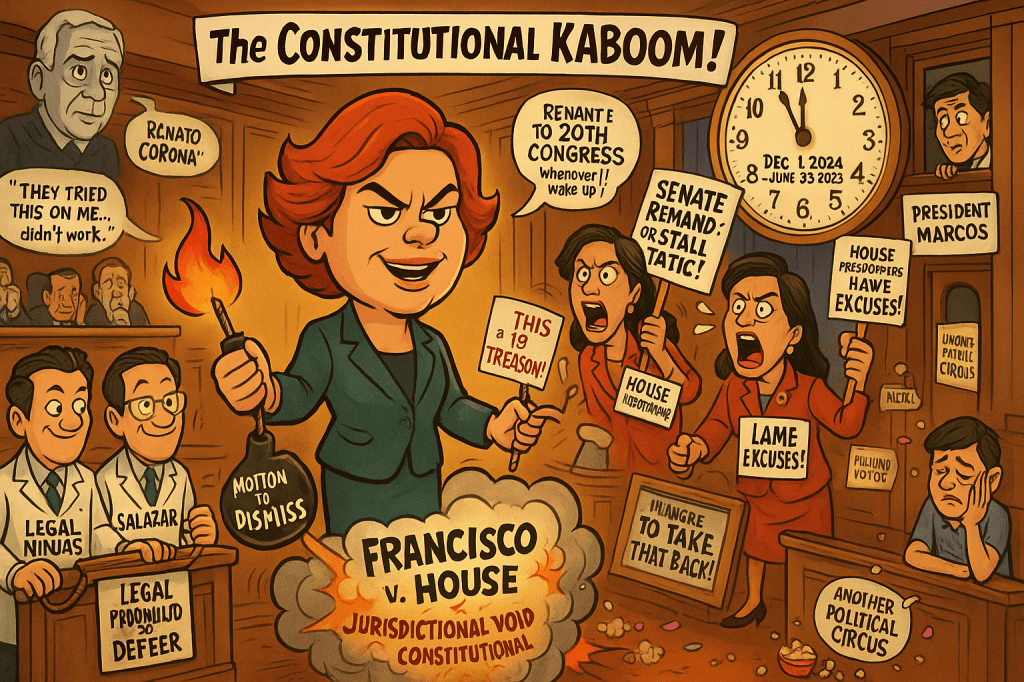
THE impeachment trial of Vice President Sara Duterte hangs by a thread, with her defense team, led by the battle-hardened Fortun Narvasa & Salazar, ready to detonate a motion to dismiss that could obliterate the entire proceeding. This isn’t a mere legal spat—it’s a constitutional powder keg, pitting the Senate’s ironclad authority against a defense strategy reeking of procedural warfare. Is this a cunning jurisdictional strike or a shameless dodge of the 1987 Constitution? Let’s rip into the fray.
Defense’s Kill Shot: A Motion to Shatter the Trial
Duterte’s legal sharpshooters are zeroing in on Article XI, Section 3(5) of the 1987 Constitution, the one-year rule, which bans impeachment proceedings against the same official more than once within a year.
Their gambit: the House’s blitz of four impeachment complaints from December 2024 to February 2025—capped by the fourth, backed by 240 lawmakers—violates this rule. The Supreme Court’s Francisco v. House of Representatives (2003) is their silver bullet, ruling that “initiation” begins with a verified complaint’s filing, not subsequent action. If the December 1, 2024, complaint started the clock, the later ones, including the trial’s trigger, are constitutional roadkill.
The House counters that the first three complaints were never “initiated” since they weren’t referred to a committee or voted on, leaving the fourth as a standalone, valid move under Article XI, Section 3(4). It’s a slick argument, but Francisco doesn’t hinge on committee action—the filing alone sets the timer. The defense’s motion is a precision strike, exploiting a constitutional gap that could gut the Senate’s jurisdiction.
Compare this to Chief Justice Renato Corona’s 2012 impeachment, where dismissal motions were swatted away like flies. The Senate barreled to trial, leaning on Article XI, Section 3(6)’s grant of “sole power to try and decide” impeachment cases. Corona’s pleas were ignored, signaling the Senate’s muscle to override procedural gripes. Duterte’s motion, though, wields the one-year rule as a potential game-changer, daring the Senate to defy a constitutional red line.
Sardonic jab: Nothing screams “justice” like an ad cautelam filing to cover your bases before you try to nuke the trial.
Senate’s Sneaky Sidestep: The Remand That Roars
The Senate’s June 10, 2025, decision to fling the impeachment articles back to the House is a jaw-dropping curveball. Demanding certification that only one complaint was filed within a year and a nod from the yet-to-exist 20th Congress, Senate President Chiz Escudero is brandishing his chamber’s dominance.
Article XI, Section 3(6) backs his swagger—the Senate’s trial power is absolute. But this remand is a first. No impeachment, from Estrada to Corona, ever saw articles yo-yoed back. Is this a legit procedural hurdle or a covert kill switch?
House prosecutors, led by Rep. Ysabel Zamora, and Antonio Bucoy, are livid, branding it a “functional dismissal” that spits on inter-parliamentary courtesy. Bucoy’s zinger—“lame excuses”—calls out the Senate for what looks like sabotage of the House’s exclusive impeachment initiation power under Article XI, Section 3(2).
The House’s refusal to accept the remanded articles sets the stage for a constitutional cage match, with the Senate treating its “co-equal” partner like a subordinate. The kicker? Demanding a manifestation from a non-existent 20th Congress is like asking for a dragon’s signature. This isn’t procedure—it’s a masterclass in political brinkmanship.
High-Stakes Drama: Persecution or Reckoning?
Duterte’s camp is milking the “political persecution” angle, framing the impeachment as a Marcos-orchestrated hit to crush a rival.
The charges—centered on the alleged misuse of P612.5 million in confidential funds and a supposed “kill plot” against the Marcos family—are juicy but contested. Duterte denies graft, insisting her remarks were twisted. Yet the House’s breakneck filing of multiple complaints reeks of a vendetta, flirting with the one-year rule’s spirit, if not its letter.
The Marcos-Duterte feud is pure political dynamite, turning impeachment into a spectacle. The House’s 240-signature blitz shows muscle, but the Senate’s remand hints at Duterte allies—like Senator Ronald “Bato” dela Rosa—angling for an escape hatch (source). This clash risks turning a constitutional check into a circus, eroding public faith in the process.
Final Showdown: Does the Motion Stand or Crumble?
Does Duterte’s motion have legs, or is it a desperate Hail Mary?
- Legally, it’s a heavyweight. The one-year rule, backed by Francisco, gives the defense a solid shot at proving the House’s complaint is a constitutional dud, potentially stripping the Senate’s jurisdiction (source).
- But the Senate’s near-absolute trial power and its history of brushing off dismissal motions—like in Corona’s case—suggest this could fizzle.
- The remand, while shady, isn’t a dismissal but a stall, keeping the trial on life support.
The Supreme Court could wade in, as it did in Sereno’s 2018 quo warranto ouster, but impeachment is political turf, and Francisco shows the Court only steps in for glaring constitutional breaches. The one-year rule might justify intervention, but overreach could spark a crisis.
Ethical alarms are blaring. Senators like Dela Rosa, already hinting at bias, taint the trial’s credibility. While the Code of Judicial Conduct doesn’t bind senator-judges, public trust demands fairness. Dela Rosa’s prejudgment is a stain on a process already wobbling.
Recommendation
The Senate should reject the motion and dive into trial, hashing out the one-year rule in open debate. If the jurisdictional flaw holds, acquittal can settle it. The Supreme Court should sit tight unless the Senate goes rogue. Anything else risks weaponizing impeachment into a political cudgel.
Duterte’s motion isn’t just a legal play—it’s a Molotov cocktail aimed at the impeachment’s core. The Senate’s next move will decide if this constitutional showdown burns out or blazes on. The clock’s ticking, and the nation’s watching.
Key References
- 1987 Constitution, Article XI: Link
- Francisco v. House of Representatives (2003): Link
- Senate Remand of Impeachment Articles: Link
- House Prosecutors’ Response: Link
- Corona Impeachment: Link
- Corona Dismissal Motion: Link
- Marcos-Duterte Feud Context: Link
- Duterte’s Defense Claims: Link
- Sereno Quo Warranto: Link

- “Forthwith” to Farce: How the Senate is Killing Impeachment—And Why Enrile’s Right (Even If You Can’t Trust Him)

- “HINDI AKO NAG-RESIGN!”

- “I’m calling you from my new Globe SIM. Send load!”

- “Mahiya Naman Kayo!” Marcos’ Anti-Corruption Vow Faces a Flood of Doubt

- “Meow, I’m calling you from my new Globe SIM!”

- “No Special Jail for Crooks!” Boying Remulla Slams VIP Perks for Flood Scammers

- “PLUNDER IS OVERRATED”? TRY AGAIN — IT’S A CALCULATED KILL SHOT

- “Several Lifetimes,” Said Fajardo — Translation: “I’m Not Spending Even One More Day on This Circus”

- “Shimenet”: The Term That Broke the Internet and the Budget

- “We Did Not Yield”: Marcos’s Stand and the Soul of Filipino Sovereignty

- “We Gather Light to Scatter”: A Tribute to Edgardo Bautista Espiritu

- $150M for Kaufman to Spin a Sinking Narrative







 KWEBA ni BAROK
Leave a comment