By Louis ‘Barok‘ C. Biraogo — June 20, 2025
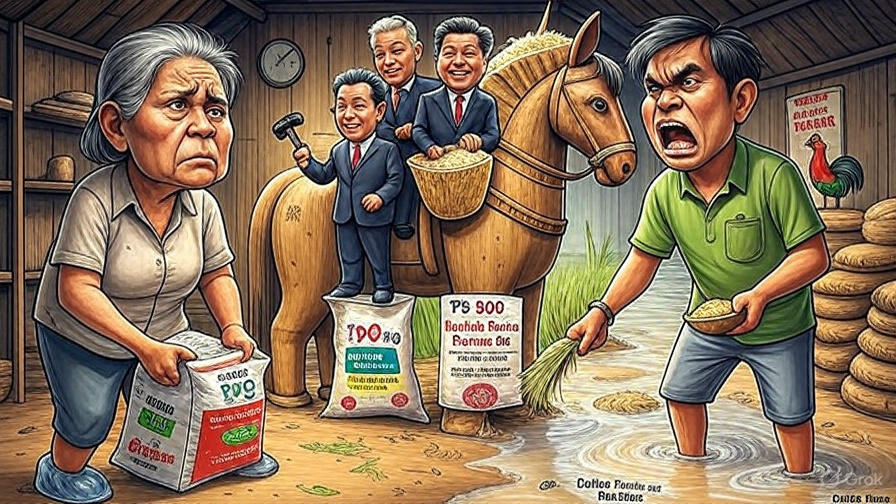
IN THE Philippines, rice is more than food—it’s a lifeline, a cultural cornerstone, and a political lightning rod. The government’s P20/kg “Benteng Bigas Meron Na” (BBM Na) program promises affordability for the poor, yet it unfolds against a backdrop of stark contradictions. As of May 2025, rice prices have plummeted by 12.8% year-on-year, driven by reduced import tariffs and swelling National Food Authority (NFA) stockpiles. Yet, poverty festers, with millions still scraping by. For Alicia Casaol, 72, in Siquijor, the P20 rice means survival, stretching her meager pension to cover bare necessities. But for Rafael, a farmer in Nueva Ecija, it’s a gut punch—palay prices languish at P18–24/kg, crushed by cheap imports and subsidized competition. The program rides the wave of tariff cuts and NFA reserves, but it sidesteps the structural rot of farmer debt and exploitative middlemen that keep rural families trapped.
The government heralds “food security” with fanfare, launching the program in Siquijor as a “strategic model” for island provinces. Yet, the rhetoric clashes with accusations of political opportunism. The Visayas-first rollout and election-linked suspensions smack of vote-chasing, while Vice President Sara Duterte’s claim that the rice is “pang hayop” (fit for animals) exposes a trust deficit. This isn’t just policy—it’s political theater, dressing up short-term handouts as national salvation.
A Lifeline Marred by Limits
For the marginalized, the P20 rice offers immediate relief. In Siquijor, 425 households (1,700 individuals) benefit, their budgets—where rice consumes 20% of spending—eased by subsidized bags. Yet, this is a bandage, not a cure. Structural barriers like farmer debt and middlemen markups remain unaddressed, risking long-term dependency. Equity gaps loom large: the Visayas-centric rollout leaves Luzon’s poorest waiting, while the ultra-poor, often immobile or uninformed, face exclusion from formal distribution points like Kadiwa centers. The program’s promise of relief is real but uneven, favoring those within reach of its limited footprint.
A Fiscal Folly and Farmer’s Foe
The program’s P4.5 billion cost strains a P1.51 trillion deficit, a fiscal gamble that screams short-term fix. Subsidized consumer prices depress palay rates, perpetuating rural poverty cycles—farmers like Rafael can’t compete with imports flooding markets under the 2019 Rice Tariffication Law. Logistically, Siquijor’s role as a “testing ground” betrays ad hoc planning; scaling to 15 million households risks chaos, with spoilage and graft haunting NFA’s murky operations. The program’s ambition is bold, but its execution feels like a house of cards.
A Call for Real Change
The Philippines deserves more than cheap rice—it deserves a system that doesn’t force its poor to choose between affordability and dignity. Replace blanket subsidies with tiered pricing, using income-based eligibility to target the neediest, as seen in 4Ps program lessons. Redirect funds to irrigation and post-harvest infrastructure, lifting farmers like Rafael from despair, as recommended by FAO analyses. Demand transparency: publish real-time distribution data to curb NFA spoilage and corruption. This program can be a start, but only if it evolves beyond political pageantry into a farmer-first, equitable vision. The choice is ours—will we settle for crumbs, or build a table where all can eat?
Key References
- DA expands, refines P20/kg. rice program logistics framework – Philippine News Agency, June 17, 2025.
- P20/kilo rice program launched in Bicol – Philippine News Agency, June 2025.
- PBBM still bullish on reducing price of rice to P20/kg – Philippine News Agency, October 2023.
- DA chief: VP remark on P20/kg. rice ‘affront’ to local farmers – Philippine News Agency, May 2025.
- DA suspends sale of P20/kg rice after first day rollout in Cebu – GMA News Online, May 2025.
- The Rice Price Cap in the Philippines: Pros, Cons, and Long-Term Implications – Social Enterprise Development Partnerships, Inc., 2023.
- Bridging the Rice Yield Gap in the Philippines – Food and Agriculture Organization, 2000.
- ADB Rice Yield Gap Philippines Report – Asian Development Bank, 2012.
- When P20 Per Kilo Rice Acts as the Elite’s Shortcut to Harvest Political Support – Philippine Kule, May 2025.
- Is P20/kilo rice possible within 2 years? ‘Baka mahirap po,’ says DA – Rappler, August 2023.
- X Post by ABSCBNNews on VP Duterte’s remark – X, May 2025.

- “Forthwith” to Farce: How the Senate is Killing Impeachment—And Why Enrile’s Right (Even If You Can’t Trust Him)
- “HINDI AKO NAG-RESIGN!”

- “I’m calling you from my new Globe SIM. Send load!”

- “Mahiya Naman Kayo!” Marcos’ Anti-Corruption Vow Faces a Flood of Doubt

- “Meow, I’m calling you from my new Globe SIM!”

- “No Special Jail for Crooks!” Boying Remulla Slams VIP Perks for Flood Scammers

- “PLUNDER IS OVERRATED”? TRY AGAIN — IT’S A CALCULATED KILL SHOT

- “Several Lifetimes,” Said Fajardo — Translation: “I’m Not Spending Even One More Day on This Circus”

- “Shimenet”: The Term That Broke the Internet and the Budget

- “We Did Not Yield”: Marcos’s Stand and the Soul of Filipino Sovereignty

- “We Gather Light to Scatter”: A Tribute to Edgardo Bautista Espiritu

- $150M for Kaufman to Spin a Sinking Narrative





 KWEBA ni BAROK
Leave a comment