By Louis ‘Barok‘ C. Biraogo — June 22, 2025
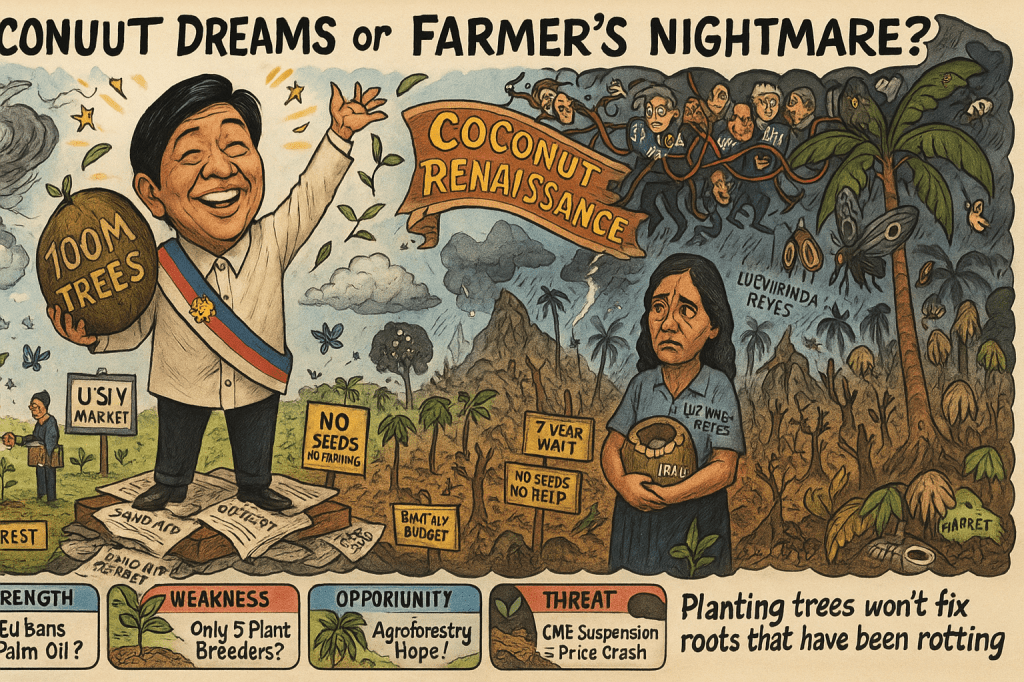
IN THE storm-scarred coconut groves of the Philippines, where gnarled trees stand as weary witnesses to decades of neglect, President Ferdinand Marcos Jr. has unfurled a dazzling promise: plant 100 million coconut trees by 2028, with a jaw-dropping 50 million targeted for 2026 alone. The Philippine Coconut Authority (PCA) hails this as a bold bid to reclaim the nation’s throne as the world’s top coconut producer, a crown lost to Indonesia 30 years ago. The plan dangles visions of doubled farmer incomes, booming exports, and a greener planet. But beneath the fanfare lurks a darker truth: bureaucratic chaos, a haunting history of betrayal, and the unrelenting poverty of 3 million coconut farmers. Will this be the salvation of an industry that feeds one in five Filipinos—or just another broken vow in a land of shattered hopes?
Cracks in the Vision: Scandals, Pests, and Empty Promises
The audacity of doubling the 2026 planting target from 25 million to 50 million trees is a logistical tightrope walk that teeters on the edge of collapse. The PCA’s recent performance—8.5 million trees planted in 2024—pales against this new ambition, raising stark questions about capacity. Seedlings, labor, and suitable land are already scarce, and the Coconut Farmers and Industry Development Plan (CFIDP), the blueprint for this effort, is a bureaucratic quagmire involving 15 agencies tripping over each other. The PCA, lacking the clout to unify this chaos, risks turning Marcos’ vision into a logistical fiasco.
Hovering over the plan is the specter of the coconut levy fund scandal, a betrayal that still stings. Under Marcos Sr., billions of pesos were fleeced from farmers to enrich cronies, leaving the industry in tatters. Though P75 billion has been returned, farmers see no relief, and Marcos Jr.’s name alone fuels distrust. Where will the new funds—vaguely promised as “adequate”—actually go? The lack of a clear answer smells of history repeating itself.
Pests are another ticking time bomb. Coconut scale insects have infested over half a million trees across eight regions, with the PCA brushing it off as “manageable” while a new threat, the coconut spike moth, emerges in Quezon province. New trees, if unprotected, could fall prey, jeopardizing fears of a wasted harvest. The PCA’s PHP1.8 billion fertilization program, meant to coax 60 nuts per year from “senile” trees that limp along at 40, is a flimsy patch on a gaping wound. With 340 million aging trees dominating the landscape, this stopgap sidesteps the deeper rot of an industry left to decay.
Hope or Hype? A Brutal SWOT Breakdown
Strengths: A Global Stage Awaits
The world is hungry for coconut oil, especially as the EU phases out palm oil by 2030. The Philippines, still the top coconut exporter, raked in $2.22 billion in 2024. Marcos’ personal stake, backed by a PHP1.8 billion fertilization budget, signals unwavering political will. Intercropping with coffee and corn could boost farmer incomes by 30–50%, offering a buffer while new trees mature over five to seven years.
Weaknesses: A House of Cards
Three million coconut farmers, among the nation’s poorest, toil on tiny plots averaging less than three hectares, too small for scale. The PCA’s five plant breeders nationwide are a laughable bottleneck for producing 50 million seedlings. The CFIDP’s multi-agency tangle invites gridlock, and the suspension of the coco-methyl ester (CME) blend increase—designed to spur coconut oil demand in diesel—threatens to tank copra prices, even as exports soar.
Opportunities: Green Gold or Greenwashing?
New trees could sequester over 10 million tons of CO₂e annually, potentially unlocking climate funds and positioning the Philippines as a sustainability leader. Partnerships like Omtse Ventures’ agroforestry model hint at innovation. But are these environmental claims a genuine climate win or a glossy pitch to woo global donors?
Threats: Storms, Scams, and Rivals
Typhoons like Yolanda, which obliterated 10 million trees in 2013, loom large, with climate change intensifying the risk. Corruption could siphon funds, echoing the coco levy scandal. Indonesia’s 17.13 million metric tons in 2024 dwarfs the Philippines’ 14.77 million, and without tackling these threats, the gap will only widen.
Faces of the Forgotten: A Farmer’s Struggle
Luzviminda Reyes, 58, stands under the sparse canopy of her two-hectare plot in Quezon province, her weathered hands tracing the bark of senile trees that yield barely enough to feed her family of five. “They say we’ll double our income,” she scoffs, “but how do I survive seven years waiting for new trees?” Her monthly P5,000 ($85) income is a thin thread, stretched thinner by the CME blend suspension, which curbs demand for coconut oil despite record export prices. Intercropping with coffee or corn could help, but Luzviminda lacks the seeds, training, or cash to start. For her and 3 million others, the government’s lofty rhetoric feels like a cruel taunt.
The PCA’s fertilization push may nudge yields upward, but senile trees are a losing bet. Intercropping, while promising, demands resources most smallholders don’t have. The CME suspension prioritizes urban fuel prices over rural livelihoods, leaving farmers like Luzviminda to bear the cost of Manila’s policy pivots. Export windfalls fill government coffers, but little trickles down to the fields where hope withers.
Fixing the Broken Roots: Bold Demands for Change
To make this plan more than a pipe dream, the government must act with ruthless clarity.
- Demand transparency: Publish a real-time, public ledger of coco levy fund spending to banish the ghosts of past scams.
- Create a “Farmer First” task force: Modeled on Thailand’s rice cooperatives, it would cut through red tape, delivering seedlings, training, and cash transfers to bridge the seven-year income gap.
- Partner with the grassroots: Engage groups like Kilusang Magbubukid ng Pilipinas to rebuild trust and ensure farmers’ voices shape the plan.
- Innovate for survival: Invest in pest-resistant, early-maturing coconut varieties to outpace climate threats and accelerate returns.
A Reckoning in the Groves
Marcos’ vision could transform the coconut industry, lifting millions from poverty and restoring global dominance. But the path is fraught with peril—bureaucratic inertia, historical distrust, and the ever-present threat of storms and pests. Without fierce accountability and a laser focus on farmers like Luzviminda, this gamble risks collapsing under its own weight. As the nation plants its hopes in the soil, one question burns: Will this be a renaissance for farmers—or another false dawn?
Key References
- Sevillano, S. (2025, June 19). PCA to plant 50M coconut trees in 2026 – DA. Philippine News Agency.
- Philippine Coconut Authority. (2024). Coconut Farmers and Industry Development Plan (CFIDP) 2024–2028.
- Food and Agriculture Organization. (2024). World Coconut Production Statistics.
- Department of Agriculture, Philippines. (2025). Coconut Industry Updates.
- Omtse Ventures. (2024). Regenerative Agroforestry in the Philippines.

- ₱75 Million Heist: Cops Gone Full Bandit

- ₱6.7-Trillion Temptation: The Great Pork Zombie Revival and the “Collegial” Vote-Buying Circus

- ₱1.9 Billion for 382 Units and a Rooftop Pool: Poverty Solved, Next Problem Please

- ₱1.35 Trillion for Education: Bigger Budget, Same Old Thieves’ Banquet
- ₱1 Billion Congressional Seat? Sorry, Sold Out Na Raw — Si Bello Raw Ang Hindi Bumili

- “We Will Take Care of It”: Bersamin’s P52-Billion Love Letter to Corruption

- “Skewed Narrative”? More Like Skewered Taxpayers!

- “Scared to Sign Vouchers” Is Now Official GDP Policy – Welcome to the Philippines’ Permanent Paralysis Economy
- “Robbed by Restitution?” Curlee Discaya’s Tears Over Returning What He Never Earned

- “No Pressure” Luistro? The House Pork Bazaar Exposed
- “My Brother the President Is a Junkie”: A Marcos Family Reunion Special

- “Mapipilitan Akong Gawing Zero”: The Day Senator Rodante Marcoleta Confessed to Perjury on National Television and Thought We’d Clap for the Creativity





 KWEBA ni BAROK
Leave a comment