By Louis ‘Barok‘ C. Biraogo — June 24, 2025
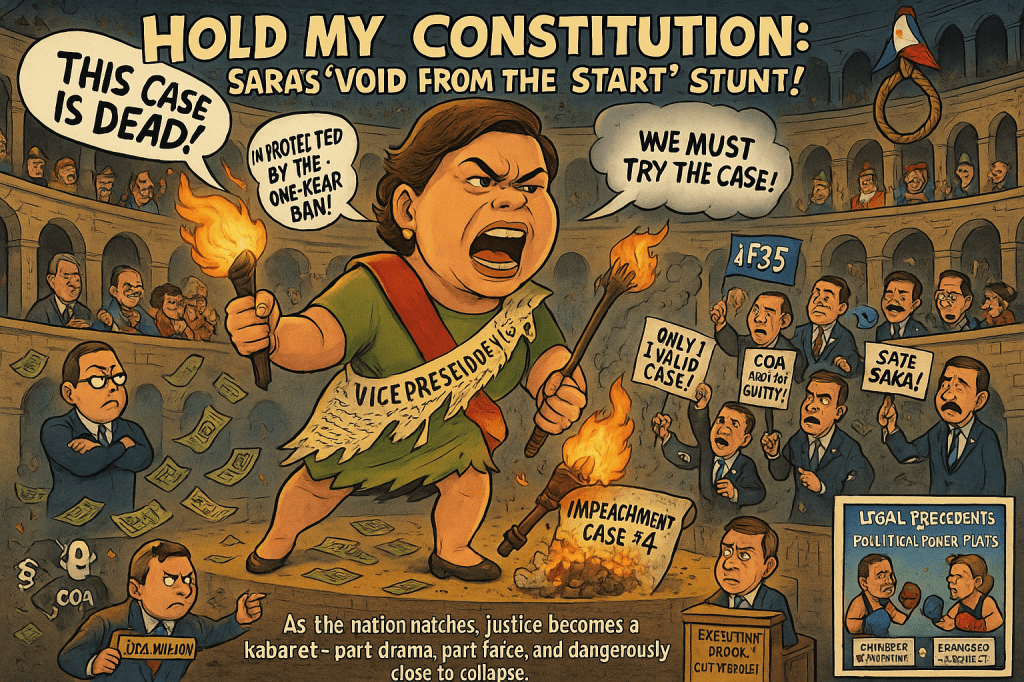
IN THE pressure cooker of Philippine politics, Vice President Sara Duterte’s impeachment saga explodes with legal fireworks, ethical rot, and raw power grabs. The House accuses her of torching public trust with misused millions and a chilling assassination threat, while Duterte counters that the case is a constitutional corpse—dead on arrival. As the Senate dances on a political tightrope, this is no mere trial; it’s a high-octane clash that could burn down the nation’s democratic foundations. Let’s carve through the chaos, exposing every legal dodge, moral failing, and political plot with surgical precision.
1. Constitutional Carnage: Duterte’s ‘Void Ab Initio’ Desperation Play
Duterte’s Legal Longshot: Grasping at Straws
Duterte’s defense hurls a constitutional Molotov cocktail, claiming the impeachment is “void ab initio” under the One-Year Ban Rule (Art. XI, Sec. 3(5), 1987 Constitution), which forbids multiple impeachment attempts in a year. Citing Francisco Jr. v. House (2003), her camp argues the fourth complaint, filed in February 2025 after three in December 2024, is a foul from the start. But Gutierrez v. House (2011) slices through this: impeachment begins only when the House votes to send articles to the Senate, not at filing. The earlier complaints fizzled without House endorsement, leaving the February 2025 case as the sole starter. Duterte’s gambit isn’t just weak—it’s a legal house of cards, collapsed by precedent and the House’s 200+ signatures.
Senate’s Procedural Pirouette: Delay or Cowardice?
On June 10, 2025, the Senate, with an 18-5 vote, punted the case back to the House for “constitutional compliance certification,” sidestepping Duterte’s dismissal motion. This isn’t caution—it’s a gutless dodge. Art. XI, Sec. 3(6) mandates the Senate to try impeachment cases, not play hot potato. Remanding buys Duterte’s allies time to rally, especially with a new Congress looming on July 28, 2025. Like the stalling in Estrada v. Desierto (2001), this move reeks of political puppetry, not principle, risking a trial derailed by backstage deals.
2. Cash and Corruption: The ₱125M Money Trail Meltdown
Dissecting the Fiscal Fiasco
The House charges Duterte with incinerating ₱125 million in confidential funds in a mere 11 days in 2022. The Commission on Audit (COA) delivers a gut punch: ₱73 million was disallowed for “fabricated recipients” and missing paperwork. The Philippine Statistics Authority adds fuel, revealing 60% of 677 listed recipients are ghosts—no civil registry records. This breaches Republic Act 3019 (Anti-Graft Law), which criminalizes shady disbursements, and RA 6713 (Code of Conduct), demanding transparency. Duterte’s “I broke no laws” defense is a paper-thin shield against COA’s damning evidence. Drawing from Nixon v. US (1993), the Senate’s political lens doesn’t need courtroom proof—just a stench of betrayal. This is no mere oversight; it’s a fiscal crime scene.
Witch Hunt or Ethical Apocalypse?
Duterte insists her spending was legit, but her silence during House probes, as reported by GMA News, screams guilt. Her camp cries Marcos-orchestrated vendetta, pointing to the UniTeam’s implosion—Duterte’s 2024 resignation as Education Secretary and public barbs at Marcos. Yet, the COA’s findings aren’t political fiction; they’re hard data. The impeachment’s timing may hint at score-settling, but the ethical rot is undeniable: a vice president squandering millions with zero accountability betrays the public trust, a slam-dunk impeachable offense under Art. XI, Sec. 2.
3. Assassination Allegations: Treasonous Tirade or Theatrical Tantrum?
Duterte’s Deadly Declaration
In November 2024, Duterte detonated a political bomb: “If I would get killed, you kill BBM [Marcos], Liza Araneta, and Martin Romualdez…I gave my orders.” This isn’t just bravado—it’s a legal landmine. Art. 139 (Sedition) and Art. 282 (Grave Threats) of the Revised Penal Code criminalize inciting violence or threatening harm. The House labels this a “high crime” under Art. XI, Sec. 2, arguing it destabilizes the state. Duterte’s later claim—it was a safety concern, not a threat—falls flat against the national security panic it sparked, per Al Jazeera. Intent may be debated, but the public stage she chose makes this a credible impeachment charge.
Prosecution’s High-Stakes Hurdle
Proving Duterte meant to incite violence is tricky—sedition and threats require clear intent. Her backtrack might sway some, but Corona’s Impeachment (2012) shows “high crimes” don’t need ironclad proof, just political will. The prosecution’s challenge is less about evidence and more about optics: this charge electrifies the case, painting Duterte as a reckless renegade, rallying public and senatorial outrage.
4. Senate Showdown: A Farce in the Making?
Navigating the Political Powder Keg
The Senate’s 18-5 remand vote, backed by Duterte loyalists like Senators Dela Rosa and Go, hints at a rigged game. Conviction needs 16 of 24 votes—a steep climb with Duterte’s allies entrenched. Corona’s Impeachment (2012) saw evidence trump loyalty, but here, the Marcos-Duterte feud—marked by Duterte’s resignation and budget cuts to her office—clouds impartiality. COA’s findings and Duterte’s own words are ironclad, yet political allegiances could bury them.
Ethical Sinkhole: Bias in the Spotlight
Senators like Dela Rosa, already drafting dismissal resolutions, are poster children for bias. Pagoda Philippines v. Universal Canning (2008) demands recusal when impartiality is compromised, but Senate rules don’t enforce it, turning the trial into a loyalty pageant. The remand decision further mocks justice, stalling accountability while Duterte’s camp plots its next move. This isn’t a trial—it’s a travesty.
5. Democracy’s Breaking Point: What’s at Stake?
Doomsday Scenarios
If Duterte skates, it’s open season for fiscal malfeasance and reckless threats, fueling her 2028 presidential run and eroding institutional trust. Conviction, however, would be a historic first—removing a vice president—but risks turning impeachment into a political weapon, chilling future executives. Either way, the public’s faith in governance is on life support, with protests looming, per Al Jazeera.
Fixing the Fracture
- Supreme Court Smackdown: The Court must settle the One-Year Ban Rule debate, as in Francisco Jr., to slam the door on legal loopholes.
- Senate Overhaul: Enforce recusal for biased senators and cap procedural delays to restore trial integrity.
- COA Crackdown: Mandate transparent audits for all confidential funds to stop future scandals in their tracks.
Final Verdict: A Nation Teetering on the Brink
Sara Duterte’s impeachment is a pulse-pounding constitutional showdown, pitting legal rigor against political rot. Her “void ab initio” defense is a hollow stunt, crushed by Gutierrez and the House’s airtight process. The corruption charges, backed by COA’s devastating audit, and the assassination plot, fueled by her own reckless words, build a case that’s hard to dismiss. Yet, the Senate’s political posturing threatens to turn justice into a sideshow. As the Philippines braces for the fallout, one question burns: will Duterte’s defiance or the rule of law prevail? The nation holds its breath, and democracy’s fate hangs in the balance.
Key Citations
- Inquirer.net, 2025: Duterte tells impeachment court: ‘Raps vs me invalid from outset’
- Gutierrez v. House (G.R. No. 193459, 2011)
- Francisco Jr. v. House (G.R. No. 160261, 2003)
- Nixon v. US (1993), 506 U.S. 224
- Corona’s Impeachment (2012), Senate Records
- Pagoda Philippines v. Universal Canning (G.R. No. 169704, 2008)
- 1987 Philippine Constitution, Art. XI
- RA 3019, RA 6713, Revised Penal Code (Arts. 139, 282)
- COA Reports
Disclaimer: This is legal jazz, not gospel. It’s all about interpretation, not absolutes. So, listen closely, but don’t take it as the final word.

- ₱75 Million Heist: Cops Gone Full Bandit

- ₱6.7-Trillion Temptation: The Great Pork Zombie Revival and the “Collegial” Vote-Buying Circus

- ₱1.9 Billion for 382 Units and a Rooftop Pool: Poverty Solved, Next Problem Please

- ₱1.35 Trillion for Education: Bigger Budget, Same Old Thieves’ Banquet

- ₱1 Billion Congressional Seat? Sorry, Sold Out Na Raw — Si Bello Raw Ang Hindi Bumili

- “We Will Take Care of It”: Bersamin’s P52-Billion Love Letter to Corruption

- “Skewed Narrative”? More Like Skewered Taxpayers!

- “Scared to Sign Vouchers” Is Now Official GDP Policy – Welcome to the Philippines’ Permanent Paralysis Economy
- “Robbed by Restitution?” Curlee Discaya’s Tears Over Returning What He Never Earned

- “No Pressure” Luistro? The House Pork Bazaar Exposed
- “My Brother the President Is a Junkie”: A Marcos Family Reunion Special

- “Mapipilitan Akong Gawing Zero”: The Day Senator Rodante Marcoleta Confessed to Perjury on National Television and Thought We’d Clap for the Creativity


 KWEBA ni BAROK
Leave a comment