By Louis ‘Barok’ C Biraogo — June 25, 2025
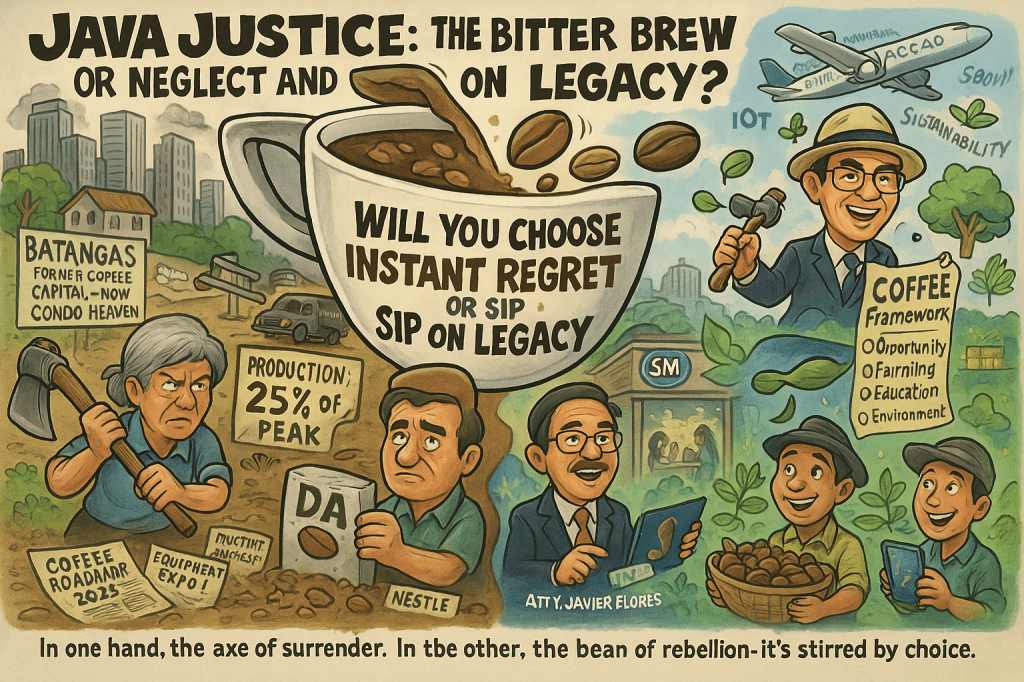
IN Batangas, where emerald hills once cradled coffee trees under dawn’s gentle mist, Juanita Reyes, a 58-year-old farmer, wields an axe with grim determination. Her grove, a legacy from her father, is being razed for a subdivision. “Houses pay more than beans,” she murmurs, voice heavy with defeat. “Coffee can’t feed my family.” Yet in Quezon, Varacco Coffee’s high-tech farms pulse with hope: IoT micro-weather stations hum, guiding farmers to nurture the soil with precision. The cruel irony stings—global coffee prices skyrocket, yet Philippine farmers like Juanita are uprooting their heritage. How did a nation once among the world’s coffee giants fall to importing beans for its own cups? Decades of government neglect, market betrayal, and lost vision brewed this crisis—but Varacco, the tech-driven maverick, is stirring a revolution to save the soul of Philippine coffee.
Roots of Ruin: Unraveling a National Tragedy
The Philippine coffee crisis isn’t a fluke; it’s a bitter harvest sown by systemic betrayal. Omar Mercado, president of Cafe de Lipa, cuts to the core: “Production is falling—it’s an agriculture problem, not just a coffee problem.” Output has crashed to a mere 25% of its historical peak, with just 25,000 metric tons grown yearly against a 100,000-ton domestic thirst. Land, the heartbeat of farming, is hemorrhaging to real estate. In Batangas and Cavite, where coffee once flourished, developers dangle fortunes, forcing farmers like Juanita into a gut-wrenching dilemma: cling to a dying crop or sell out to survive. Mercado laments, “The land is too expensive, and it’s more profitable to develop it.” The Department of Agriculture (DA) tosses out programs—expo sponsorships, sporadic equipment handouts—but Mercado scorns them as “scattered” and “unsustainable.” The DA’s Philippine Coffee Industry Roadmap aimed for 240,000 metric tons by 2022, yet production limps, crippled by paltry funding and disjointed efforts.
Varacco, by contrast, wields technology like a lifeline. Their IoT sensors—tracking moisture, temperature, and nutrients—have empowered 8,000 farmers to double their plots, eyeing a 15% income surge by 2029. While the DA flounders, Varacco’s micro-weather stations deliver data-driven precision, proving innovation can outsmart neglect. The government’s failure to shield coffee lands or bankroll replanting—coffee trees take seven years to mature—has left the industry gasping. Why are farmers paying the price for a nation’s myopia?
The market, too, shackles farmers in an “instant coffee trap.” Nearly 90% of consumption is low-grade instant coffee, chaining growers to Robusta that fetches pennies compared to specialty beans. Abroad, Arabica commands P600-P1,000 per kilo; locally, Excelsa claws at P390-P420. Mercado notes Filipinos are “a young coffee country,” blind to washed beans or defect standards that could triple bean value. Yet Varacco’s triumph at SM Mall of Asia’s Coffee Fest tells a different story. Urbanites savored their Liberica blends, discovering flavors their own soil birthed. If Filipinos crave quality, why are farmers stuck peddling instant-grade scraps? The market’s inequity—multinationals like Nestlé import 90% of their needs while local growers starve—is a scandal of warped priorities.
Varacco’s Rebellion: Technology as Salvation
Varacco Coffee storms this wasteland as a disruptor, fusing farmer dignity with cutting-edge tech. Atty. Javier Flores, Varacco’s firebrand leader, told me, “We’re not just growing coffee—we’re resurrecting a heritage. IoT isn’t a luxury; it’s our leap over decades of neglect.” Their COFFEE framework—Community, Opportunity, Fairness, Farming, Education, Environment—embodies this crusade. Ariestelo Asilo, Varacco’s sustainability torchbearer, puts it sharply: “Sustainability means farmers prosper *while ecosystems thrive—no more zero-sum games.” Their IoT network, spanning Quezon and Bicol, optimizes yields with real-time insights, slashing waste and elevating quality. Partnerships with BIMP-EAGA and the Global Green Institute signal a scalable vision, linking Filipino farmers to ASEAN markets craving sustainable brews.
Varacco’s impact is measurable: 8, farmers have doubled their plots, with 1,000 farmers have doubled farm sizes, and 1,784 households have escaped poverty through infrastructure like farm-to-market roads. Their cafes at SM malls and upcoming kiosks at SM Megamall aren’t mere shops—they’re platforms for Filipino coffee’s renaissance. By championing Liberica and Excelsa, Varacco proves Philippine beans can rival global titans. Their 15% income boost target isn’t just ambition; it’s a lifeline for farmers teetering on collapse.
A Rallying Cry: Fury, Faith, and the Fight Ahead
The Philippine coffee crisis is a national disgrace—a squandered legacy. Why must farmers like Juanita choose between survival and their heritage? A 25% plunge in production over decades screams neglect, yet the DA’s “scattered” programs offer crumbs for a shattered system. The instant coffee trap, fattening multinationals while farmers scrape by, is a damning indictment of market betrayal. Yet amid this fury, Varacco kindles hope—a tech-fueled, farmer-first rebellion that doesn’t just grow coffee but restores pride. Their IoT revolution, COFFEE framework, and BIMP-EAGA alliances prove transformation is within reach.
The Philippines doesn’t need pity—it needs warriors like Varacco and leaders with the guts to follow. The DA must craft a unified roadmap, not a mosaic of half-measures. Policymakers must barricade coffee lands against real estate’s greed. Consumers must embrace quality over instant mediocrity. Juanita’s axe need not fall if we act. Let Varacco’s brew jolt us awake to a future where Filipino coffee farmers don’t just endure—they thrive. The beans are ripe; are we?
Key References
- Ozaeta, T. G. (2025). Coffee prices rise, but PH farmers still struggle with low production. Rappler.
- Varacco uses IoT technology to boost coffee output. (2024, June 26). BusinessWorld.
- Varacco coffee proudly showcasing local flavors at SM Mall of Asia Coffee Fest. (2024). Journal News.
- Asilo, A. (2024). Varacco’s COFFEE framework for sustainable coffee production. Journal of Human Ecology and Sustainability.
- Expressing advocacies through espresso. (2024). AIM2Flourish.
- PhilCAFE project concludes, leads evolution in Philippine coffee sector. (2023). World Coffee Research.
- 63 Coffee Statistics Philippines You Need to Know For 2025. (2024). Hills and Valleys.
- DA: Phl coffee production ‘very low’ despite high demand. (2024, March 18). Daily Tribune.
- Coffee production in the Philippines. (2024). Wikipedia.
- Coffee market in the Philippines. (2024). Statista Market Forecast.


 KWEBA ni BAROK
Leave a comment