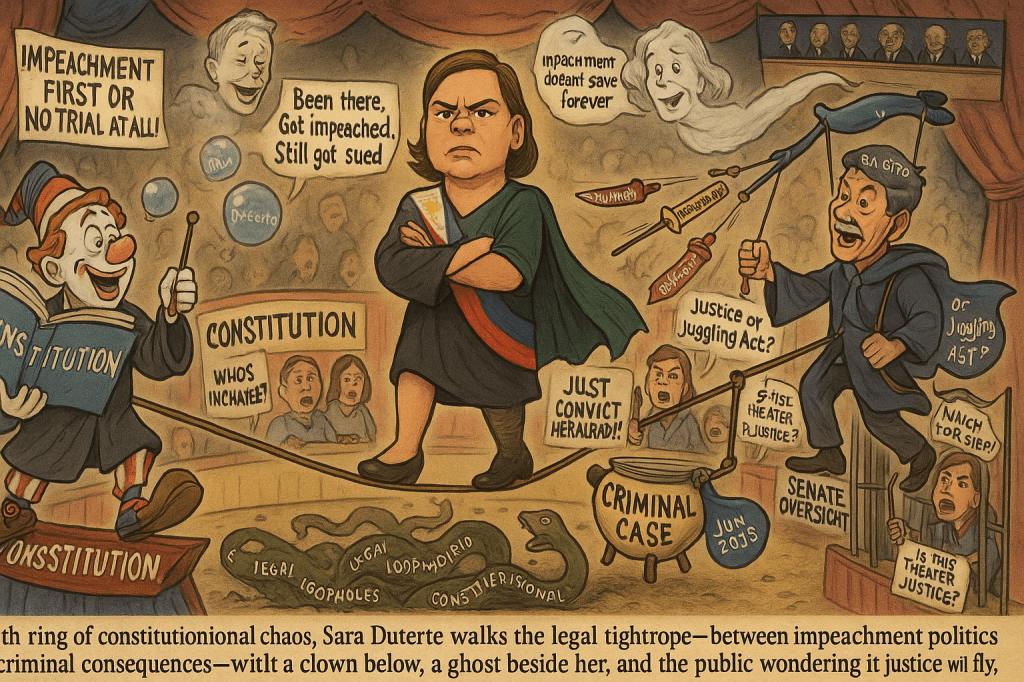
By Louis ‘Barok‘ C. Biraogo — June 25, 2025
REP. Joel Chua swears the Constitution chains Vice President Sara Duterte’s criminal fate to impeachment. But the Supreme Court torched that myth in Estrada v. Desierto. Why’s Chua peddling a legal ghost? And is the Ombudsman’s breakneck probe a quest for justice or a political hit job? Buckle up—we’re ripping this saga apart.
Chua’s Constitutional Con Game
Joel Chua’s bold claim: impeachable officials like Sara Duterte must be ousted via impeachment before facing criminal charges. He leans on Ombudsman v. CA (G.R. No. 146486, 2005) and a 1995 Desierto ruling. Is this a masterclass in constitutional defense or a desperate misread?
Unmasking Chua’s Argument
- Backing Chua’s Play:
- Ombudsman v. CA (G.R. No. 146486, 2005) cites a 1995 Desierto ruling, stating impeachable officers (e.g., Ombudsman) “must first be removed… via impeachment” before criminal or administrative liability kicks in.
- Article XI, Section 2 of the 1987 Constitution lists impeachable officials and mandates removal solely through impeachment, hinting at temporary immunity.
- Chua argues this protects high officials from political vendettas, preserving governance stability.
- Shredding Chua’s Logic:
- Here’s the fatal flaw: Ombudsman v. CA (G.R. No. 146486, 2005) doesn’t blanket all impeachable officials with an impeachment-first rule. It clarified Deputy Ombudsmen aren’t impeachable, greenlighting their prosecution without impeachment. The Desierto nod is narrow—tied to disbarment, not broad criminal liability. “To rule otherwise will create a procedural void leading to a substantive perpetual bar to any prosecution—an absurd situation not contemplated by the framers.”
- Estrada v. Desierto (G.R. Nos. 146710-15, 2001) obliterates Chua’s stance. The Supreme Court allowed criminal charges against ex-President Estrada post-resignation, no impeachment needed, declaring:
- Article XI, Section 3(7) states: “Judgment in cases of impeachment… shall not extend further than removal… but the party convicted shall nevertheless be liable and subject to prosecution.” Criminal cases can run parallel or post-impeachment—impeachment isn’t a gatekeeper.
- RA 6770 (Ombudsman Act) empowers the Ombudsman to probe any official, including impeachable ones. Demanding Duterte’s reply is a preliminary step, not a charge, dodging Chua’s objection.
- Exposing the Contradictions:
- Chua warps Ombudsman v. CA (G.R. No. 146486, 2005). It’s context-specific, not a universal shield. His cherry-picking ignores its actual holding.
- Estrada greenlights concurrent proceedings. Why sidestep this precedent? Is Chua blind or calculating?
What’s Chua’s endgame? His argument is a house of cards, crumbling under constitutional text and Supreme Court rulings. It’s a distraction from Duterte’s accountability.
Ombudsman’s Lightning Strike: Heroic or Hostile?
The Ombudsman’s order for Duterte to answer within 10 days—hot on the heels of the House report—has lawmakers like Leila de Lima sounding alarms. Is this a rare flex of efficiency, or a sly move to sabotage Duterte’s cases? Let’s cut through the noise.
Probing the Ombudsman’s Motives
- Procedural Legitimacy:
- RA 6770 mandates the Ombudsman to investigate graft, with Administrative Order No. 7 setting preliminary probe rules. Demanding Duterte’s counter-affidavit is textbook procedure.
- The House report (June 10, 2025) provided probable cause, compelling action under RA 6713 (Code of Conduct). Delay could breach ethical duties for timely service.
- Historically, the Ombudsman’s been slammed for dragging its feet (e.g., Rodrigo Duterte cases). Speed here counters that narrative.
- Sabotage Whispers:
- Why the red flags? De Lima calls the Ombudsman’s pace “out of character,” noting sluggish probes into Rodrigo Duterte’s allies. Ombudsman Samuel Martires, a Duterte appointee, faces bias accusations, with his term expiring July 2025.
- Timing screams politics: The probe aligns with the Senate’s impeachment delay (remanded to the House). A criminal case dismissal could sap the impeachment’s steam.
- But where’s the proof? No smoking gun confirms sabotage. Martires’ moves are procedurally kosher, and bias claims lean on speculation.
- Ethical and Historical Context:
- RA 6713 demands impartiality. If Martires shields Duterte, it’s unethical—but if evidence drives his speed, it’s duty fulfilled.
- Past low Sandiganbayan filings suggest selective zeal, but this case’s spotlight may force Martires to act decisively.
Is this a setup? The Ombudsman’s sprint is legal but reeks of political theater. Without hard evidence, sabotage is a hunch—but the optics are damning.
Duterte’s Double Jeopardy Dodge: Legal and Political Chaos
Can Duterte juggle impeachment and criminal charges? What if one crashes the other? With Martires’ term ending soon, how does timing twist the knife?
Legal Fallout
- Parallel Tracks:
- Estrada v. Desierto allows simultaneous impeachment (political) and criminal probes (judicial). They’re distinct beasts with no legal clash.
- Double jeopardy? Nope. Lecaroz v. Sandiganbayan (G.R. No. L-56384, 1984) confirms impeachment isn’t criminal, so Article III, Section 21 doesn’t apply.
- Hidden risk: Shared evidence could spark conflicting rulings. An Ombudsman dismissal might weaken the Senate’s impeachment case.
- Jurisdictional Tangles:
- Duterte’s Supreme Court plea to nix the impeachment (citing Article XI, Section 3(5)’s one-year bar) could freeze proceedings. If granted, criminal cases take center stage; if not, both rumble on.
- The Sandiganbayan (graft court) and Senate operate independently, risking procedural gridlock.
Political Powder Keg
- Timing’s Deadly Edge:
- Martires exits July 2025. A new Ombudsman could pivot, dropping or doubling down on Duterte’s cases.
- The Senate’s stall (election break) hands the Ombudsman the lead. A criminal case fizzle could tank impeachment’s credibility.
- Duterte’s political muscle, tied to her father’s legacy, fuels her victim narrative. Dual probes could galvanize her base.
- Public Trust on the Line:
- Overlapping cases breed confusion, threatening institutional legitimacy. A collapse in either risks cries of foul play.
- Transparency is oxygen. The Ombudsman and Senate must show their work to dodge bias charges.
What’s Duterte’s escape route? She’s in a legal crucible, with no clear victor. Concurrent probes are legal but sloppy, and politics could tilt the outcome.
Battle Plan: Fixing the Constitutional Mess
How can the Senate and lawmakers dodge this legal quagmire? What reforms stop future gridlock?
Senate’s Power Move:
- Fast-track impeachment: Launch the trial to reclaim constitutional dominance Article XI, Section 3. A verdict clears the criminal path, minimizing overlap.
- Press the Ombudsman for transparency. Shared evidence could sync processes without bias.
- Ombudsman’s Tightrope:
- Hold off on formal charges until impeachment wraps, honoring the Constitution’s removal-first spirit. Keep preliminary probes active.
- Martires must squash bias claims with public rationales, per RA 6713.
- Legislative Overhaul:
- Tweak RA 6770: Define the Ombudsman’s power to probe impeachable officials during impeachment, setting clear timelines.
- Pass a “Concurrent Proceedings Act” to align impeachment and criminal tracks, with rules for evidence-sharing and jurisdiction.
- Create a bipartisan oversight panel for the Ombudsman to curb political meddling.
Can we break the cycle? Without reform, Duterte’s saga is a preview of chaos. Bold fixes are the only way out.
Final Reckoning: Justice or Political Circus?
Chua’s impeachment-first mantra is a legal mirage, crushed by Estrada and the Constitution. The Ombudsman’s turbo probe is lawful but stinks of political games—sabotage or not, it’s a risky gambit. Duterte’s twin battles dodge double jeopardy but court public distrust. The Senate must lead, and lawmakers must seal the cracks. Will accountability triumph, or will politics choke justice? This thriller’s got more twists to come.
Key Citations
- 1987 Constitution, Article XI: Accountability of Public Officers
- Estrada v. Desierto, G.R. Nos. 146710-15, March 2, 2001
- Office of the Ombudsman v. Court of Appeals, G.R. No. 146486, March 4, 2005
- Lecaroz v. Sandiganbayan, G.R. No. L-56384, February 24, 1984
- Republic Act No. 6770: Ombudsman Act of 1989
- Republic Act No. 6713: Code of Conduct and Ethical Standards for Public Officials
- Sandiganbayan Official Website
Disclaimer: This is legal jazz, not gospel. It’s all about interpretation, not absolutes. So, listen closely, but don’t take it as the final word.

- ₱75 Million Heist: Cops Gone Full Bandit

- ₱6.7-Trillion Temptation: The Great Pork Zombie Revival and the “Collegial” Vote-Buying Circus

- ₱1.9 Billion for 382 Units and a Rooftop Pool: Poverty Solved, Next Problem Please

- ₱1.35 Trillion for Education: Bigger Budget, Same Old Thieves’ Banquet

- ₱1 Billion Congressional Seat? Sorry, Sold Out Na Raw — Si Bello Raw Ang Hindi Bumili

- “We Will Take Care of It”: Bersamin’s P52-Billion Love Letter to Corruption

- “Skewed Narrative”? More Like Skewered Taxpayers!

- “Scared to Sign Vouchers” Is Now Official GDP Policy – Welcome to the Philippines’ Permanent Paralysis Economy

- “Robbed by Restitution?” Curlee Discaya’s Tears Over Returning What He Never Earned

- “My Brother the President Is a Junkie”: A Marcos Family Reunion Special

- “Mapipilitan Akong Gawing Zero”: The Day Senator Rodante Marcoleta Confessed to Perjury on National Television and Thought We’d Clap for the Creativity

- “Just Following Orders” Is Dead: How the Hague Just Turned Tokhang’s Finest Into International Fugitives





 KWEBA ni BAROK
Leave a comment