By Louis ‘Barok‘ C. Biraogo — June 28, 2025
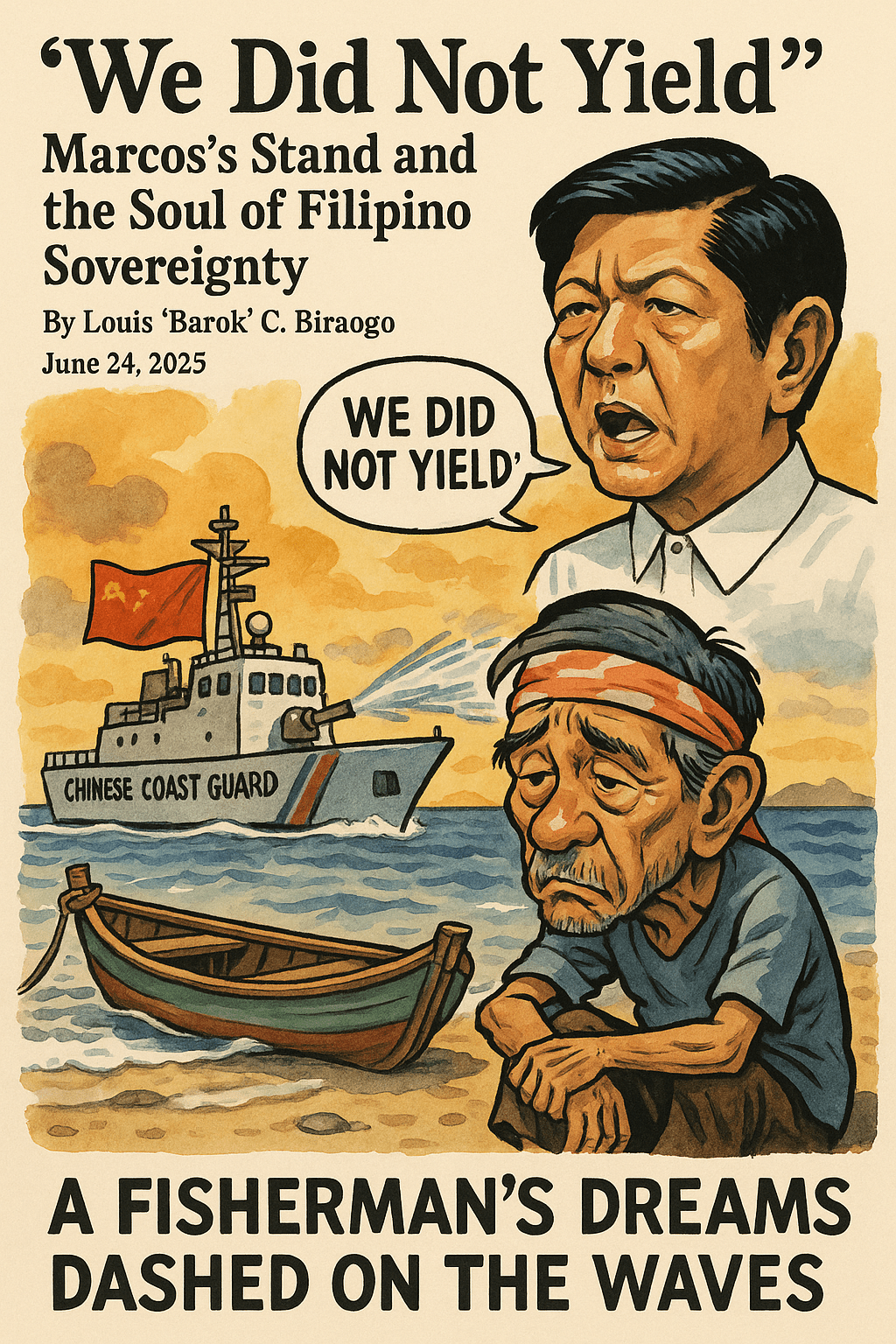
A Fisherman’s Dreams Dashed on the Waves
Tolomeo Forones, a 70-year-old fisherman from Masinloc, Philippines, once sailed to Scarborough Shoal with hope in his heart and nets full of promise. His hands, etched with the labor of decades, hauled in catches worth $705 every three months—enough to feed his family and settle debts. Now, he sits on the shore, his boat tethered, staring at a horizon patrolled by Chinese Coast Guard vessels armed with water cannons and menace. “We borrow just to eat,” he told me, his voice cracking under the weight of loss. Tolomeo’s story echoes across the West Philippine Sea (WPS), where thousands of fishermen are caught in the crosshairs of a geopolitical standoff, their livelihoods sacrificed to a superpower’s ambition. This isn’t just a territorial dispute—it’s a human tragedy, where families go hungry while leaders trade bold words.
President Ferdinand Marcos Jr. recently declared, “We did not yield,” vowing to defend Filipino sovereignty in the WPS. But for Tolomeo, the question isn’t whether Marcos stands firm—it’s whether his government, and the world, will fight for the people who call these waters home or leave them to sink into poverty and despair.
Unveiling the Layers of a Global Heist
The WPS crisis lays bare a brutal power imbalance: China, a global titan, bullies a smaller nation with impunity. Beijing’s “nine-dash line” claim, struck down by the 2016 Hague ruling, swallows nearly the entire South China Sea, including the Philippines’ 200-mile Exclusive Economic Zone (EEZ). Chinese vessels harass Filipino fishermen, block supply missions, and construct artificial islands atop razed coral reefs, flouting international law. This is no mere dispute—it’s a calculated campaign to dominate, echoing imperial conquests of centuries past, from the Opium Wars to today’s militarized reefs.
Economic Plunder: The WPS holds 12,158 billion cubic feet of natural gas and 6,203 million barrels of oil—resources that could fuel the Philippines’ future. Yet Chinese intimidation halts exploration, chaining the nation to costly energy imports. Fisheries, employing 1.6 million Filipinos and contributing 1.3% to GDP, suffer most. In 2024, 77 Chinese-flagged vessels illegally fished in the Philippines’ EEZ, driving a 6.78% drop in fish catch and a 0.02% GDP loss from mid-2021 to mid-2022. Coastal communities face 17,000 lost jobs and 24,000 more Filipinos pushed into poverty. While China plunders the sea, families like Tolomeo’s spiral into debt.
Marcos’s Gambit: Marcos’s “no yield” rhetoric aims to ignite national pride, but its impact is murky. His administration has bolstered ties with the U.S., Japan, and Australia, and launched a transparency initiative, inviting journalists to witness Chinese aggression. Initiatives like the LAYAG-WPS Project offer fishermen fuel subsidies, but these are mere patches on a gaping wound. Critics question whether Marcos’s defiance masks political posturing, with defense modernization lagging and corruption scandals undermining trust. His family’s past—his father’s regime cozied up to China while neglecting fishermen—raises doubts: Is this a fight for sovereignty or a bid to polish a tarnished legacy before 2028?
Global Hypocrisy Exposed: The international response is a masterclass in empty promises. The U.S. reaffirms its Mutual Defense Treaty, patrolling with freedom-of-navigation operations, while allies like Japan and the EU decry China’s actions. But where is the action that matters—sanctions, trade pressure, or UN-backed enforcement? The 2016 Hague ruling, a beacon of international law, lies ignored as China’s defiance goes unchecked. This reveals a bitter truth: global institutions falter when powerful nations opt for expediency, leaving countries like the Philippines to face giants alone.
Echoes of History, Shadows of Betrayal
The WPS crisis is a modern chapter in a centuries-old saga of territorial greed, where human lives are pawns in strategic games. The Philippines’ colonial past—Spanish, then American—left it vulnerable to external powers. The 1898 Treaty of Paris and 1900 Treaty of Washington defined its maritime borders, but post-colonial leaders struggled to enforce them. Rodrigo Duterte’s dismissal of the 2016 ruling for Chinese economic favors mirrored earlier betrayals, like Gloria Arroyo’s 2005 joint exploration deal with China, which violated the Constitution. Each compromise emboldened Beijing, proving Marcos’s warning: “Give them an inch, they’ll take a mile.”
China’s tactics—artificial islands as military outposts, illegal fishing bans—mirror its regional playbook, from the Spratly Islands to Japan’s Senkaku/Diaoyu dispute. For the Philippines, this is a battle for more than resources; it’s a stand for dignity, a nation refusing to bow. Yet the Marcos legacy complicates this narrative. Ferdinand Marcos Sr.’s 1978 claim to the Kalayaan Island Group was bold, but his regime’s corruption and abuses fractured unity. Can his son, with three years left, redeem this history, or is he merely staging a performance for political gain?
Questions That Demand Answers
Marcos’s defiance raises searing questions. Is his “no yield” stance a true shield for Filipinos or a distraction from domestic failures like inflation and electoral losses? His cabinet reshuffles signal urgency, but do they deliver aid to fishermen or just bureaucratic chaos? How do we weigh the urgent needs of families like Tolomeo’s against the long-term goal of deterring China? Escalation risks war, potentially pulling in the U.S. and upending the region. Accommodation, as Duterte tried, surrenders sovereignty and invites further aggression. What’s the true price of each choice?
Globally, why does “support” for the Philippines stop at words? The U.S. and allies fear China’s economic clout, but doesn’t their inaction embolden Beijing? For Filipinos, how much trust should they place in a government that promises change but struggles to deliver? The LAYAG-WPS Project is a step, but fishermen need boats and protection, not platitudes, to face Chinese intimidation. These questions aren’t rhetorical—they demand accountability from Manila to Washington.
Charting a Course Through the Storm
The WPS crisis tests the Philippines’ resolve, international law’s strength, and humanity’s commitment to justice over power. Here are three bold recommendations to forge a path forward:
- Lifeline for Fishermen Now: Expand the LAYAG-WPS Project to equip fishermen with modern boats, satellite communication, and legal aid to document Chinese harassment. Local governments must offer zero-interest loans and alternative livelihoods like aquaculture to end debt cycles. International donors, led by the U.S. and Japan, should commit $50 million yearly to support 50,000 coastal families, ensuring immediate relief.
- Forge a United Front: The Philippines must spearhead an ASEAN coalition to negotiate a binding South China Sea Code of Conduct, backed by UN sanctions for violations. Marcos should host a 2026 WPS summit, rallying allies like Vietnam and Indonesia, with the EU and Australia as mediators. This would isolate China diplomatically unless it honors UNCLOS.
- Build a Resilient Shield: Accelerate the Comprehensive Archipelagic Defense Concept, dedicating 2% of GDP to modernize the navy and coast guard by 2028. Transparent budgeting is non-negotiable to prevent corruption. The U.S. and Japan should co-fund joint exercises and supply patrol vessels, while Manila develops clear rules of engagement to deter China without sparking conflict.
Long-term, a just resolution demands a world where international law has teeth. Reform global institutions to enforce rulings like the 2016 award with trade penalties or asset freezes. For the Philippines, sustainability lies in diversifying its economy—investing in renewable energy and marine conservation to reduce reliance on contested waters.
Your Voice Can Save a Sea
Tolomeo Forones doesn’t seek sympathy—he demands his sea, his dignity, his life back. His struggle, shared by millions of Filipinos, reminds us that sovereignty is more than maps; it’s the right to thrive. Marcos’s vow to “not yield” is a spark, but it needs fuel—action from Manila, pressure from allies, and voices like yours. The Philippines, with the world’s backing, must protect its people, uphold international law, and build a future where small nations stand tall.
You can act. Urge your leaders—in Washington, Tokyo, Brussels—to match their words with sanctions and aid. Support groups like the National Federation of Fisherfolk Organizations, amplifying Filipino voices. Share Tolomeo’s story, because every share stokes the fire of change. The West Philippine Sea isn’t a far-off problem—it’s a test of our collective resolve. Will we pass it?
Key Citations
- Inquirer.net, “Marcos: ‘We did not yield’ on WPS issue,” June 21, 2025
- Maritime Fairtrade, “Fish catch in West Philippine Sea declines amid geopolitical tensions,” October 7, 2024.
- Maritime Fairtrade, “China-Philippines conflict impact on West Philippine Sea economy,” December 6, 2024.
- FULCRUM, “Philippines needs deterrence strategy for West Philippine Sea,” August 15, 2024.
- China-Global South Project, “Fight for food and sovereignty impacts Filipino fishermen,” November 28, 2024.
- DA-NFRDI, “Unlocking the diverse bounty of West Philippine Sea resources,” May 20, 2024.
- ORF Online, “Examining Manila’s contemporary West Philippine Sea strategy,” May 23, 2024.
- Philstar.com, “Fishers feel impact of West Philippine Sea tensions,” October 1, 2024.

- ₱75 Million Heist: Cops Gone Full Bandit

- ₱6.7-Trillion Temptation: The Great Pork Zombie Revival and the “Collegial” Vote-Buying Circus

- ₱1.9 Billion for 382 Units and a Rooftop Pool: Poverty Solved, Next Problem Please

- ₱1.35 Trillion for Education: Bigger Budget, Same Old Thieves’ Banquet

- ₱1 Billion Congressional Seat? Sorry, Sold Out Na Raw — Si Bello Raw Ang Hindi Bumili

- “We Will Take Care of It”: Bersamin’s P52-Billion Love Letter to Corruption

- “Skewed Narrative”? More Like Skewered Taxpayers!

- “Scared to Sign Vouchers” Is Now Official GDP Policy – Welcome to the Philippines’ Permanent Paralysis Economy
- “Robbed by Restitution?” Curlee Discaya’s Tears Over Returning What He Never Earned

- “My Brother the President Is a Junkie”: A Marcos Family Reunion Special

- “Mapipilitan Akong Gawing Zero”: The Day Senator Rodante Marcoleta Confessed to Perjury on National Television and Thought We’d Clap for the Creativity

- “Just Following Orders” Is Dead: How the Hague Just Turned Tokhang’s Finest Into International Fugitives





 KWEBA ni BAROK
Leave a comment