By Louis ‘Barok‘ C. Biraogo — June 30, 2025
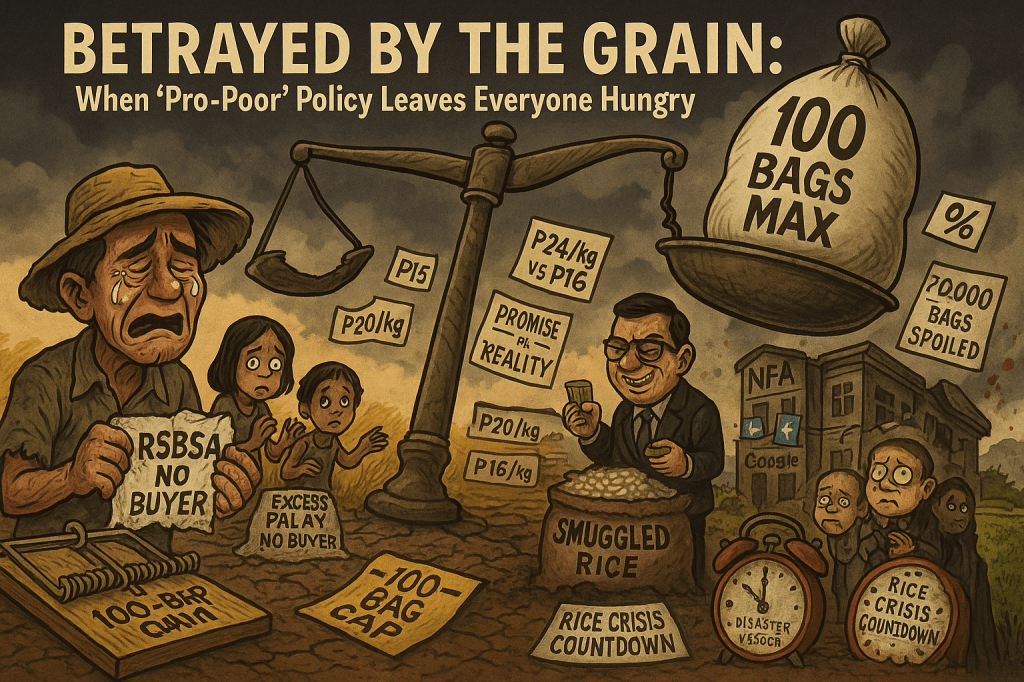
IN A sun-scorched barangay in Nueva Ecija, Mang Lito, a grizzled rice farmer, rips his RSBSA certificate in half, his weathered hands shaking with rage. “This was my ticket to stability,” he growls, “now it’s a shackle.” Meanwhile, in a shadowy warehouse, a trader counts smuggled palay sacks, smirking as he outwits the government’s latest rules.
The National Food Authority’s (NFA) new policy—capping palay sales at 100 bags per farmer per season, hailed as a pro-poor triumph—has sparked a firestorm. Marketed as a transparency crusade, it risks plunging the Philippines’ rice economy into chaos, exposing a treacherous clash between lofty promises and devastating fallout. This critique unmasks the policy’s contradictions, from its human toll to its systemic flaws, and demands urgent reform.
The Human Toll: Heroes of the Harvest or Victims of Policy?
The NFA’s 100-bag cap, announced June 26, 2025, claims to shield small farmers from traders exploiting government procurement prices (P20–P24/kg versus private traders’ P16/kg). Administrator Larry Lacson insists it ensures “benefits flow to genuine farmers,” but the truth is thornier.
Small farmers, often yielding under 100 bags per season, may secure a reliable buyer in the NFA—a lifeline for those tilling marginal lands. Yet, larger producers, whom Lacson acknowledges can harvest far beyond 100 bags, face a crushing blow. Forced to offload excess palay to private traders at cutthroat rates, these farmers—rural economies’ linchpins—risk plummeting incomes. A 2025 BusinessWorld report suggests productive farmers could see earnings slashed, averaging P20/kg when blending NFA and private sales, eroding the premiums they once relied on.
The “trader loophole” paradox is a festering wound. New rules—ID checks, RSBSA verification, and delivery logging—aim to block middlemen (NFA, Philippine News Agency, 2025). But the NFA’s history of inefficiency, including a 2018 scandal where 60,000 bags of rice rotted, fuels doubt. Traders, with deep networks and cash reserves, are already sidestepping caps by orchestrating proxy sales through registered farmers, potentially burying corruption deeper.
The Magna Carta for Small Farmers threatens penalties for complicit NFA staff, but enforcement hinges on an agency long plagued by mismanagement. The toll is stark: small farmers gain a sliver of security, but larger producers and rural communities face ruin, while traders slither through the cracks, unscathed.
The Poor in Peril: Rice Crisis Countdown Begins
Rice is the Philippines’ lifeblood, yet 68% of non-poor households reportedly hoard NFA’s subsidized P20/kg rice, elbowing out the destitute (Context.ph, 2025). With buffer stocks at a robust 140% of target, the NFA boasts short-term stability (Inquirer.net, 2025). But what happens when warehouses run dry?
The cap risks choking procurement from larger farmers, who drive significant supply. If private markets absorb excess palay at lower prices, a temporary surplus might stabilize consumer costs. But any disruption—typhoon, drought, or bureaucratic fumble—could drain stocks swiftly. Japan’s 2025 rice crisis, where prices doubled due to distribution failures, is a grim warning (BusinessWorld, 2025).
The clock is ticking—will the next rice crisis catch the NFA flat-footed? The irony burns: a policy sold as pro-poor could imperil the very supply the destitute rely on. With rice devouring low-income budgets, any price spike would crush those least equipped to cope. The NFA’s P20/kg rice promise in the Visayas, a political sop, teeters on consistent procurement and distribution—both jeopardized by the cap (Malaya Business Insight, 2025). If traders exploit loopholes or farmers curb production, the poor will pay the price, not the policymakers who rolled the dice.
Systemic Collapse: Transparency Charade or Substantive Fix?
The NFA’s transparency playbook—Google Sheets, Facebook posts, and warehouse observation tables—projects reformist zeal (Philstar.com, 2025). But it’s a flimsy curtain over systemic decay. The agency grapples with ballooning debts, over-importation (3.8 million metric tons in 2024), and rotting stocks—10,000 metric tons spoiled in 2023 alone (GMA News, 2025). These aren’t glitches but symptoms of a bureaucracy rotten with corruption and incompetence.
Echoes of Marcos Sr.’s Oil Price Stabilization Fund haunt this policy. That 1980s subsidy scheme, meant to protect consumers, spiraled into a debt-fueled disaster, burdening taxpayers. The NFA’s current tack—capping procurement to subsidize rice prices while ignoring structural rot—courts a similar catastrophe. Transparency gestures are hollow without tackling chronic underinvestment (Philippine rice yields stagnate at 3-6 tons/hectare versus Vietnam’s 5-8 tons) and land conversion (palay’s agricultural GVA fell 10.4% annually) (BusinessWorld, 2025).
The NFA’s reforms are less a fix than a performance, masking a system on the brink.
Fixes That Bite: Rewriting the Rice Playbook
This policy’s cracks demand audacious solutions.
- Ditch the one-size-fits-all 100-bag cap for tiered limits: 50 bags for smallholders, 200 for mid-sized farms, 500 for larger operations. This balances equity and efficiency, sparing productive farmers from punishment.
- Deploy blockchain tracking to log every sack from farm to warehouse, ensuring tamper-proof transparency that Google Sheets can’t match. Traders’ workarounds would be exposed, and corruption curbed.
- Invest in irrigation—only 57% of Philippine farmland is irrigated, versus 90% in Vietnam. Modern systems could boost yields by 20-30%, cutting import reliance and stabilizing prices naturally (BusinessWorld, 2025).
- Empower the NFA as a market regulator to crush cartel-driven price spikes, not just a buyer of last resort.
These aren’t suggestions—they’re imperatives.
A Nation’s Hunger on the Line
In a country where rice is survival, the NFA’s policy isn’t mere bureaucracy—it’s a life-or-death wager. Mang Lito’s shredded certificate and the trader’s smuggled sacks are omens of a system teetering on collapse. The poor can’t afford another rice crisis, nor can farmers endure more broken promises.
Policymakers must act now, refining this policy with transparency, fairness, and resilience at its core. The Philippines deserves a rice system that nourishes its people, not its dysfunction. The countdown is on—will we save our harvest, or let hunger triumph?
Key Citations
- Department of Agriculture: NFA tightens palay buying rules to block traders, help real farmers
- BusinessWorld: NFA to limit palay purchases to farmers in gov’t registry
- Philippine News Agency: NFA: Stricter buying rules to benefit more farmers, push transparency
- Inquirer.net: NFA lowers palay sale limit per rice grower
- GMA News: NFA eyes limiting palay purchase to 100 bags per farmer
- Malaya Business Insight: DA, NFA to limit palay-buying at 100 bags per farmer, vow transparent process
- Context.ph: NFA tightens palay buying rules to block traders, help real farmers
- Philstar.com: NFA: Palay buying program only for registered farmers

- ₱75 Million Heist: Cops Gone Full Bandit

- ₱6.7-Trillion Temptation: The Great Pork Zombie Revival and the “Collegial” Vote-Buying Circus

- ₱1.9 Billion for 382 Units and a Rooftop Pool: Poverty Solved, Next Problem Please

- ₱1.35 Trillion for Education: Bigger Budget, Same Old Thieves’ Banquet
- ₱1 Billion Congressional Seat? Sorry, Sold Out Na Raw — Si Bello Raw Ang Hindi Bumili

- “We Will Take Care of It”: Bersamin’s P52-Billion Love Letter to Corruption

- “Skewed Narrative”? More Like Skewered Taxpayers!

- “Scared to Sign Vouchers” Is Now Official GDP Policy – Welcome to the Philippines’ Permanent Paralysis Economy
- “Robbed by Restitution?” Curlee Discaya’s Tears Over Returning What He Never Earned

- “No Pressure” Luistro? The House Pork Bazaar Exposed
- “My Brother the President Is a Junkie”: A Marcos Family Reunion Special

- “Mapipilitan Akong Gawing Zero”: The Day Senator Rodante Marcoleta Confessed to Perjury on National Television and Thought We’d Clap for the Creativity





 KWEBA ni BAROK
Leave a comment