By Louis ‘Barok‘ C. Biraogo — June 29, 2015
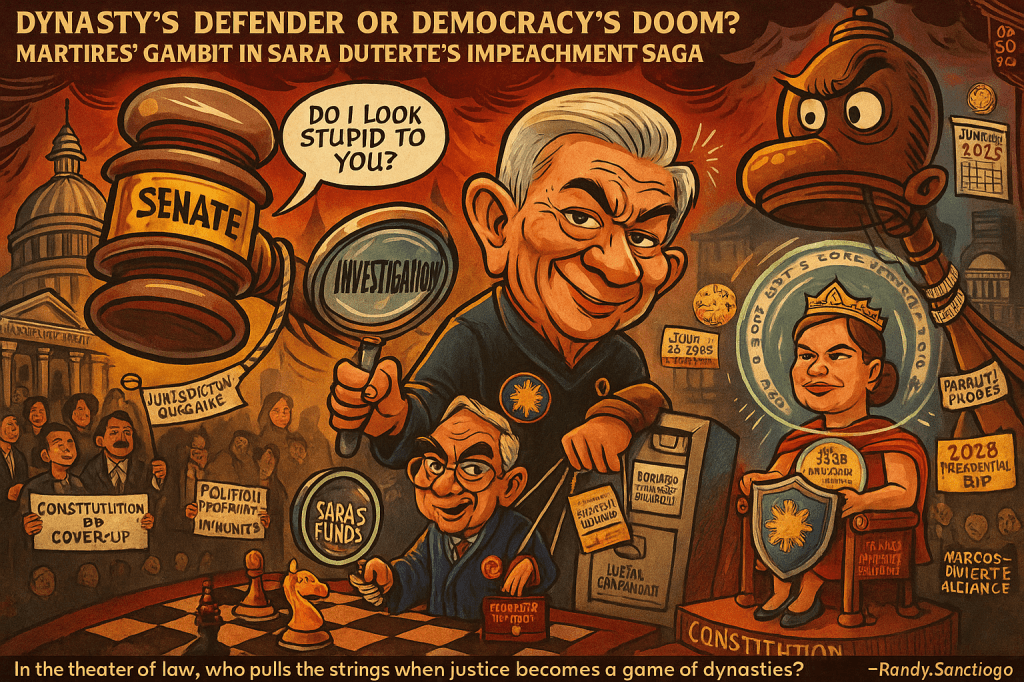
THE showdown between Ombudsman Samuel Martires and the Senate over Vice President Sara Duterte’s impeachment trial is a high-octane legal thriller that could reshape Philippine democracy. Martires, a Rodrigo Duterte appointee retiring on July 27, 2025, insists his investigation into Sara’s alleged misuse of confidential funds is a procedural necessity, deferring to the Senate’s impeachment primacy under Article XI, Section 3(6). Yet, his provocative suggestion to “hide” findings that clash with the Senate’s verdict—coupled with his questionable timing and Duterte ties—ignites a firestorm of constitutional, procedural, and ethical questions. Is Martires a dutiful servant of the law or a puppet shielding a political dynasty? This critique slices through the legal and political fog to expose the stakes in this perilous drama.
Constitutional Clash: Defying the Senate or Dodging Accountability?
Martires anchors his probe in Article XI, Sections 12–13 of the 1987 Philippine Constitution and Republic Act No. 6770 (Ombudsman Act), which empower the Ombudsman to investigate public officials for misconduct. He claims his summons to Sara Duterte, prompted by a House committee report on alleged fund misuse, is routine. Yet, he pledges to pause until the Senate, with exclusive impeachment jurisdiction under Article XI, Section 3(6), delivers its verdict. This deference is a constitutional tightrope stretched thin.
The Supreme Court’s ruling in Ombudsman v. Court of Appeals (G.R. No. 146486, 2005) confirms that impeachable officials like the Vice President must face impeachment before criminal prosecution. Martires’ parallel probe, while within his investigative mandate under RA 6770, Section 15, risks encroaching on the Senate’s turf, creating a jurisdictional quagmire. His reliance on 1987 Constitutional Commission deliberations—where drafter Jose Nolledo stated the Ombudsman “can conduct investigations but cannot prosecute” in impeachment contexts—holds legal weight but doesn’t justify a probe that could disrupt the Senate’s primacy.
Martires’ most egregious misstep is his claim that an impeachment acquittal bars criminal charges while Sara remains Vice President. This contradicts Article XI, Section 3(7), which explicitly states that impeachment judgments “shall not preclude” subsequent criminal prosecution. Constitutional scholar Paolo Tamase obliterates this logic, arguing that impeachment is a political process, not judicial, and acquittal only preserves office, not immunity from criminal liability. Tamase emphasizes that only the President enjoys immunity under Article VII, Section 17, and corruption—like alleged misuse of confidential funds—is a non-official act, prosecutable anytime. Martires’ interpretation is a constitutional sleight of hand, threatening to cripple the Ombudsman’s role as the “protector of the people” and handing Sara Duterte a potential legal shield.
Procedural Ploy: Stalling Justice or Fulfilling Duty?
Martires’ timing is a masterclass in procedural jujitsu. Under RA 6770, Section 15, the Ombudsman must act on complaints, and Martires claims the House report compelled his summons. But launching a probe weeks before his July 27 retirement—knowing he can’t resolve it—smacks of a stalling tactic. The Senate’s recent remand of the impeachment case to the House, delaying the trial, amplifies suspicions. Martires admits the next Ombudsman will handle any resolution, raising questions about his probe’s urgency. Is this a legitimate exercise of duty or a calculated move to derail accountability?
Contrast this with former Ombudsman Conchita Carpio Morales, who recused herself from investigating Rodrigo Duterte due to familial ties but allowed the probe to proceed independently. Morales’ restraint preserved the Ombudsman’s credibility, while Martires’ aggressive move—paired with his Duterte appointment—invites accusations of bias. The Senate’s remand creates a legal vacuum, and Martires’ probe seems to exploit this, potentially dragging Sara’s accountability past the 2028 election cycle, when she’s poised to run for president. This isn’t just procedural; it’s political chess.
Ethical Abyss: Bias or Betrayal of Public Trust?
Martires walks an ethical tightrope as a Rodrigo Duterte appointee. RA 6713 (Code of Conduct for Public Officials), specifically Rule III, mandates resolving conflicts of interest in the public’s favor. Martires deflects bias allegations by citing his dismissal of graft charges against Benigno Aquino in the Mamasapano case, but this is a flimsy shield. Mamasapano involved official acts (military command decisions), while Sara’s alleged fund misuse is corrupt and non-official, demanding rigorous scrutiny. His selective aggression fuels perceptions of favoritism toward the Duterte dynasty.
Martires’ suggestion to “hide” findings that contradict the Senate’s verdict is an ethical landmine. Article XI, Section 13(6) requires publicizing investigations “with due prudence,” and suppressing evidence violates this transparency mandate. Unlike Morales, who testified in the Renato Corona impeachment trial to uphold accountability, Martires’ secrecy plot risks complicity in a cover-up, eroding public trust in the Ombudsman’s independence. His combative rhetoric—“Do I look stupid to you?”—only deepens skepticism about his motives.
Political Powder Keg: A Dynasty’s 2028 Playbook?
The implosion of the Marcos-Duterte alliance sets the stage for this legal drama. Sara Duterte, a frontrunner for the 2028 presidency, stands to gain immensely from any impeachment delay or dismissal. An acquittal would burnish her candidacy, while a protracted process could bury damaging evidence until after the election. Martires’ probe, by creating parallel proceedings, risks derailing the Senate’s focus and amplifying perceptions of a Duterte-orchestrated shield. His investigation could preserve evidence for future use, but its timing suggests a deeper motive: protecting Sara’s political future.
A clash between the Ombudsman and Senate could ignite a constitutional crisis, paralyzing governance and shattering public faith in institutions. If Martires’ findings—say, a recommendation for criminal charges—diverge from a Senate acquittal, the resulting legal ambiguity could embolden political actors to manipulate processes for electoral gain. This isn’t just a legal spat; it’s a battle for the soul of Philippine democracy, with the 2028 election as the ultimate prize.
Fixing the Fault Lines: Reforms to Avert Disaster
To prevent future constitutional crises, the following reforms are non-negotiable:
- Clarify Jurisdictional Lines: Congress must amend RA 6770 to explicitly bar parallel Ombudsman probes during impeachment trials, reinforcing the Senate’s exclusive authority under Article XI, Section 3(6).
- Insulate the Ombudsman: Introduce fixed, non-renewable seven-year terms for the Ombudsman to shield the office from political influence and restore public trust.
- Assert Senate Primacy: The Senate must flex its impeachment authority, demanding full Ombudsman cooperation, as exemplified by Morales’ testimony in the Corona trial.
- Mandate Transparency: Enforce RA 6713 and Article XI, Section 13(6) to require public disclosure of all impeachment-related findings, with exceptions only for national security.
Final Provocation: Guardian of Justice or Duterte’s Shield?
Martires’ probe into Sara Duterte’s alleged misconduct, cloaked as procedural duty, threatens to subvert the Senate’s constitutional mandate and shield a political dynasty from accountability. His suggestion to conceal findings betrays the Ombudsman’s duty to the public, risking a constitutional crisis that could destabilize Philippine democracy. As the nation watches this high-stakes drama unfold on June 28, 2025, one question burns: Is Martires guarding the rule of law—or guarding a Duterte dynasty?
Key References
- 1987 Philippine Constitution, Article XI: Defines Ombudsman powers and impeachment processes.
- 1987 Philippine Constitution, Article VII: Outlines presidential immunity.
- Republic Act No. 6770 (Ombudsman Act): Details Ombudsman’s investigative and prosecutorial duties.
- Republic Act No. 6713 (Code of Conduct): Sets ethical standards for public officials.
- Ombudsman v. Court of Appeals (G.R. No. 146486, 2005): Clarifies Ombudsman’s role in investigating impeachable officials.
- Rappler, June 27, 2025: Martires: Ombudsman will give way to impeachment court in Sara Duterte case: Details Martires’ statements and actions in the Sara Duterte case; provides constitutional counterarguments to Martires’ claims by Paolo Tamase
Disclaimer: This is legal jazz, not gospel. It’s all about interpretation, not absolutes. So, listen closely, but don’t take it as the final word.

- ₱75 Million Heist: Cops Gone Full Bandit

- ₱6.7-Trillion Temptation: The Great Pork Zombie Revival and the “Collegial” Vote-Buying Circus

- ₱1.9 Billion for 382 Units and a Rooftop Pool: Poverty Solved, Next Problem Please

- ₱1.35 Trillion for Education: Bigger Budget, Same Old Thieves’ Banquet

- ₱1 Billion Congressional Seat? Sorry, Sold Out Na Raw — Si Bello Raw Ang Hindi Bumili

- “We Will Take Care of It”: Bersamin’s P52-Billion Love Letter to Corruption

- “Skewed Narrative”? More Like Skewered Taxpayers!

- “Scared to Sign Vouchers” Is Now Official GDP Policy – Welcome to the Philippines’ Permanent Paralysis Economy

- “Robbed by Restitution?” Curlee Discaya’s Tears Over Returning What He Never Earned

- “No Pressure” Luistro? The House Pork Bazaar Exposed
- “My Brother the President Is a Junkie”: A Marcos Family Reunion Special

- “Mapipilitan Akong Gawing Zero”: The Day Senator Rodante Marcoleta Confessed to Perjury on National Television and Thought We’d Clap for the Creativity




 KWEBA ni BAROK
Leave a comment