By Louis ‘Barok‘ C. Biraogo — June 30, 2025
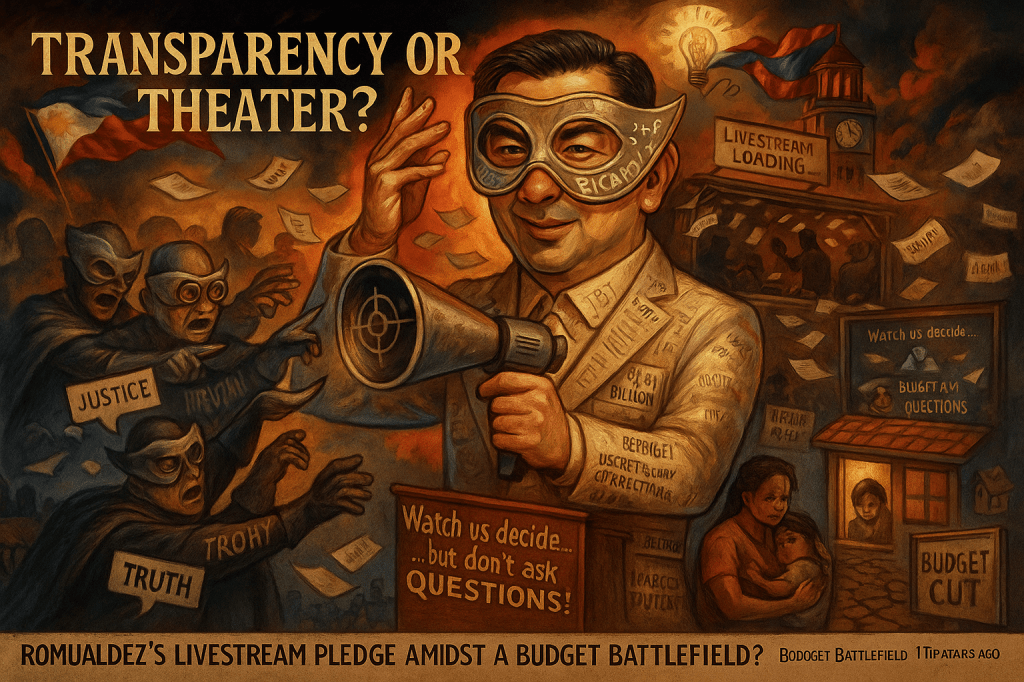
IN THE Philippines, where dynastic politics often overshadow democratic ideals, House Speaker Martin Romualdez’s call to livestream bicameral budget deliberations offers a glimmer of reform. On June 27, 2025, he declared, “Transparency and accountability must be the cornerstones of the budget process,” rallying behind the #OpenBicam campaign to open the secretive chamber where billions in taxpayer money are allocated. His vision suggests a Congress accountable to Filipinos, who could watch their future take shape in real time. Yet, this pledge emerges amid a tempest of controversy, with families priced out of healthcare, children stuck in crumbling schools, and farmers left parched by slashed irrigation funds. Is Romualdez’s push a step toward true democracy, or does it risk being lost in the fog of political maneuvering?
Promise Under Pressure: Can Transparency Clear the Air?
Romualdez’s push for openness comes at a fraught moment. In February 2025, allies of former President Rodrigo Duterte, led by ex-House Speaker Pantaleon Alvarez, filed criminal and graft complaints against Romualdez and three other congressmen, alleging irregularities in the insertion of P241 billion in “blank items” into the 2025 national budget. These blanks—line items in the bicameral conference committee report that appeared filled in the final budget sent to President Ferdinand Marcos Jr.—sparked claims of post-ratification changes, potentially violating Article 170 of the Revised Penal Code. Alvarez called the P241 billion a significant concern, arguing it wasn’t a mere correction.
Romualdez’s team, including acting House appropriations chair Stella Quimbo, countered that these were “technical corrections” by authorized staff, a routine part of the process. The scale—P241 billion, enough to fund healthcare or schools for millions—has raised eyebrows, but Marcos denied the blanks’ existence, calling Duterte’s claims misleading, while the Department of Budget and Management deemed them “reckless.” Evidence persists: Representative Raoul Manuel noted blanks in the ratified bicam report, and budget expert Zy-za Suzara highlighted the need for clearer processes. The Supreme Court now faces a petition to review the 2025 GAA’s legality.
Romualdez’s #OpenBicam pledge, announced amid this debate, aligns with calls for reform but raises questions about timing. Is this a proactive step to restore trust, or a response to mounting scrutiny? The push for transparency could signal a commitment to change, but its success hinges on navigating a complex political landscape.
Starving the Needy: Budget Choices That Break Hearts
The 2025 budget reveals stark trade-offs that hit the vulnerable hardest. While Romualdez emphasizes “the will and welfare of the people,” the numbers tell a tougher story. The bicameral committee cut P14 billion from education, trimming programs like school computerization in a nation where 90% of children face learning poverty. The Department of Health lost P25.8 billion, and PhilHealth, a lifeline for millions, saw its P74 billion subsidy vanish, forcing reliance on a P600 billion reserve fund that critics say should expand benefits, not cover gaps. The 4Ps program, vital for six to seven out of ten poor families, was slashed by P50 billion, leaving millions struggling.
Meanwhile, the Department of Public Works and Highways (DPWH) swelled to P1.14 trillion, including P288.6 billion in discretionary funds often tied to lawmakers’ district projects. Marcos vetoed just P26 billion, leaving most intact, prompting University of the Philippines professor Cielo Magno to call the budget “pro-politician” rather than pro-poor. Programs like the Ayuda para sa Kapos ang Kita Program (AKAP) survived scrutiny, though critics note its past use in political campaigns.
Who benefits? Not the farmer in Nueva Ecija, whose irrigation projects were sidelined while flood control funds favored certain districts. Not the mother in Manila, denied PhilHealth coverage for her child’s surgery. Not the student in Mindanao, studying in a school without computers. The budget’s priorities seem to tilt toward political projects over public needs, raising questions about whose interests are served.
Camera or Curtain? Will Livestreaming Expose or Obscure?
Romualdez’s proposal to livestream bicameral meetings could be a game-changer. The bicameral conference committee, where House and Senate reconcile budgets, is a closed-door arena where billions shift quietly. The 2025 controversy—P241 billion in post-ratification changes—underscored how this secrecy can fuel distrust. Livestreaming could let Filipinos see decisions unfold, pushing lawmakers to justify cuts to health or education in real time and fostering accountability.
Yet, it’s not a cure-all. Without safeguards—full document access, clear formats, and public education on budget complexities—livestreaming risks becoming a spectacle. Lawmakers might play to the cameras, prioritizing optics over substance. Technical terms could confuse viewers, obscuring deals. The 2025 bicam report’s blanks were ratified, yet changes slipped through afterward. Livestreaming alone won’t stop off-camera maneuvering.
South Africa’s livestreamed budget debates work due to strong oversight and public access to records. In the Philippines, where the enrolled bill doctrine shields final budgets, livestreaming may only polish the surface of a flawed system. Romualdez’s call—“Makialam, makinig, manood”—is inspiring, but without tools to understand the budget, it’s an incomplete promise.
Dynastic Dance: A Marcos-Duterte Tug-of-War
Romualdez’s transparency push plays out against a backdrop of political rivalry between the Marcos-Romualdez alliance and the Duterte faction. The 2025 budget became a flashpoint: Duterte allies, including Alvarez and Representative Isidro Ungab, filed the Ombudsman complaint and Supreme Court petition, questioning the budget’s integrity. The House responded by impeaching Vice President Sara Duterte and cutting her office’s budget from P2.037 billion to P733 million. #OpenBicam could shift this dynamic.
Public scrutiny might expose budget maneuvers by all sides, including past bicameral adjustments that benefited various factions. It could strengthen Romualdez’s reformist image, but it also risks revealing systemic flaws that implicate both camps. As the 2028 elections loom, #OpenBicam is as much a political strategy as a policy proposal, navigating a tense power struggle.
This rivalry shapes the nation’s priorities. While elites spar, Filipinos bear the cost: a grandmother in Cebu, unable to afford dialysis after PhilHealth cuts; a teacher in Quezon, managing 60 students without books; a fisherman in Palawan, watching crops fail as irrigation funds go elsewhere.
The Silenced Sufferers: Budget Cuts’ Human Toll
The budget’s choices hit hardest at the margins. Maria, a 42-year-old mother in Tondo, waited hours at a hospital, only to learn PhilHealth couldn’t cover her son’s appendectomy due to the P74 billion subsidy cut. She borrowed at crushing rates, delaying his recovery. Juan, a 15-year-old in Davao, studies by candlelight in a school where the computer lab—cut by the P14 billion education reduction—is a dream. In Bicol, farmer Pedro faces cracked fields, his irrigation project defunded while discretionary funds build district projects.
These stories reflect a budget that struggles to prioritize the vulnerable. The P50 billion 4Ps cut pushes families like Maria’s deeper into poverty. Education cuts trap Juan’s generation in failing schools. Pedro’s lost irrigation funds mirror agriculture’s 0.2% growth under Marcos, neglected while discretionary budgets grow.
Rebuilding Trust: A Roadmap for Real Change
Romualdez’s livestreaming proposal is a step forward, but systemic flaws demand bolder action:
- Seal the Loopholes: Legislate a ban on post-ratification changes to the bicameral report, closing the gap that allowed P241 billion in 2025 adjustments.
- Hold Accountable: Strengthen anti-graft laws with clear penalties for unauthorized insertions, ensuring probes like the Ombudsman’s review set lasting precedents.
- Prioritize the Poor: Cap DPWH’s discretionary funds and redirect the P288.6 billion surplus to restore PhilHealth, fund 4Ps, and rebuild schools, uplifting millions.
- Empower the Public: Pair livestreaming with a campaign to educate Filipinos on budgets, using infographics and town halls to foster informed oversight.
- Strengthen Guardians: Expand the Commission on Audit’s role to monitor bicam deliberations in real time, catching irregularities before they take root.
These reforms require political will to place people over power, a challenge for any leader in a polarized landscape.
The Defining Question
Romualdez’s #OpenBicam campaign promises a window into the budget process, but windows can be mere props in a political drama. As cameras roll in the 20th Congress, will Filipinos see democracy—or a dressed-up oligarchy? The answer lies not in promises, but in whether leaders can prioritize Maria, Juan, Pedro, and millions like them over the politics of privilege.
Key Citations
- Philstar: Romualdez seeks bicam transparency ahead of 2026 budget talks
- Rappler: 2025 budget ‘blanks’: Billions involved in DA adjustments after ratification
- Rappler: Marcos Jr. response to Rodrigo Duterte blank national budget allegations
- Rappler: Congress ratifies proposed 2023 budget after bicam approval
- Rappler: 2025 national budget: Marcos vetoes P26 billion
- Asia Sentinel: Philippines’ 2025 budget faces scrutiny
- GMA News: Ombudsman urged to probe 2025 budget anomalies
- Inquirer: House leaders face raps over alleged insertion of P241B unauthorized items in 2025 budget
- World Bank: Philippines Learning Poverty Brief 2022
- Parliament of South Africa: Budget Process

- Mayor Awingan’s Holy Hypocrisy: Liquor Ban or Church-State Violation?
- PH Begs Iran: “Please Call Us Non-Hostile” While Hugging US Bases
- PAGCOR’s P310M Casino Heist: The Regulator That Robs Its Own Players
- Philippines as ASEAN’s Ukraine? War Factory Fantasy Exposed
- COMELEC Clown Car Impeached: Garcia’s 26-Page Wet Firecracker



 KWEBA ni BAROK
Leave a comment