By Louis ‘Barok‘ C. Biraogo — July 4, 2025
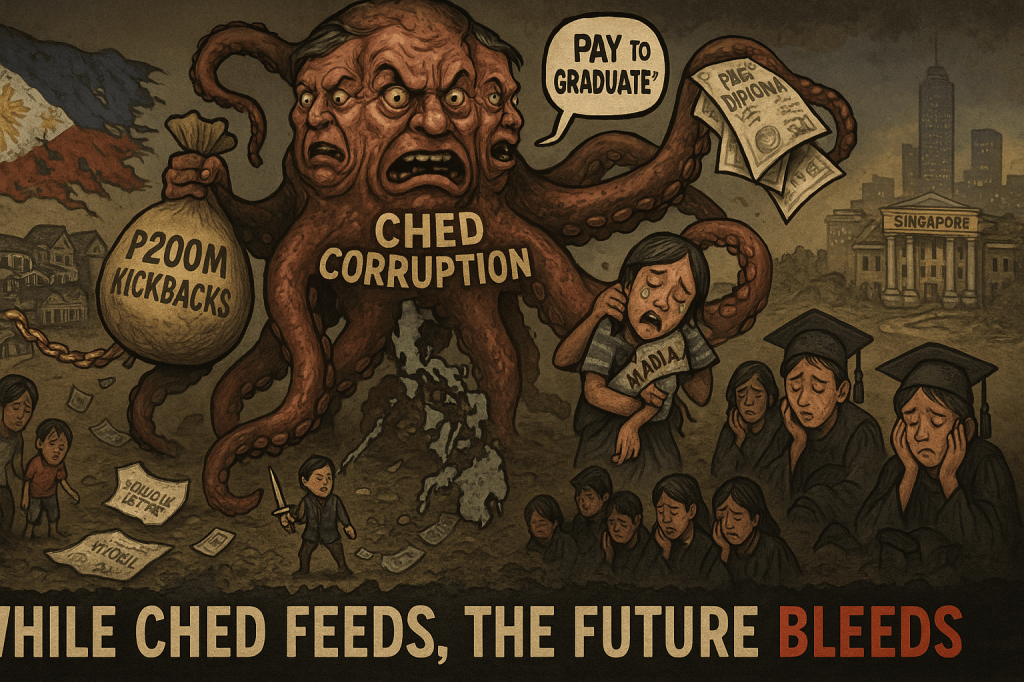
WHEN Maria, an 18-year-old from Davao, clutched her CHED scholarship letter, her family saw a lifeline out of poverty. A chance to study engineering, to rewrite their story. But a university official’s demand for a bribe shattered that hope. Unable to pay, Maria watched her scholarship slip to a politician’s son. Her dreams dissolved, and with them, a fragment of the Philippines’ promise. Maria’s betrayal is not an anomaly—it’s the bitter fruit of a corrupt system festering within the Commission on Higher Education (CHED), where greed suffocates opportunity.
The Rotten Core: Unmasking CHED’s Scandalous Underbelly
CHED, tasked with elevating Philippine higher education, has instead become a den of graft, bleeding the nation dry. The evidence paints a grim picture:
- The P200 Million Kickback Racket: In 2017, Wing-An Construction’s P200 million student center contract at the University of Science and Technology of Southern Philippines (USTP) was terminated for refusing a 10% “Standard Operating Procedure” bribe. Engineer Selwyn Lao’s 14 unanswered letters to President Duterte and Congress implicate then-USTP president Dr. Ricardo Rotoras and former CHED Chair Patricia Licuanan in a scheme where contracts are sold to the highest bidder, not the most qualified.
- Crony Appointments: Rotoras, convicted in 2011 for misconduct and moral turpitude, was inexplicably reappointed USTP president by Licuanan, defying CHED’s own rules. His 2017 murder, possibly tied to these dealings, casts a dark shadow over the institution’s moral decay.
- Internal Power Games: In 2024, Commissioner Aldrin Danilag faced a 90-day suspension for grave misconduct, only to retaliate with graft charges against then-Chair Prospero de Vera III under RA 3019. Commissioner Ronald Adamat’s 2018 charges of oppression and dishonesty further expose CHED as a battleground of self-interest, not public service.
- Scholarship Plunder: Funds meant for students like Maria are pilfered. Reports reveal regents’ relatives monopolizing scholarships, while deserving students’ families sign false receipts, receiving only fractions of promised grants. This isn’t just theft—it’s a calculated assault on the poor.
These scandals mirror education crises in nations like Nigeria, where corrupt oversight breeds diploma mills. In the Philippines, CHED’s corruption turns universities into factories of fraud, churning out degrees as worthless as counterfeit pesos.
A Nation’s Dreams Stolen: The Devastating Fallout
CHED’s corruption doesn’t just rob wallets—it robs futures. The Philippines’ dismal PISA rankings, among the world’s lowest, reflect a system prioritizing bribes over books. Misallocated funds—diverted from labs, libraries, and faculty—leave classrooms crumbling, graduates unemployable.
The World Bank estimates corruption in education costs developing nations billions in GDP. For the Philippines, this means a workforce unfit for global competition, chaining the economy to stagnation.
The human toll is heart-wrenching. Students like Maria lose scholarships to the well-connected, forcing them into dead-end jobs or overseas labor markets. Families pay bribes for grades, draining savings. Graduates with fraudulent degrees face rejection in a job market demanding real skills. Like Mexico’s fake universities, the Philippines risks producing a generation of graduates betrayed by their own system.
Inequality festers as elites hoard opportunities. Scholarships and admissions favor the powerful, echoing India’s education scandals where wealth trumps merit. This entrenches dynasties, leaving the poor to fight for scraps.
Marcos’ Shake-Up: A New Dawn or Smoke and Mirrors?
In May 2025, President Ferdinand Marcos Jr. appointed Shirley Agrupis as CHED chair, alongside commissioners Marita Canapi, Ethel Agnes Valenzuela, and Desiderio Apag III (Philstar, May 29, 2025). The move promises reform, but skepticism lingers.
Agrupis’ clean record is a start, but her predecessors’ failures loom large. The 2025 budget, slashing CHED’s funding by P26.9 billion while funneling P7.2 billion to state universities through murky “direct downloads,” smells of the same accounting tricks that mask corruption (Daily Tribune, June 16, 2025). Without structural change, this reshuffle risks being political theater, not progress.
Breaking the Chains: Demanding Real Reform
To save Philippine education, CHED must face a reckoning:
- Jail the Corrupt: The Ombudsman’s silence is complicity. Why haven’t Licuanan, de Vera, or Danilag faced trial under RA 3019? Swift prosecutions are essential to deter future graft.
- Expose the Books: CHED’s budgets and contracts must be public, audited independently, and posted online in real time. Every peso—from scholarships to construction—must be traceable to root out theft.
- Protect the Truth-Tellers: Students and faculty exposing graft face expulsion or worse. Anonymous hotlines linked to the Ombudsman’s e-BOS system and strict non-retaliation policies are critical to empower whistleblowers.
- Merit Over Cronyism: Appointments and scholarships must be transparent, with public vetting to prevent cases like Rotoras. Scholarships must prioritize the deserving, not the connected, with audited criteria.
Singapore’s education system thrives on transparency and accountability—why can’t the Philippines follow suit? These reforms aren’t dreams; they’re necessities.
A Moral Imperative: Save the Next Generation
The Philippines cannot rise while its universities are auctioned off. CHED’s corruption is a moral catastrophe, stealing futures from students like Maria and shackling a nation to mediocrity. Every bribe, every stolen scholarship, every rigged contract is a dagger in the heart of progress.
President Marcos faces a defining choice: Will he dismantle this corrupt machine, or let it grind on? The Philippines’ youth deserve more than hollow promises—they demand justice now.
Key Citations
- Daily Tribune: CHEd, center of corruption
- SunStar: Lao urges Duterte to probe USTP officials
- Philstar: Marcos appoints new CHED chairperson
- Wikipedia: Ricardo Enriquez Rotoras
- RA 3019: Anti-Graft and Corrupt Practices Act
- OECD: PISA 2022 Results
- UNODC: Philippine anti-corruption efforts

- ₱75 Million Heist: Cops Gone Full Bandit

- ₱6.7-Trillion Temptation: The Great Pork Zombie Revival and the “Collegial” Vote-Buying Circus

- ₱1.9 Billion for 382 Units and a Rooftop Pool: Poverty Solved, Next Problem Please

- ₱1.35 Trillion for Education: Bigger Budget, Same Old Thieves’ Banquet

- ₱1 Billion Congressional Seat? Sorry, Sold Out Na Raw — Si Bello Raw Ang Hindi Bumili

- “We Will Take Care of It”: Bersamin’s P52-Billion Love Letter to Corruption

- “Skewed Narrative”? More Like Skewered Taxpayers!

- “Scared to Sign Vouchers” Is Now Official GDP Policy – Welcome to the Philippines’ Permanent Paralysis Economy
- “Robbed by Restitution?” Curlee Discaya’s Tears Over Returning What He Never Earned
- “No Pressure” Luistro? The House Pork Bazaar Exposed
- “My Brother the President Is a Junkie”: A Marcos Family Reunion Special

- “Mapipilitan Akong Gawing Zero”: The Day Senator Rodante Marcoleta Confessed to Perjury on National Television and Thought We’d Clap for the Creativity






 KWEBA ni BAROK
Leave a comment