By Louis ‘Barok‘ C. Biraogo — July 5, 2025
A Mother’s Tragedy Sets the Stage
In a suffocating Quezon City slum, Mona, a single mother of three, clutches the fading memory of her youngest, lost to dengue last year when overwhelmed hospitals slammed their doors. Her heartbreak is a searing indictment of a health system that crumbled during COVID-19, leaving the poorest Filipinos defenseless.
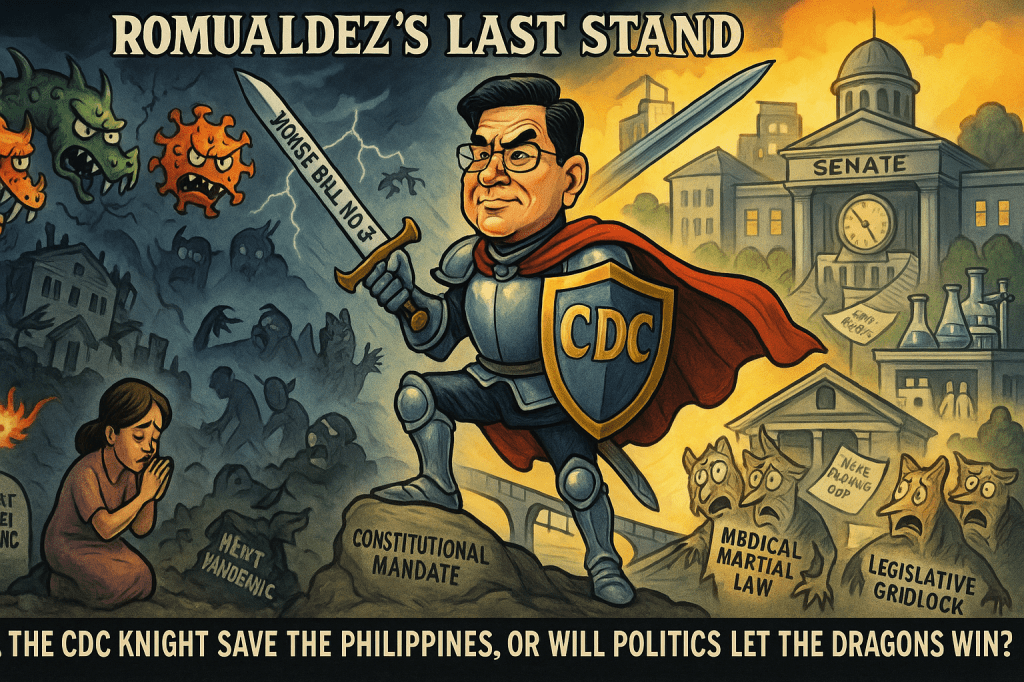
Now, as the specter of the next crisis looms, Leyte Rep. Martin Romualdez wields House Bill No. 3, a daring proposal for a Philippine Center for Disease Prevention and Control (CDC). This isn’t just policy—it’s a lifeline. But can it break through the political quagmire, or will the Philippines roll the dice with millions of lives?
Romualdez’s Crusade: A Shield Against Chaos
Romualdez, flanked by Tingog Party-list Reps. Jude Acidre and Andrew Julian Romualdez, isn’t tinkering at the edges—he’s demanding a seismic shift in public health. The COVID-19 pandemic laid bare a fractured system: scattered DOH bureaus, underfunded labs, and sluggish responses that failed the vulnerable.
House Bill No. 3 envisions a centralized CDC with four cornerstones—health statistics, epidemiology, health evidence, and laboratories—to replace chaos with science-driven precision. Anchored in the Constitution’s mandate to protect every Filipino’s right to health, Romualdez argues this agency is a moral necessity.
“The pandemic revealed deficiencies in disease surveillance, outbreak response, and coordination,” he declared,
a view echoed by DOH Secretary Teodoro Herbosa, who sees the CDC as the antidote to fragmented efforts.
For the poor, this could be a game-changer. In rural Leyte, where tuberculosis ravages under-resourced clinics, a CDC could deploy rapid diagnostics, sparing families like Mona’s the anguish of preventable loss. By prioritizing prevention—vaccines, surveillance, robust labs—the agency could blunt the economic devastation of outbreaks.
COVID-19 plunged 2.3 million Filipinos into poverty in 2020, with Manila’s slum dwellers hit hardest, losing livelihoods as lockdowns crushed informal economies. The CDC, Romualdez insists, isn’t a shadow government—it’s a shield against a burning crisis.
Slaying the ‘Medical Martial Law’ Monster
Critics, led by groups like the Lunas Pilipinas Coalition, conjure nightmares of “medical martial law,” warning that the CDC’s powers—quarantines, surveillance, even animal culls—could spiral into authoritarian control. They fret over provisions allowing the National Telecommunications Commission to share patient data or fear WHO influence eroding sovereignty, as voiced in a May 2023 protest rally.
These claims, though gripping, don’t hold up. DOH officials, including Vergeire, confirm the bill lacks provisions for warrantless arrests or foreign control. Contrast this with the real terror: during COVID-19, Manila’s slums became infection hotspots, with families crammed in shanties unable to isolate, and hospitals turning away the desperate.
Unemployment spiked to 17.7% in April 2020, gutting lives. The true monster isn’t a hypothetical tyranny—it’s a system too weak to save its people.
Still, privacy concerns deserve attention. Surveillance powers, like tracking patient locations, could erode trust, especially among the poor, who often face disproportionate scrutiny. These risks don’t demand scrapping the CDC but require robust safeguards—independent audits, transparent data protocols—to protect rights without sacrificing lives.
Without centralized coordination, diseases like tuberculosis, claiming 70 Filipino lives daily, will continue to prey on the vulnerable.
A Beacon for the Poor—If It Shines Equitably
For marginalized communities, the CDC’s promise is electrifying. Swift outbreak containment could stop diseases like dengue or TB before they spiral, sparing rural Leyte farmers or Manila slum dwellers from crippling medical debt.
Preventive care, like free TB diagnostics, could stabilize incomes by cutting emergency costs—vital for the 18% of Filipinos below the poverty line. A data-driven CDC could level health access, ensuring remote areas aren’t forgotten, as seen in the DOH’s “Lab for All” initiative.
Yet shadows linger. Diverting funds to a new agency could starve existing programs, like primary care clinics the poor depend on. Without airtight oversight, surveillance might disproportionately target vulnerable communities, deepening distrust.
Romualdez must embed transparency—public dashboards tracking CDC spending—and prioritize pro-poor measures, like free diagnostics and mobile clinics.
Sierra Leone’s centralized disease programs, bolstered by Helen Keller International, tamed Ebola through community-driven surveillance and equitable care—a blueprint the Philippines could adapt to ensure the CDC serves the poorest first.
The Ticking Clock: Will Politics Betray the Vulnerable?
Will the Philippines repeat its COVID-era chaos when the next pandemic strikes? The question pulses with urgency. House Bill No. 3 cleared the House in December 2022, but as of July 4, 2025, it languishes in the Senate, ensnared by political infighting or bureaucratic inertia.
Can Romualdez’s vision outmaneuver vested interests—those profiting from a broken system or paralyzed by fear of change? Time is running out. Tuberculosis, dengue, and emerging threats like mpox don’t pause for legislative gridlock. Every delay risks another Mona, another child lost to a shattered system.
Rallying Cry: Act Before the Next Crisis Strikes
The Senate must seize this moment. Pass House Bill No. 3, but fortify it with ironclad safeguards: transparent budgets, pro-poor mandates, and rigorous oversight to prevent abuse.
Public dashboards, like Sierra Leone’s, can track spending and outcomes, rebuilding trust. Free TB diagnostics and mobile health units must prioritize slums and rural barrios, not just urban hubs.
Lawmakers should draw from global triumphs—Sierra Leone’s Ebola response, Thailand’s disease control model—to craft a CDC that’s lean, equitable, and unstoppable.
Mona’s loss isn’t just a tragedy—it’s a siren. The Philippines can’t afford to wager its people’s lives. Romualdez’s CDC is a chance to rewrite the future, to forge a system that saves the poorest first.
But it’s a high-stakes race against time, politics, and the next unseen virus. Will lawmakers rise, or will they let another crisis torch the nation’s most vulnerable? The choice is theirs—and the lives of millions hang in the balance.
Key Citations
- Philippine News Agency (PNA) – March 28, 2023: Details on House Bill No. 3’s progress and DOH’s support for the Philippine CDC, reflecting Health Secretary Teodoro Herbosa’s alignment with efforts to strengthen disease prevention and control infrastructure.
- House of Representatives, 2025: Press release 9n House Bill no. 3
- Vera Files – May 31, 2023: Outlines opposition arguments, including concerns about “medical martial law.”
- Philippine Statistics Authority (PSA) – 2020 Poverty Indicators Survey: Data on poverty increase during COVID-19.
- PSA Employment Situation – April 2020: Unemployment spike during the pandemic.
- Reuters, 2022: Pandemic pushed millions more into poverty in the Philippines, government says
- DOH Tuberculosis Program – Statistics on TB mortality in the Philippines.
- DOH Lab for All – Information on the DOH’s mobile health initiative.
- Helen Keller International – Details on Sierra Leone’s Ebola response model.

- ₱75 Million Heist: Cops Gone Full Bandit

- ₱6.7-Trillion Temptation: The Great Pork Zombie Revival and the “Collegial” Vote-Buying Circus

- ₱1.9 Billion for 382 Units and a Rooftop Pool: Poverty Solved, Next Problem Please

- ₱1.35 Trillion for Education: Bigger Budget, Same Old Thieves’ Banquet

- ₱1 Billion Congressional Seat? Sorry, Sold Out Na Raw — Si Bello Raw Ang Hindi Bumili

- “We Will Take Care of It”: Bersamin’s P52-Billion Love Letter to Corruption

- “Skewed Narrative”? More Like Skewered Taxpayers!

- “Scared to Sign Vouchers” Is Now Official GDP Policy – Welcome to the Philippines’ Permanent Paralysis Economy
- “Robbed by Restitution?” Curlee Discaya’s Tears Over Returning What He Never Earned
- “No Pressure” Luistro? The House Pork Bazaar Exposed
- “My Brother the President Is a Junkie”: A Marcos Family Reunion Special

- “Mapipilitan Akong Gawing Zero”: The Day Senator Rodante Marcoleta Confessed to Perjury on National Television and Thought We’d Clap for the Creativity


 KWEBA ni BAROK
Leave a comment