By Louis ‘Barok‘ C. Biraogo — July 11, 2025
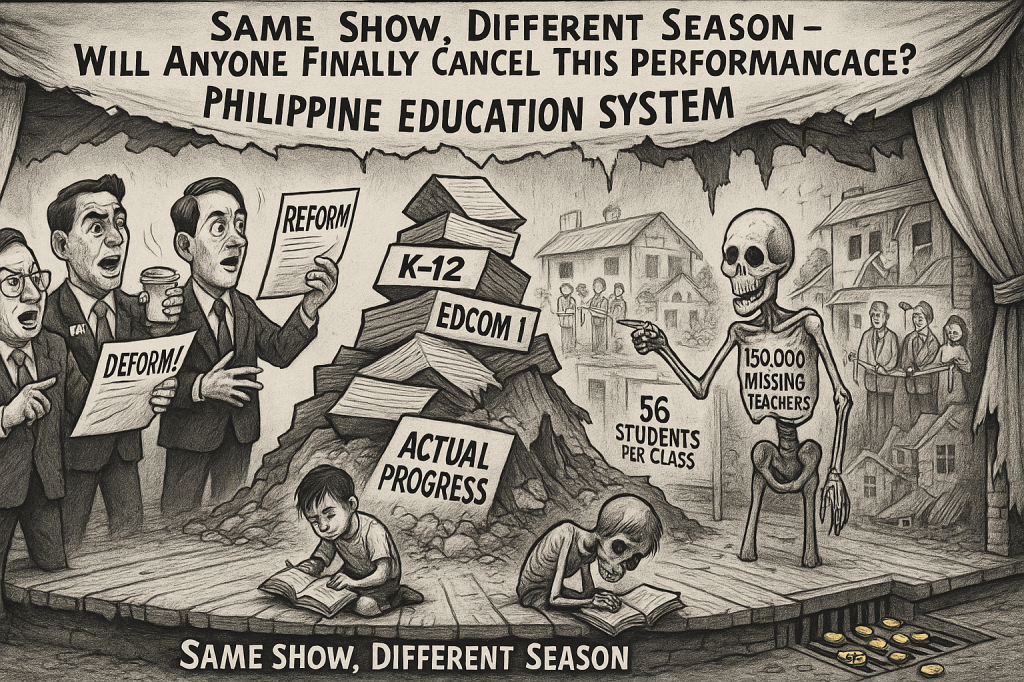
CONGRATULATIONS, Philippines—you’ve sculpted an education system so catastrophic it’s practically performance art, where nine out of ten kids can’t read at grade level, and the next generation is set to botch not just a McDonald’s menu but the nation’s future.
The Philippine Business for Education (PBEd) has unfurled yet another “urgent” report, brandishing a four-point agenda like a tattered flag in a crisis that’s been rotting since flip phones were high-tech. Spoiler: it’s the same tired script, repackaged with corporate buzzwords and a fresh sheen of despair.
Let’s eviscerate this travesty with the scalding scrutiny it deserves, exposing the human toll, the theatrical hand-wringing, and the spin that keeps this tragedy on an endless loop.
Unveiling PBEd’s Four-Point Fiasco: Buzzwords Masquerading as Salvation
PBEd’s latest manifesto is a glossy pamphlet of despair: decentralization, early learning, curriculum realignment, quality instruction. It’s the kind of jargon you’d hear at a Pasay City forum where elites sip artisanal coffee while kids collapse in dilapidated classrooms.
Let’s shred this agenda with the cynicism of a journalist who’s watched too many “reforms” dissolve into bureaucratic mist.
Decentralization: The Great Buck-Passing Scam
PBEd wants to empower Local School Boards (LSBs) and overhaul Special Education Fund (SEF) spending, as if handing the reins to local governments will miraculously mend a system shattered for decades.
Reality check: many LSBs are dormant because local politicos treat them like ATMs, diverting SEF funds to basketball courts or campaign-branded tarps instead of books or teacher training. In 2020, only 67.8% of SEF funds were used, leaving schools to crumble.
Decentralization isn’t a fix; it’s a buzzword to dodge the real problem: nobody wants to fund reform. Without bulletproof anti-corruption measures and capacity-building, this is like entrusting a sinking ship to captains who can’t navigate.
PBEd’s Bal Camua insists, “Solutions must come from those who understand the context best.” Sure, but when your “context” is a mayor who thinks textbooks are optional, good luck.
Early Learning and Remediation: Band-Aids on a Bleeding Wound
Scaling up Early Childhood Care and Development (ECCD) and the Aral Law to teach kids reading, writing, and math sounds noble—until you realize it’s a flimsy patch on a gangrenous system.
Nine out of ten students can’t read at grade level, a stat so dire it’s a national humiliation. PBEd’s call is like yelling “Fire!” after the house is ashes.
The Aral Law, meant to bridge learning gaps, is a nice gesture, but where’s the cash? Where’s the army of trained teachers? Picture a child in BARMM, crammed into a classroom with 50 others, taught by a teacher who hasn’t seen a workshop since Y2K. That’s not education; it’s a prison for potential.
And with 26% of kids under 5 malnourished, many are too hungry to learn. PBEd’s “foundational skills” spiel is corporate drivel when kids are fainting at their desks.
Curriculum Realignment: Churning Cogs, Not Thinkers
PBEd pushes for tech-voc and higher education to align with industry needs, as if transforming schools into job factories will save the day.
Four in ten college students drop out, and graduates often find their degrees as useful as a paperweight in a digital economy. TESDA’s assessor shortage—needing 47,000 assessors to clear backlogs—is a dark comedy.
But let’s be real: focusing on “industry needs” risks producing call-center drones while neglecting critical thinking or civic education. The Philippines needs citizens who can read a ballot, not just a job ad.
PBEd’s fix sidesteps the core issue: a system so broken that even aligned curricula won’t help kids who can’t read the syllabus.
Quality Instruction: Teachers as Sacrificial Lambs
Lower student-teacher ratios and better training? Revolutionary. Except 62% of teachers are teaching subjects they’re not trained for, and class sizes average 43.9 in elementary and 56.1 in secondary schools.
Teachers are stretched thinner than a peso in a sari-sari store, yet PBEd’s solution heaps more expectations on them while DepEd treats them like glorified babysitters.
Professional development is a pipe dream when the government spends a pathetic 3.4% of GDP on education—below UNESCO’s 6% benchmark. Teachers aren’t just overworked; they’re martyrs in a system that glorifies their suffering while politicians pose for selfies at half-empty school openings.
PBEd’s agenda isn’t wrong—it’s redundant. EDCOM I, K–12, EDCOM II—decades of “urgent calls” have stacked up like unread emails in DepEd’s inbox.
“We’re racing against time,” Camua proclaims. Sorry, Bal, the race ended 20 years ago, and the kids lost.
The Human Carnage: A Generation Abandoned to Ruin
Imagine a child in Samar, trekking miles to a school with no power, sharing a tattered textbook with three classmates, taught by a teacher juggling subjects she barely grasps. That’s not education; it’s a cruel charade.
Only 7% of kids in poor regions finish college—not a pipeline, but a sewage leak draining human potential.
The poor bear the brunt:
- 26% of kids under 5 are malnourished, stunting their brains;
- Poverty pushes 2.1 million kids into child labor;
- Schools in places like BARMM are more fantasy than fact.
PBEd’s “systems transcend administrations” mantra feels like a TED Talk for elites who’ve never seen a classroom without Wi-Fi. These kids aren’t stats; they’re human collateral in a system content to let them rot.
This isn’t just academic failure—it’s moral bankruptcy. Illiteracy locks the poor out of democracy, leaving them vulnerable to disinformation and dynasties. High dropout rates fuel crime and unrest, with youth unemployment at 14.2% in 2024.
This isn’t a learning gap; it’s a betrayal of a generation, condemning them to scrape by while the elite ship their kids to private schools abroad.
The Culprits: Profiteers Feasting on Failure
Who’s profiting from this disaster?
- Politicians who treat schools as Instagram backdrops, grinning with kids for votes while SEF funds vanish into “infrastructure” black holes.
- Corrupt LGUs, misallocating budgets to pad pockets or patronage networks.
- Textbook monopolies, churning out overpriced, outdated books while students share dog-eared copies.
- DepEd, CHED, and TESDA—the three blind mice of education—squabbling over who lost the cheese while students languish.
DepEd’s “We’ll fix it next budget cycle” mantra earns the Golden Backburner Award, a shining tribute to kicking the can down a road paved with broken dreams.
Then there’s PBEd, bankrolled by oligarchs who preach reform while their empires thrive on a cheap, undereducated workforce. The irony is thicker than Manila traffic: these tycoons lament the skills gap but profit from it.
If they’re so concerned, why not tax their fortunes to fund the schools they claim to champion? Hypocrisy, thy name is corporate philanthropy.
A Radical Reckoning: Marshall Plan or Mediocrity
No more vague “investment” pleas. The Philippines needs a Marshall Plan for education—a seismic overhaul admitting the system is a national disgrace.
- Tax the oligarchs behind PBEd—yes, you, the ones funding forums while kids learn under mango trees.
- Use that revenue to hire 50,000 teachers annually to close the 150,000-teacher gap and build 90,000 classrooms to end the backlog.
- Slash student-teacher ratios to 1:20, not 1:50, and pay teachers like professionals, not saints.
- Mandate ongoing training, not one-off workshops, and ditch the textbook cartels—open-source digital materials are cheaper and better.
Decentralization? Sure, but with muscle:
- National oversight to curb LGU corruption,
- Equitable funding to prevent rich regions from outshining poor ones,
- Principals trained as instructional leaders, not paper-pushers.
Merge DepEd, CHED, and TESDA into one agency that actually communicates.
For the poor, integrate nutrition programs into schools—26% of kids under 5 are malnourished, and empty stomachs don’t learn.
Fund ECCD and the Aral Law with real pesos, targeting BARMM and Samar first.
Anything less is admitting the Philippines is content being Southeast Asia’s cautionary tale—a nation where potential is squandered, and the poor are left to drown.
The Final Indictment
The real test isn’t whether Filipino kids can read—it’s whether their leaders can read the room before it burns down.
Will the Philippines keep staging this farce of reform, or will it confront the crisis with the urgency it demands?
Don’t hold your breath. The kids can’t afford to.
Key Citations
- Philippine Business for Education (PBEd) – Source of the education crisis report and four-point agenda.
- WIN: Underutilization of Special Education Fund flagged – Data on SEF fund utilization flagged
- PhilStar, 2024: 62% of high school teachers teaching outside their field, new report reveals
- Republic Act No. 12028 (Aral Law) – Legislation for remedial education.
- UNICEF Philippines: Nutrition Statistics – Data on child malnutrition.
- PhilStar, 2024: Senator: Philippines needs 47,000 Tesda assessors
- International Labour Organization: Child Labor in the Philippines – Statistics on child labor.
- Philippine Statistics Authority: Labor Force Survey 2024 – Youth unemployment data.
- Department of Education: Education Statistics – Teacher and classroom shortages, student-teacher ratios.
- Rappler, 2025: Philippines’ classroom shortage may take over 20 years to resolve
- TESDA: Assessor Shortage – Information on certification backlogs.
- PIDD, 2025: PHL underspending on education – study
- World Bank: Education Spending – GDP spending on education.

- ₱75 Million Heist: Cops Gone Full Bandit

- ₱6.7-Trillion Temptation: The Great Pork Zombie Revival and the “Collegial” Vote-Buying Circus

- ₱1.9 Billion for 382 Units and a Rooftop Pool: Poverty Solved, Next Problem Please

- ₱1.35 Trillion for Education: Bigger Budget, Same Old Thieves’ Banquet
- ₱1 Billion Congressional Seat? Sorry, Sold Out Na Raw — Si Bello Raw Ang Hindi Bumili

- “We Will Take Care of It”: Bersamin’s P52-Billion Love Letter to Corruption

- “Skewed Narrative”? More Like Skewered Taxpayers!

- “Scared to Sign Vouchers” Is Now Official GDP Policy – Welcome to the Philippines’ Permanent Paralysis Economy
- “Robbed by Restitution?” Curlee Discaya’s Tears Over Returning What He Never Earned
- “No Pressure” Luistro? The House Pork Bazaar Exposed
- “My Brother the President Is a Junkie”: A Marcos Family Reunion Special

- “Mapipilitan Akong Gawing Zero”: The Day Senator Rodante Marcoleta Confessed to Perjury on National Television and Thought We’d Clap for the Creativity





 KWEBA ni BAROK
Leave a comment