By Louis ‘Barok‘ C. Biraogo — July 14, 2025
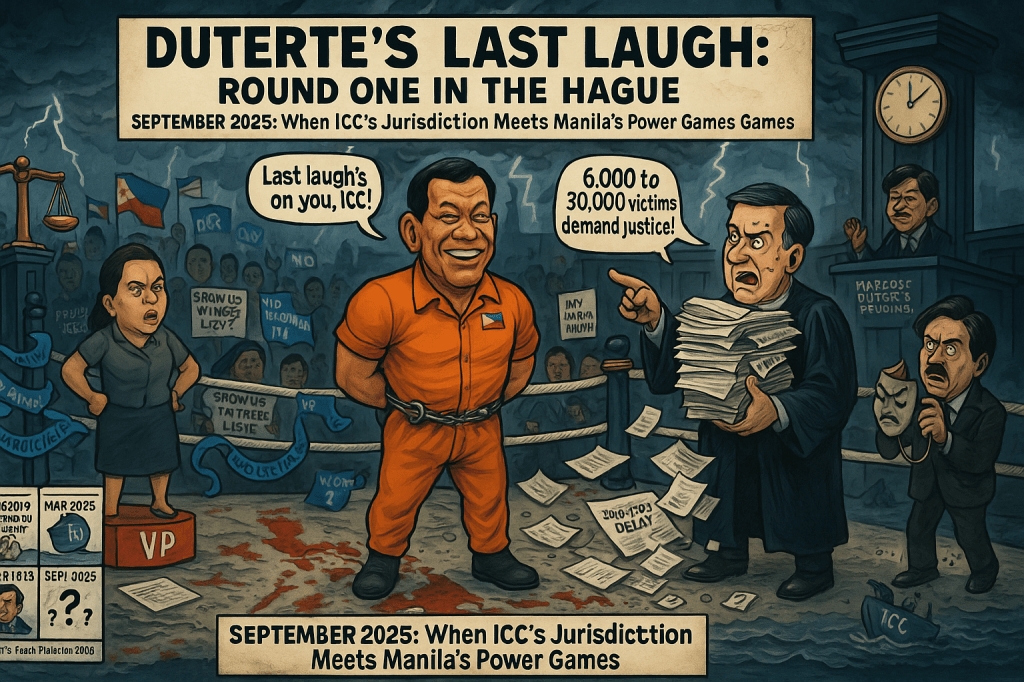
THE International Criminal Court’s (ICC) case against former Philippine President Rodrigo Duterte is a legal bloodbath with global reverberations. Arrested on March 11, 2025, for alleged crimes against humanity in his brutal “war on drugs,” Duterte faces a September 2025 charges hearing that could cement or crater the ICC’s legitimacy. With estimates of 6,000 to 30,000 extrajudicial killings, this case is a crucible of jurisdictional knife-fights, political backstabbing, and existential questions about global justice. Is the ICC a righteous enforcer or a tool in Manila’s dynastic wars? Let’s tear it apart.
Jurisdictional Cage Match: Can the ICC Pin Duterte?
Duterte’s legal team, led by Nicholas Kaufman and Dov Jacobs, is throwing haymakers, demanding dismissal by arguing the ICC lost its grip when the Philippines ditched the Rome Statute in March 2019. Their core claim? The prosecution slept on its job, only requesting a formal investigation in 2021—two years after withdrawal—despite a preliminary examination starting in February 2018. Citing Article 127(2), which preserves ICC authority only for matters “under consideration” pre-withdrawal, they lean on dissenting judges Perrin De Brichambaut and Gocha Lordkipanidze, who in 2023 slammed the prosecution’s snail’s pace (ICC Appeals Chamber, 2023).
The defense insists a preliminary probe isn’t enough and, quoting Judge Van den Wyngaert’s Katanga ruling, argues due process trumps victims’ cries (Katanga Judgment, 2012). This is jurisdictional cage fighting, but the defense is punching above its weight.
The prosecution counters that the 2018 preliminary examination—launched before Duterte’s withdrawal notice—qualifies as “under consideration,” locking jurisdiction for crimes from November 2011 (Philippines’ Rome Statute entry) to March 2019. Article 127(2) doesn’t demand a full investigation, and the Burundi precedent confirms jurisdiction holds for pre-withdrawal crimes.
The defense’s dissent-heavy strategy is a long shot; the 2023 Appeals Chamber ruling (ICC-01/21-77) greenlit the probe, and Katanga is irrelevant to jurisdiction. Still, the prosecution’s 2018-2021 delay isn’t a good look—Duterte’s team could paint it as bad faith. The Pre-Trial Chamber must decide: is the ICC’s reach a steel grip or a paper tiger?
Witness Witch Hunt: Evidence Under Fire
The ICC’s arsenal—forensic reports, whistleblower testimonies, and UN data—paints a gory picture of Duterte’s drug war, with human rights groups estimating 6,000-30,000 deaths (Human Rights Watch, 2020). But the defense calls it a rushed, politicized hit job.
Vice President Sara Duterte, Rodrigo’s daughter, alleges witness coercion without hard proof and gripes about not seeing the witness list, despite the prosecution’s 12 evidence submissions by July 2025 (ICC Filing, July 2, 2025). The prosecution, citing Article 68, plays hardball on witness protection, delaying disclosures to shield sources from reported online harassment (Amnesty International, 2025).
This witness witch hunt is a high-stakes sideshow. The defense’s disclosure complaints carry weight; Article 67 demands a fair shot at preparation. But the Lubanga precedent (Lubanga, 2008) balances protection with defense rights, and the prosecution met the July 1, 2025, deadline. Sara’s public tantrums are pure theater, rallying loyalists while fishing for procedural fouls. The ICC must plug transparency gaps—Vice President Duterte’s secrecy jabs fuel “neo-colonial” critiques and erode trust.
Geopolitical Bloodbath: Marcos vs. Duterte vs. The Hague
This case is a political Molotov cocktail. President Ferdinand Marcos Jr.’s flip from ICC defiance to cooperation reeks of opportunism, timed with his feud against the Dutertes. Sara’s impeachment threats and alleged assassination plots (Reuters, 2025) suggest Marcos is using the ICC as a guillotine for his rivals.
Duterte’s “Punisher” bravado—framing the case as Western meddling—plays to loyalists and taps regional skepticism about the ICC’s reach. The ICC’s own baggage weighs heavy. Critics, pointing to its Africa-heavy caseload, cry neo-colonialism (African Union, 2017). Duterte’s case, the first against an Asian leader, could counter that narrative—or cement it if mishandled.
With only Cambodia and Timor-Leste as Southeast Asian ICC members (ICC Member States), a botched case risks alienating the region, while a win could pull others in. The ICC’s on a tightrope, and Duterte’s team is shaking the rope.
Verdict’s Global Shockwaves: Justice or Sovereignty’s Swan Song?
The September 2025 hearing is a do-or-die moment. A dismissal could greenlight authoritarians to dodge accountability by quitting the Rome Statute, as Burundi did (ICC Burundi, 2017). The ICC’s Gbagbo ruling (Gbagbo, 2012) confirms jurisdiction for member-state crimes, but a loss here would paint the Court as impotent.
A conviction, however, could deter future “war on drugs” bloodbaths, signaling impunity’s limits. In the Philippines, the case stokes Marcos-Duterte tensions, risking chaos if loyalists riot. Domestic courts, with only four low-level convictions (Philippine Star, 2024), flunk Article 17’s complementarity test. The ICC must push Manila to prosecute mid-tier perpetrators to prove local justice isn’t a farce.
For readers, the stakes are stark: a mishandled case could destabilize Manila or torch regional trust in the ICC.
Recommendations
- For the ICC: Publish crystal-clear witness protocols to shut down Sara’s secrecy complaints. Transparency bolsters legitimacy without risking witness safety.
- For the Philippines: Launch domestic trials for mid-level drug war players. It’s the only way to show complementarity isn’t a hollow buzzword.
- For Readers: Brace for turbulence—Duterte’s base could ignite Manila’s streets, and ASEAN’s watching to see if the ICC is friend or foe.
The ICC’s leaky boat is sailing into a Category 5 storm. September 2025 will decide if it holds water or sinks under Duterte’s sovereignty gambit. The world’s got front-row seats.
Key Citations
- Rome Statute of the International Criminal Court – Articles 11, 12, 15, 17, 67, 68, 127.
- ICC Appeals Chamber Decision, 2023 (ICC-01/21-77) – Authorized resumed investigation into the situation in the Philippines, covering Duterte’s case.
- ICC Burundi Situation – Precedent for jurisdiction post-withdrawal.
- Katanga Judgment, 2012 (ICC-01/04-01/07-3436) – Cited by defense on due process.
- Lubanga Decision, 2008 (ICC-01/04-01/06-1401) – Witness protection vs. defense rights.
- Gbagbo Decision, 2012 (ICC-02/11-01/11-656) – Jurisdiction over member-state crimes.
- Human Rights Watch, 2020 – Drug war death estimates.
- Amnesty International, 2025 – Witness intimidation reports.
- Reuters, 2024: ‘Open warfare’: Philippines’ Marcos-Duterte alliance crumbles – Marcos-Duterte political tensions.
- The Conversation, 2017: International Criminal Court must not ignore threats of an African mass withdrawal – ICC neo-colonialism critiques.
- Philippine Star, 2024: Rights groups refute Marcos’ claim of ‘progress’ in ending drug war abuses – Low domestic convictions.

- “Forthwith” to Farce: How the Senate is Killing Impeachment—And Why Enrile’s Right (Even If You Can’t Trust Him)

- “HINDI AKO NAG-RESIGN!”

- “I’m calling you from my new Globe SIM. Send load!”

- “Mahiya Naman Kayo!” Marcos’ Anti-Corruption Vow Faces a Flood of Doubt

- “Meow, I’m calling you from my new Globe SIM!”

- “No Special Jail for Crooks!” Boying Remulla Slams VIP Perks for Flood Scammers

- “PLUNDER IS OVERRATED”? TRY AGAIN — IT’S A CALCULATED KILL SHOT

- “Several Lifetimes,” Said Fajardo — Translation: “I’m Not Spending Even One More Day on This Circus”

- “Shimenet”: The Term That Broke the Internet and the Budget

- “We Did Not Yield”: Marcos’s Stand and the Soul of Filipino Sovereignty

- “We Gather Light to Scatter”: A Tribute to Edgardo Bautista Espiritu

- $150M for Kaufman to Spin a Sinking Narrative






 KWEBA ni BAROK
Leave a comment