By Louis ‘Barok‘ C. Biraogo — July 12, 2025
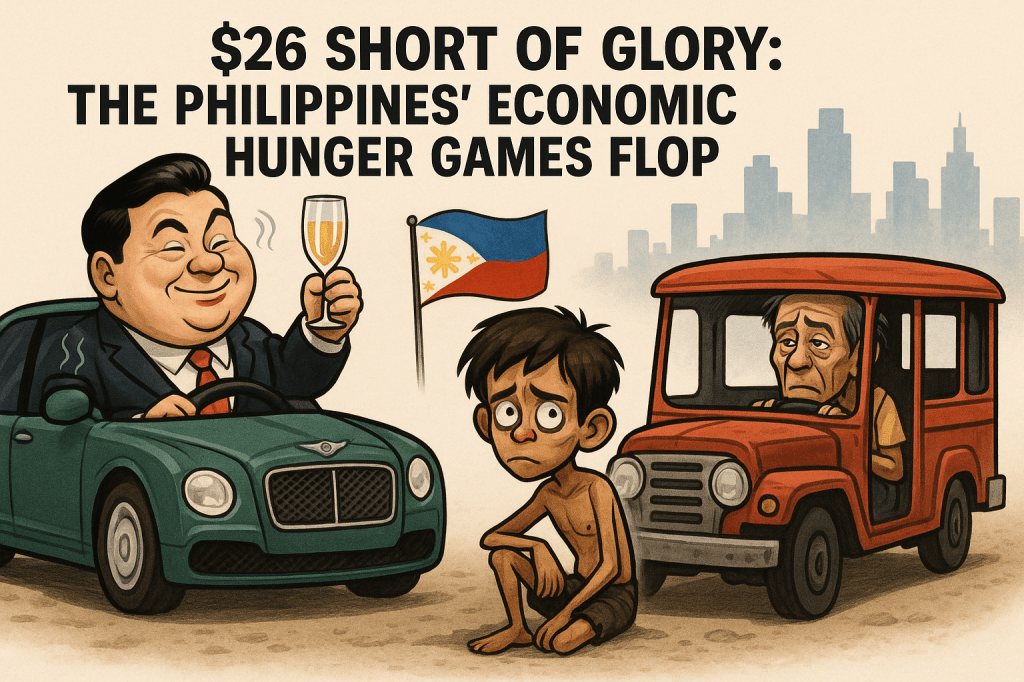
MABUHAY, Philippines! You’ve snagged the economic equivalent of a consolation prize—$26 shy of the World Bank’s upper middle-income country (UMIC) status, while 17 million families scrape by on less than ₱20,000 a year. The nation’s GNI per capita hit $4,470 in 2024, a hair’s breadth from the $4,496 threshold, yet this near-miss is less a thriller than a cruel hallucination. For the average Filipino, UMIC status is as graspable as a Marcos-era gold bar—gleaming in rhetoric, absent in reality.
The Grand Illusion of “Almost There”
The Philippines’ UMIC flirtation is a statistical sleight-of-hand worthy of a Vegas magician. GNI per capita, the World Bank’s go-to metric, blends the nation’s wealth like a smoothie of caviar and carabao dung, masking obscene disparities. The richest 10% hoard as much as the poorest 50%, yet this chasm vanishes in the GNI glow. Malacañang trumpets “steady growth,” but for the jeepney driver dodging Manila’s craters or the farmer yoked to a water buffalo, the $26 gap isn’t a statistic—it’s a lifetime of want. While elites clink glasses, 25% of Filipinos languish below the poverty line, their “inclusion” in progress as real as a teleserye sob story.
The Theater of Perpetual Almosts
The Philippines’ UMIC chase is a tragicomedy trapped in a Groundhog Day rerun. President Marcos Jr.’s 2022 vow to hit UMIC by 2024 has been punted to 2027, as predictable as a monsoon flood. The nation excels at spinning potential into PowerPoint decks, while absurdities pile up. Makati’s skyscrapers dazzle, but provincial roads resemble Swiss cheese, crumbling under the weight of “Build Better More” promises. Farmers, tethered to 10% of GDP while employing 25% of workers, plow with tools from a bygone era next to billboards peddling AI startups. Vietnam, meanwhile, turned rice paddies into iPhone factories, hitting $4,490 GNI per capita in 2024, leaving the Philippines choking on its dust.
This isn’t mere policy failure; it’s a farce scripted by dynasties and oligarchs. Political clans fuel corruption, with studies tying dynastic provinces to graft in public procurement. Infrastructure “pushes” are a theater of delays, and agricultural stagnation festers like an untreated wound. Vietnam’s disciplined reforms—slashing red tape and boosting exports—show what’s possible. The Philippines? It’s got a knack for missing the mark.
Screwed Again: The Poor Watch UMIC Zoom Past in a Tinted SUV
The UMIC race is a Bentley zooming past jeepney commuters—tinted windows up, AC blasting. For the 63% of workers in low-productivity informal jobs, or the urban poor facing 8% year-on-year food inflation, UMIC is a cruel mirage. The “trickle-up economy” thrives: when elites toast with $26 champagne, the crumbs are branded “inclusive growth.” Small enterprises, the backbone of employment, are starved of capital and tech, trapped in a low-productivity purgatory. Rural Filipinos face a double whammy: rice yields lag at 3.8MT/ha vs. Vietnam’s 5.6MT/ha, and only 50% of rural households have piped water. For them, UMIC is as relevant as a Taguig penthouse.
Reforms or Just More Hot Air?
If the Philippines wants out of this economic limbo, it needs to torch the slogans and get brutal. “Build Better More”? How about “Build Anything That Doesn’t Collapse.” Infrastructure must extend beyond Manila’s vanity projects to rural backwaters where poverty thrives. Land reform 2.0 is overdue—since landlords won’t share soil, let farmers mine Bitcoin or at least get modern gear. Oligarchs, who treat crony capitalism like an Olympic sport, need a detox: bust monopolies in telecoms, energy, and ports. A GNI Truth Commission could audit elite tax evasion, funneling funds to expand conditional cash transfers, which currently reach just 20% of the population, and school feeding programs.
The Hunger Games of Hollow Metrics
The Philippines’ UMIC quest is a hunger games where the odds favor only the districts of Makati and Bonifacio Global City. The $26 gap isn’t just a number; it’s a symptom of a nation where elites feast while millions starve for opportunity. Ditch the World Bank’s income pageant. Measure progress in school meals served, jobs created, and oligarchs jailed. If poverty were a TikTok trend, the Philippines would go viral. It’s time to rewrite the script.
Key Citations
- IBON Foundation: Poverty and Inequality in the Philippines – Data on wealth disparities and poverty rates.
- World Bank: Philippines Overview – GNI per capita and UMIC threshold data.
- World Bank: Vietnam Overview – Vietnam’s GNI per capita and economic ascent.
- Philippine Statistics Authority: Poverty Statistics – Poverty incidence and rural access data.
- BusinessWorld: Inflation in the Philippines 2024 – Food inflation statistics.
- Rappler: Infrastructure Challenges in the Philippines – Rural infrastructure issues.
- FAO: Agricultural Productivity Data – Rice yield comparisons.
- Transparency International: Corruption in the Philippines – Political dynasties and corruption.
- The Economist: Crony Capitalism in the Philippines – Oligarchic monopolies.
- DSWD: Pantawid Pamilyang Pilipino Program – Conditional cash transfer coverage.

- ₱75 Million Heist: Cops Gone Full Bandit

- ₱6.7-Trillion Temptation: The Great Pork Zombie Revival and the “Collegial” Vote-Buying Circus

- ₱1.9 Billion for 382 Units and a Rooftop Pool: Poverty Solved, Next Problem Please

- ₱1.35 Trillion for Education: Bigger Budget, Same Old Thieves’ Banquet
- ₱1 Billion Congressional Seat? Sorry, Sold Out Na Raw — Si Bello Raw Ang Hindi Bumili

- “We Will Take Care of It”: Bersamin’s P52-Billion Love Letter to Corruption

- “Skewed Narrative”? More Like Skewered Taxpayers!

- “Scared to Sign Vouchers” Is Now Official GDP Policy – Welcome to the Philippines’ Permanent Paralysis Economy
- “Robbed by Restitution?” Curlee Discaya’s Tears Over Returning What He Never Earned
- “No Pressure” Luistro? The House Pork Bazaar Exposed
- “My Brother the President Is a Junkie”: A Marcos Family Reunion Special

- “Mapipilitan Akong Gawing Zero”: The Day Senator Rodante Marcoleta Confessed to Perjury on National Television and Thought We’d Clap for the Creativity




 KWEBA ni BAROK
Leave a comment