By Louis ‘Barok‘ C. Biraogo — July 17, 2025
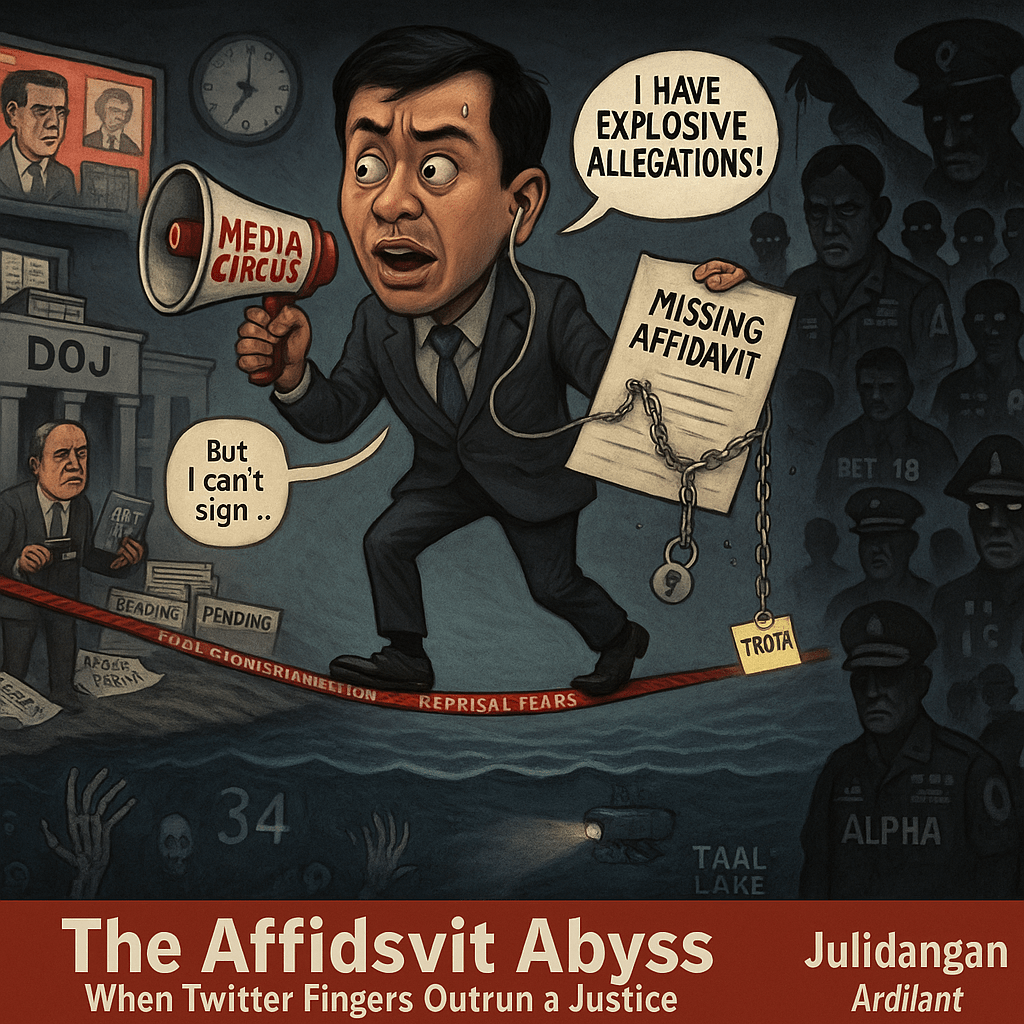
JULIE Patidongan’s explosive allegations in the missing sabungeros case have electrified the Philippines, yet his refusal to file a sworn complaint-affidavit leaves the Department of Justice (DOJ) floundering in a legal abyss. His TV-fueled media frenzy, accusing gaming tycoon Charlie “Atong” Ang and a rogue’s gallery of cops, including retired Lt. Gen. Jonnel Estomo, of orchestrating abductions and murders, is a high-wire act teetering on collapse. Patidongan’s Twitter-finger has outrun his affidavit-signing hand—a fatal fumble in a deadly game.
Let’s carve into this saga with a legal machete, exposing why his silence stalls justice, how his media circus threatens to poison the case, and what bold moves he must make to salvage the truth.
1. The Affidavit Abyss: Patidongan’s Silence Cripples Justice
Legal Gridlock: A Case Stranded Without a Sworn Statement
Under Rule 110, Section 3 of the Revised Rules of Criminal Procedure, a criminal prosecution demands a sworn complaint-affidavit to trigger a preliminary investigation. Patidongan’s failure to deliver one renders his TV confessions—alleging strangulations and body dumps in Taal Lake—legally impotent.
Prosecutor General Richard Fadullon’s stance, as reported by SunStar Manila, that claims remain “unvalidated” without an affidavit isn’t bureaucratic nitpicking; it’s a cornerstone of due process under Rule 112. His protective custody under the Witness Protection Act (RA 6981) offers safety but not credibility.
RA 6981, Section 10 promises immunity for “substantially corroborated” testimony, yet without an affidavit, Patidongan’s leverage is a mirage. His status as an accused in the kidnapping case, compounded by the Court of Appeals’ December 2024 bail reversal, further muddies his reliability. His silence isn’t just deafening—it’s a death knell for the case.
Mastermind Move or Cowardly Retreat?
Why the hold-up? Three theories cut through the fog:
- Fear of Deadly Reprisal: Patidongan’s claim that Estomo, an alleged “Alpha member” of Ang’s Pitmaster Group, pushed Ang to have him killed (ABS-CBN News) signals real danger. Despite PNP protective custody, Ang’s counter-complaints for extortion and slander hint at a legal—and possibly physical—counterattack. Fear could be paralyzing his pen.
- Dodging Self-Incrimination: As an accused in the kidnapping and serious illegal detention of six sabungeros, Patidongan risks legal blowback. Filing an affidavit could expose incriminating details, especially after the Court of Appeals’ bail ruling tightened the noose. Section 17, Article III of the Constitution shields him from self-incrimination, and his counsel’s withdrawal—likely due to his media antics—suggests advice to stay mum, avoiding a Latogan v. People misstep where procedural errors sank testimony.
- Calculated Power Play: Patidongan’s administrative complaints against 18 cops, filed with the National Police Commission (GMA News), are a low-risk jab compared to criminal filings. These complaints, governed by lighter evidentiary standards, let him pressure suspects without the legal exposure of an affidavit. But this gambit risks fizzling out, as NAPOLCOM’s 60-day timeline may yield mere slaps rather than the murder or kidnapping charges (Articles 248, 267, RPC) needed for justice.
2. Media Mayhem: How Patidongan’s Tell-Alls Threaten to Torpedo the Case
Trial by Telenovela: Evidence at Risk
Patidongan’s TV exposés, naming Ang, Estomo, and cops like Col. Jacinto Malinao Jr. and Lt. Col. Ryan Jay Orapa, have turned the case into a public circus. This mirrors the chaos in People v. Teehankee (G.R. Nos. 111206-08), where out-of-court statements tainted witness identifications and jeopardized mistrial fears.
His vivid accounts of strangulations and Taal Lake disposals could tip off suspects to destroy evidence or craft alibis, violating Rule 130, Section 3’s best evidence rule. The Supreme Court’s disdain for trial by publicity looms large, and Patidongan’s media blitz risks poisoning the case before it reaches court.
DOJ in Chains: Procedural Rigidity or Shield for Impunity?
Fadullon’s insistence on affidavits to “validate and evaluate” allegations is textbook Rule 112, but it feels like a bureaucratic straitjacket. With 34 sabungeros missing and families in agony, this rigidity—while legally sound—teeters on enabling impunity, especially with powerful players like Ang in the mix.
Justice Secretary Jesus Crispin Remulla’s planned meeting with Patidongan, per SunStar Manila, signals urgency, but without an affidavit, it’s a hollow gesture. The DOJ’s hands are tied, and Patidongan’s silence is the knot.
Forensic Flashpoint: Taal Lake’s Bones Could Break or Bury the Case
The discovery of six potentially human bones in Taal Lake, as detailed by GMA News, is a forensic bombshell. Lt. Col. Edmar dela Torre’s team identified human-like structures (pubic bone, ilium), and DNA cross-checking with the sabungeros’ kin could confirm identities.
But Patidongan’s cooperation is pivotal. If he’s withholding location details—perhaps to preserve leverage or out of fear—the remotely operated vehicle (ROV) deployment, with Remulla’s six-month timeline, becomes a needle-in-a-haystack hunt across a 224-square-kilometer lake. His reticence could choke this forensic lifeline, leaving the DOJ with bones but no story.
3. Checkmate or Stalemate? Patidongan’s Must-Make Legal Moves
Witness Protection Lifeline: A Shield Against Ang’s Wrath
To escape the affidavit abyss, Patidongan must lock in his RA 6981 application. A mock application would stress:
- Testimony Scope: Detailed accounts of the abductions, strangulations, and Taal Lake disposals, backed by Manila Arena witnesses and bone recoveries.
- Immunity Plea: Per Section 10, immunity from his kidnapping charges if testimony is “substantially corroborated” (e.g., DNA matches, ROV findings).
- Security Demands: Relocation and round-the-clock protection, citing threats from Ang and Estomo.
This could neutralize Ang’s countersuits for extortion and slander, noted in SunStar Manila. But immunity depends on credible testimony, and Patidongan’s media spree risks tainting his reliability. A shift to formal channels is his only shot.
Nuclear Strike: DOJ’s Path to Indictment Without Patidongan
The DOJ could sidestep Patidongan’s silence by building a murder case (Article 248, RPC) on forensic evidence. If Taal Lake’s bones yield DNA matches, prosecutors can file charges against Ang and the 18 cops under Rule 110, Section 5, which allows state-initiated complaints for heinous crimes.
The ROV’s deployment, per GMA News, aims to unearth more remains, but Remulla’s six-month timeline smells like a stall. Taal Lake’s murky depths and limited ROV resources hinder progress, and a sluggish pace could let suspects slip away. A turbo-charged forensic push could force Patidongan to cooperate or risk irrelevance.
Ethical Minefield: Lawyers in the Crosshairs
Patidongan’s media onslaught violates the IBP Code of Professional Responsibility, Canon 13, which forbids extrajudicial statements that prejudice cases. His counsel’s withdrawal, per research materials, likely stems from these breaches.
While Patidongan isn’t bound by the IBP Code, his lawyers face sanctions for failing to rein him in, as seen in People v. Teehankee. New counsel—if secured—must gag his TV appearances to preserve case integrity and dodge disciplinary action.
Conclusion: A Case Teetering on the Brink
Julie Patidongan’s affidavit dodge is a self-inflicted wound, driven by fear, legal peril, and tactical gamesmanship. His media circus has electrified public interest but risks tainting evidence and alienating allies. The Taal Lake bones are a forensic beacon, but without Patidongan’s cooperation, the case may drown in a sea of procedural delays.
To seize checkmate, he must file a sworn affidavit, secure RA 6981 protections, and silence his media megaphone. The DOJ, meanwhile, must turbo-charge its forensic efforts to bypass his hesitancy. Without these moves, the sabungeros’ fate will remain buried in Taal Lake’s depths, a grim testament to a justice system stalled by silence.
Key Citations
- Revised Rules of Criminal Procedure, Rules 110-112
- Republic Act No. 6981, Witness Protection Act
- People v. Teehankee, G.R. Nos. 111206-08 (1995)
- Latogan v. People, G.R. No. 238298 (2018)
- SunStar Manila, “6 men nabbed over involvement in abduction of sabungeros” (2025)
- ABS-CBN News, “Who is ‘Totoy’? Whistleblower in missing sabungeros reveals identity” (July 3, 2025)
- GMA News Online, “Patidongan, missing sabungeros’ kin file complaint vs. 12 cops at NAPOLCOM” (2025)
- IBP Code of Professional Responsibility
- 1987 Philippine Constitution, Article III, Section 17

- ₱75 Million Heist: Cops Gone Full Bandit

- ₱6.7-Trillion Temptation: The Great Pork Zombie Revival and the “Collegial” Vote-Buying Circus

- ₱1.9 Billion for 382 Units and a Rooftop Pool: Poverty Solved, Next Problem Please

- ₱1.35 Trillion for Education: Bigger Budget, Same Old Thieves’ Banquet

- ₱1 Billion Congressional Seat? Sorry, Sold Out Na Raw — Si Bello Raw Ang Hindi Bumili

- “We Will Take Care of It”: Bersamin’s P52-Billion Love Letter to Corruption

- “Skewed Narrative”? More Like Skewered Taxpayers!

- “Scared to Sign Vouchers” Is Now Official GDP Policy – Welcome to the Philippines’ Permanent Paralysis Economy

- “Robbed by Restitution?” Curlee Discaya’s Tears Over Returning What He Never Earned

- “My Brother the President Is a Junkie”: A Marcos Family Reunion Special

- “Mapipilitan Akong Gawing Zero”: The Day Senator Rodante Marcoleta Confessed to Perjury on National Television and Thought We’d Clap for the Creativity

- “Just Following Orders” Is Dead: How the Hague Just Turned Tokhang’s Finest Into International Fugitives






 KWEBA ni BAROK
Leave a comment