By Louis ‘Barok‘ C. Biraogo — July 18, 2025
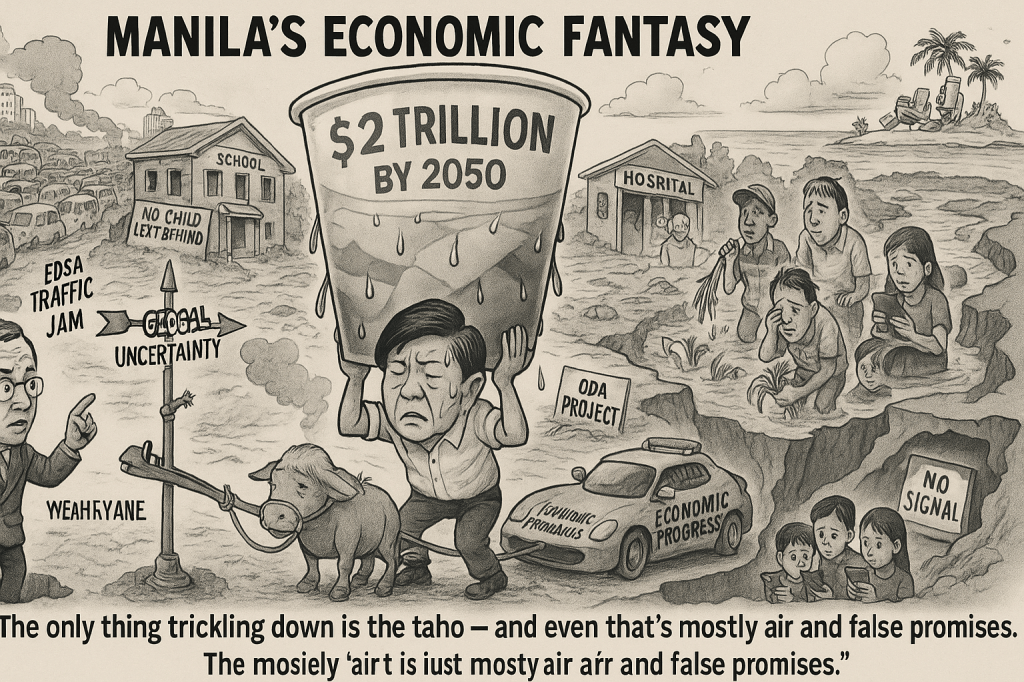
STEP right up to the greatest economic spectacle in Southeast Asia! The Philippines’ Department of Economy, Planning and Development (DEPDev) is hawking a $2 trillion economy by 2050, a vision so dazzling it could outshine a Quiapo firecracker stall. Secretary Arsenio Balisacan, with the bravado of a carnival barker, pitches this fantasy to European investors, proclaiming the Philippines “Asia’s next economic juggernaut” (Bilyonaryo, May 8, 2025). It’s a dream propped up by a $392 billion economy, a youthful population, and reforms like the Philippines-Korea Free Trade Agreement.
But the De La Salle University-Angelo King Institute (DLSU-AKI) has stormed this parade with a reality check: hitting $2 trillion demands a 6.7% annual GDP growth rate for 25 years—a target so absurd it’s like expecting Manila traffic to clear by noon. “This will not happen,” DLSU-AKI snaps in their Philstar.com report, delicately dodging: “Because your policies are a flaming dumpster.”
GDP Braggadocio Meets a Mathematical Smackdown
Let’s carve this $2 trillion delusion like a lechon at a barangay fiesta. DEPDev’s chest-thumping rhetoric banks on the Philippines’ middle-income status and a median age of 27, as if youthful vibes can mint trillions (Vietnam+, May 9, 2025). They nod to Asian Tigers like South Korea and China, conveniently forgetting the state-driven industrialization, land reforms, and, let’s be real, a dictatorship or two that fueled those miracles. The Philippines, with its pothole-ridden roads and a manufacturing sector more ghost story than growth engine, is no 1980s Singapore.
DLSU-AKI’s ice-cold data projects a $1.7 trillion economy by 2050, with growth slumping from 4.8% to 3.6%. “We cannot become richer and grow as fast as today,” they state, tactfully skipping: “Your plan’s a PowerPoint pipe dream.”
The government’s own numbers are a tragicomic fumble. The Development Budget Coordination Committee slashed 2025 GDP targets from 6-8% to 5.5-6.5%, blaming typhoons and “external risks” (Philstar.com, July 13, 2025). Nothing screams “we’re winning” like cutting next year’s forecast while swearing the 2050 jackpot is still in the bag. It’s like vowing to conquer Everest while tripping over your own shoelaces.
The World Bank (December 2024) clocks 2024 growth at 5.9%, with 6.1% for 2025—decent, but nowhere near the 6.7% marathon needed for Balisacan’s hallucination.
“Secretary Balisacan’s pitch to European investors: ‘Give us your money, and in 25 years, we’ll maybe hit a number!’”
— Philippine Daily Inquirer, May 8, 2025
Poverty’s New Hustle: From Muddy Fields to Mall Misery
The human cost of this economic clown show is where the laughs turn bitter. DLSU-AKI warns that by 2050, agriculture’s employment share will shrink—great, until you realize it’s being replaced by wholesale and retail jobs. Congratulations, Filipinos! You’ll swap backbreaking farm labor for soul-crushing mall shifts at $5 a day.
The World Bank notes that agriculture, employing 62% of the poor, has been choked by decades of policy neglect. Trading rice paddies for retail counters peddling knockoff sneakers isn’t progress; it’s a sequel called “Poverty in Neon Hell.”
“‘We cannot become richer and grow as fast as today,’ says DLSU-AKI, politely omitting: ‘Because your policies are a flaming dumpster.’”
— Philstar.com, July 13, 2025
This shift isn’t a glow-up; it’s a grim hustle. The $2 trillion fantasy assumes wealth will trickle down—a theory as believable as a Marcos family Instagram post tagged “#Equality.” Income inequality, a festering wound ignored in these growth debates, ensures the elite will pocket the gains. PIDS data shows the Philippines’ poverty reduction limped at 0.7% annually from 1971-1994, compared to Indonesia’s 2.0% and Malaysia’s 1.6%. The poor aren’t holding their breath for a $2 trillion windfall—they’re too busy dodging the next economic sucker punch.
Then there’s the climate guillotine. Typhoons, like those that slashed 2024’s growth to 5.9% (World Bank, December 2024), don’t just nick GDP; they devastate the poor. When storms drown crops, economists see “external risks.” Farmers see starvation. The government’s resilience plans are as flimsy as a tarp in a typhoon, leaving rural communities to rebuild with nothing but grit and prayers.
Oligarchs’ Golden Heist: The Real $2 Trillion Prize
Balisacan’s European charm offensive (Philippine Daily Inquirer, May 8, 2025) is less a national vision than a VIP pass for oligarchs. The World Economic Forum dangles the $2 trillion carrot, but only if education and human development get massive funding—fat chance when schools are crumbling and tax breaks flow to the elite.
The Philippine Development Plan 2023-2028 preaches inclusivity, but without taxing the oligarchs who own everything from malls to senators, it’s just a glossy pamphlet. The same families who’ve turned growth into their personal ATM will cash in, while the poor get a front-row seat to their own exclusion.
Reforms like the Ease of Paying Taxes Act (Philippine News Agency, May 7, 2025) are like slapping a Band-Aid on a broken spine. The economy’s real cancers—weak manufacturing, a comatose agriculture sector, and a skills gap wider than the South China Sea—need radical surgery. DLSU-AKI’s realism is a slap in the face, but their “we’ll all be poorer” vibe isn’t a plan. Where’s the roadmap to bridge the gap between 5.9% and 6.7%?
A Playbook to Dodge the Economic Faceplant
Here’s the fix:
- For the Government: Drop the GDP machismo. Chasing a $2 trillion mirage is less useful than creating jobs that pay more than pocket change. Tax the oligarchs bankrolling your campaigns—shocking idea, we know—and funnel the cash into schools, not another crony-friendly toll road. Modernize agriculture so farmers aren’t one storm away from ruin. Build climate defenses before the next typhoon turns your growth targets into seaweed.
- For Critics: DLSU-AKI, your data is fire, but “we’re doomed” isn’t a strategy. Propose a path—vocational training, digital infrastructure—that could nudge growth closer to 6.7%. Otherwise, you’re just shouting “iceberg!” without steering the ship.
- For the Poor: Start a betting pool. Will $2 trillion arrive before the next typhoon washes your home away? Or before the elite snap up another private island? Your grit is the real Philippine miracle—demand policies like land reform and healthcare that actually reach you.
The Philippines’ economic policy is like a drunk uncle chasing a parked car: all ambition, no coordination, and a faceplant waiting to happen. The think tanks are sober enough to laugh, and the poor are tough enough to endure. But unless the government swaps its $2 trillion pipe dream for a plan that puts people over propaganda, 2050 will bring more oligarchs’ yachts than Filipinos’ hope.
The storms are coming, and the clock’s ticking.
Key Citations
- Philstar.com, July 13, 2025: DLSU-AKI’s report on the unrealistic 6.7% GDP growth requirement.
- Bilyonaryo, May 8, 2025: Balisacan’s pitch to European investors.
- Philippine Daily Inquirer, May 8, 2025: Government’s $2 trillion goal.
- Vietnam+, May 9, 2025: Philippines’ demographic and economic potential.
- World Bank, December 2024: Economic growth projections and typhoon impacts.
- PIDS: Historical poverty reduction data.
- Philippine News Agency, May 7, 2025: Policy reforms like the Ease of Paying Taxes Act.
- Philippine Development Plan 2023-2028: Government’s socioeconomic agenda.
- Wikipedia, Economy of the Philippines: World Economic Forum’s perspective on growth potential.

- ₱75 Million Heist: Cops Gone Full Bandit

- ₱6.7-Trillion Temptation: The Great Pork Zombie Revival and the “Collegial” Vote-Buying Circus

- ₱1.9 Billion for 382 Units and a Rooftop Pool: Poverty Solved, Next Problem Please

- ₱1.35 Trillion for Education: Bigger Budget, Same Old Thieves’ Banquet
- ₱1 Billion Congressional Seat? Sorry, Sold Out Na Raw — Si Bello Raw Ang Hindi Bumili

- “We Will Take Care of It”: Bersamin’s P52-Billion Love Letter to Corruption

- “Skewed Narrative”? More Like Skewered Taxpayers!

- “Scared to Sign Vouchers” Is Now Official GDP Policy – Welcome to the Philippines’ Permanent Paralysis Economy
- “Robbed by Restitution?” Curlee Discaya’s Tears Over Returning What He Never Earned
- “No Pressure” Luistro? The House Pork Bazaar Exposed
- “My Brother the President Is a Junkie”: A Marcos Family Reunion Special

- “Mapipilitan Akong Gawing Zero”: The Day Senator Rodante Marcoleta Confessed to Perjury on National Television and Thought We’d Clap for the Creativity





 KWEBA ni BAROK
Leave a comment