By Louis ‘Barok‘ C. Biraogo — July 18, 2025
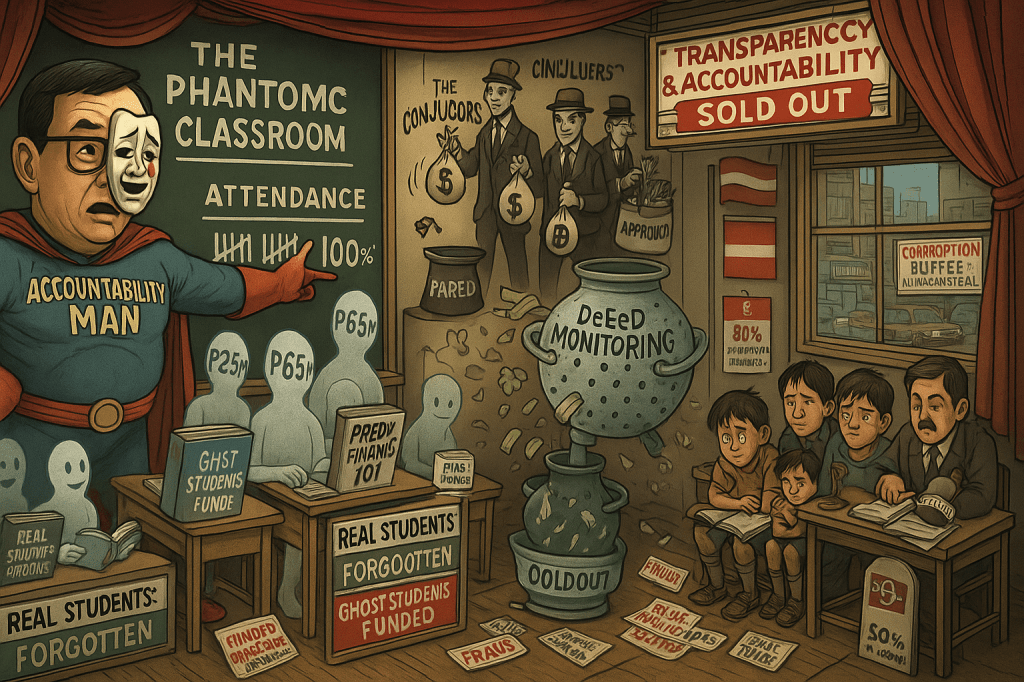
IN THE Philippines, where education is heralded as the great equalizer, the Department of Education (DepEd) has turned the Senior High School (SHS) voucher program into a grotesque parody of reform. Meant to decongest public schools and fund private education for deserving students, the program has instead become a playground for fraud, with millions of pesos vanishing into the bureaucratic ether via “ghost students”—fictional pupils conjured by corrupt officials. This isn’t just a scandal; it’s a betrayal, cloaked in the sanctimonious rhetoric of “transparency” and “accountability.” Welcome to DepEd’s theater of the absurd, where the only thing more fictitious than the students is the promise of meaningful change.
The Farce of ‘Ghost Students’: A Masterclass in Creative Accounting
Imagine a scheme so brazen it could star in a heist flick: twelve private schools, in cahoots with DepEd insiders, fabricate “ghost students” to siphon off subsidies meant for real children. These aren’t innocent clerical errors but deliberate acts of estafa, with falsified enrollment records and doctored billing statements. The haul? A staggering ₱52 million nearly slipped away for the 2023-2024 school year alone, on top of ₱65 million already pilfered from 2021 to 2023 [PhilStar]. If this were a film, it’d be Catch Me If You Can: DepEd Edition, with the tagline: “Education for all—except the kids who actually show up.”
The Coordinating Council of Private Educational Associations (COCOPEA) has the gall to dismiss this as a minor hiccup, claiming it affects “only 1% of beneficiaries” [PhilStar]. Oh, splendid! Just a trifling ₱65 million stolen from taxpayers! Why bother when classrooms are bursting, teachers are underpaid, and students share textbooks like wartime rations? The hypocrisy is breathtaking: COCOPEA champions the voucher program as a noble decongestant for public schools while ignoring that their member institutions are clogging the system with fraud. Meanwhile, real students sweat in overcrowded, underfunded classrooms, their dreams crushed by a bureaucracy too busy chasing phantoms to notice.
Prosecution or Persecution? Sonny Angara’s Accountability Tour (Spoiler: It’s Mostly PR)
Enter Education Secretary Sonny Angara, strutting onto the stage like a man who’s just discovered corruption—think Columbus claiming America in 1492. Three school officials face charges of estafa and falsification, a move trumpeted as proof of DepEd’s commitment to justice [PhilStar]. But hold the applause. Why are the names of these officials cloaked in secrecy? If transparency is the goal, why shield the accused while waving their crimes like a banner? It’s a peculiar brand of accountability that protects the culprits while leaving the public guessing.
The charges feel like a kabuki performance—elaborate, theatrical, and possibly a distraction. The fraud spanned 2021 to 2023, yet DepEd only acted in 2025, after the stench of scandal became too rank to ignore [PhilStar]. As I’ve written before, nothing galvanizes a bureaucracy like a scandal—except, perhaps, a newspaper headline. Angara’s tough talk about “no space for deception” rings hollow when the system allowed thousands of ghost students to haunt its ledgers for years. Are these three officials the masterminds, or sacrificial lambs to appease an outraged public?
The real crime is a monitoring system so porous it could double as a sieve. DepEd insiders colluded with schools to fake enrollments, exploiting student data like pickpockets in a crowded palengke [PhilStar Explainer]. Yet, instead of rooting out this systemic rot, DepEd points fingers at a trio of fall guys. Bravo, Secretary Angara—your accountability tour is selling out, but the audience is still waiting for the main act.
DepEd’s ‘Reforms’: Band-Aids on a Bullet Wound
DepEd’s response to this fiasco is a masterclass in half-measures. Random audits? Groundbreaking. Publishing beneficiary lists online? How 2005. Cross-referencing enrollment data with the Learner Information System? Welcome to the 21st century, DepEd. These are the kinds of reforms you’d expect from a bureaucracy that thinks a Band-Aid can fix a bullet wound [DepEd Statement].
Compare this to Latvia—yes, Latvia, with fewer people than Metro Manila’s stray dogs—which boasts 80% compliance with OECD anti-corruption frameworks, including real-time financial tracking and robust whistleblower protections [OECD Anti-Corruption]. In the Philippines, DepEd’s solution is to hire more auditors to chase ghosts, when what they need is a ghostbuster—a system that stops fraud before it starts, not after millions have vanished.
The recovery of ₱65 million from 54 schools is a start, but 14 schools still haven’t returned the funds, and DepEd’s response is to send “final demand letters” [DepEd Statement]. How quaint! Perhaps they’ll follow up with a politely worded email or a sternly raised eyebrow. The Private Education Assistance Committee (PEAC) flagged issues as early as 2016, yet the ghost student parade marched on, with ₱40 billion in voucher funds treated like a buffet for the corrupt [PhilStar Explainer]. This isn’t oversight; it’s willful blindness, a bureaucratic slumber that let fraud fester unchecked.
Beyond the Jest: A Moral Molotov for DepEd’s Mess
Enough with the farce. If DepEd wants to salvage its credibility, it must move beyond PR stunts and embrace reforms that bite.
- Real-time blockchain tracking for voucher funds—every peso traced, every transaction transparent, no room for ghosts. Latvia’s doing it; why can’t we? [OECD Anti-Corruption].
- Whistleblower rewards to incentivize insiders to expose fraud, because trust in DepEd is as scarce as a quiet day on EDSA.
- Blacklist corrupt schools permanently—not just demand refunds, but bar them from ever touching public funds again.
- Investigate DepEd’s own ranks with the same zeal reserved for press conferences. Collusion doesn’t happen without insiders, and sparing them undermines the entire crusade [PhilStar].
This scandal isn’t just about ₱65 million; it’s about a system that fails the very students it claims to serve. While DepEd plays whack-a-mole with ghost students, real children languish in overcrowded schools, their futures stolen not by phantoms but by a bureaucracy too broken to care. If DepEd were a student, it’d be held back for failing Basic Integrity 101.
It’s time to stop the theatrics and start the reckoning—because nothing unites Filipinos like disgust for corruption, except, perhaps, the traffic on EDSA.
Key Citations
- PhilStar: DepEd: 3 charged over SHS voucher anomaly
- PhilStar: Explainer: The ‘ghost students’ in DepEd’s voucher program
- DepEd: DepEd recovers funds from erring private schools as SHS voucher investigation rolls
- OECD: Anti-Corruption and Integrity Frameworks

- “Forthwith” to Farce: How the Senate is Killing Impeachment—And Why Enrile’s Right (Even If You Can’t Trust Him)

- “HINDI AKO NAG-RESIGN!”

- “I’m calling you from my new Globe SIM. Send load!”

- “Mahiya Naman Kayo!” Marcos’ Anti-Corruption Vow Faces a Flood of Doubt

- “Meow, I’m calling you from my new Globe SIM!”

- “No Special Jail for Crooks!” Boying Remulla Slams VIP Perks for Flood Scammers

- “PLUNDER IS OVERRATED”? TRY AGAIN — IT’S A CALCULATED KILL SHOT

- “Several Lifetimes,” Said Fajardo — Translation: “I’m Not Spending Even One More Day on This Circus”

- “Shimenet”: The Term That Broke the Internet and the Budget
- “We Did Not Yield”: Marcos’s Stand and the Soul of Filipino Sovereignty

- “We Gather Light to Scatter”: A Tribute to Edgardo Bautista Espiritu

- $150M for Kaufman to Spin a Sinking Narrative






 KWEBA ni BAROK
Leave a comment