By Louis ‘Barok‘ C. Biraogo — July 19, 2925
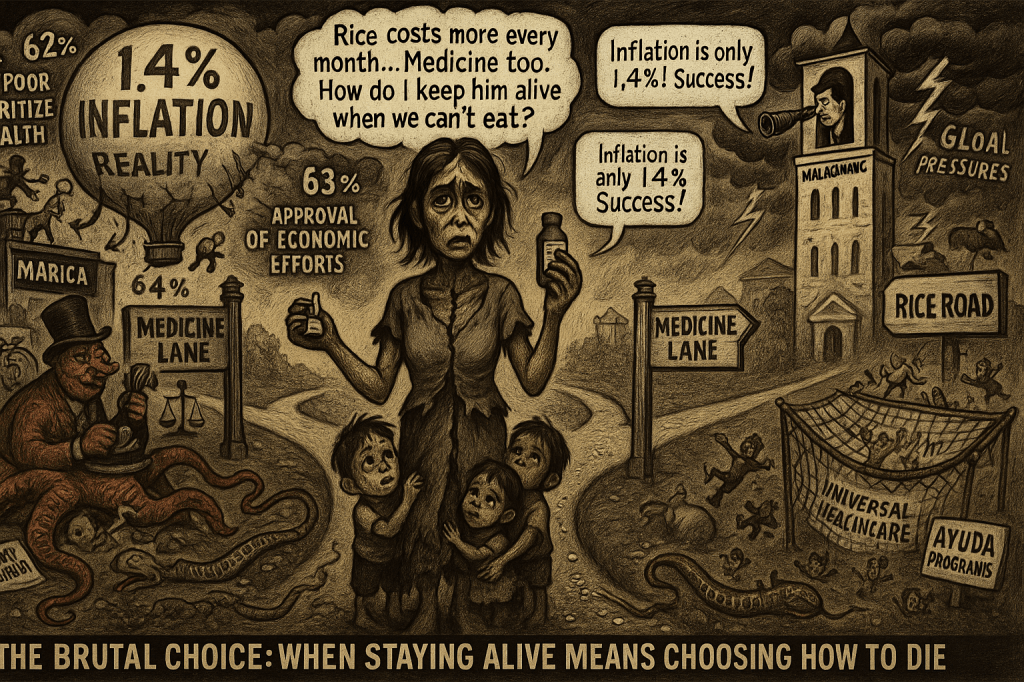
IN Manila’s Tondo slum, Maria, a 38-year-old mother of three, faces a heart-wrenching choice. To afford her son’s asthma inhaler, she skips meals, her hunger a quiet sacrifice for his breath. “Rice costs more every month,” she whispers, her voice heavy with exhaustion. “Medicine too. How do I keep him alive when we can’t eat?”
Her story echoes across the Philippines, where the Pulse Asia survey (June 26-30, 2025) reveals a nation gripped by dual fears: 62% rank skyrocketing prices as their top national worry, while 64% prioritize staying healthy above all personal concerns. Yet, with inflation at a six-year low of 1.4% (Reuters, July 2025), why does this dread persist? And why does health trump even jobs in a country where poverty stalks millions?
The Inflation Nightmare: When 1.4% Feels Like a Lie
The official inflation rate of 1.4% in June 2025 sounds like a victory (Department of Finance, July 2025). It’s the lowest since 2019, driven by falling food and fuel prices. But for Filipinos like Maria, this number is a cruel mirage. The sting of rice prices doubling since 2022 lingers like a fresh wound—a cumulative price trauma that shatters trust in statistics. When a kilo of rice still costs 20% more than three years ago (Department of Economic Planning, July 2025), “low inflation” feels like a betrayal.
Geographic Fault Lines:
- The burden isn’t equal. In Metro Manila, 72% cite inflation as their top fear, compared to 60% in the Visayas (Pulse Asia, July 2025).
- Urbanites face crushing rents and utility bills, while rural families battle volatile food prices. Mindanao, at 64%, feels both pressures.
- Hidden costs like shrinkflation—smaller portions for the same price—and erratic electricity rates deepen the distrust. A Quezon City vendor told me, “The sugar bag shrinks, but my bill doesn’t.”
- This sense of being cheated fuels the 66% disapproval of the Marcos administration’s economic efforts (Pulse Asia, July 2025).
The Wage-Price Chasm:
- With 51% now demanding higher pay—a 17% surge from last quarter—workers know their salaries lag behind prices (Pulse Asia, July 2025).
- Real wages, eroded by years of price hikes, leave families like Maria’s stretched thin.
- The government’s P242 billion in cash aid, like the Ayuda sa Kapos ang Kita program, hasn’t closed this gap (Department of Finance, July 2025).
- Why? Corruption, a top concern for 24%, siphons off funds meant for relief. Subsidies vanish into elite pockets, leaving Maria rationing her son’s medicine.
The Health Obsession: A Nation Haunted by Sickness
Staying healthy, cited by 64% as the top personal concern, overshadows jobs (53%) and savings (45%) (Pulse Asia, July 2025). This isn’t just about dodging illness—it’s the ghost of COVID-19’s devastation. The pandemic left scars: long COVID, mental health crises, and heightened fear of diseases like dengue and leptospirosis, tied to poor sanitation (WHO, July 2025).
A 2024 Manulife survey found 82% of Filipinos fear rising healthcare costs, with heart disease and diabetes topping their worries (Manulife, 2024). For Maria, her son’s asthma is a daily reminder that one hospital visit could ruin her.
Class E’s Exclusion:
- Strikingly, the poorest Filipinos—Class E—don’t prioritize health, likely because care is a luxury they can’t afford (Pulse Asia, July 2025).
- The Universal Health Care Act of 2019 promised equity, but implementation falters.
- Out-of-pocket health spending still accounts for 41.5% of total health expenditure, with the poorest quintile spending P190 billion in 2021 (IDinsight, December 2024).
- Rural clinics lack staff, and PhilHealth coverage often applies only during hospitalization—too late for prevention.
- Class E is trapped: too poor to prioritize health, too sick to escape poverty.
The Healthy but Hungry Riddle:
- Only “bare majorities” in Class E and the Visayas worry about food security, despite 40% disapproving of the government’s hunger efforts (Pulse Asia, July 2025).
- Is this survey stigma—shame in admitting hunger—or a policy blind spot?
- The government’s P20-per-kilo rice program hasn’t shifted perceptions, likely due to spotty implementation (Department of Finance, July 2025).
- If Marcos can feed typhoon victims (63% approval), why not tackle inflation’s daily toll?
Who’s Failing Filipinos?
Government’s Stumbles:
- The Marcos administration’s 66% disapproval on inflation reflects a failure of policy and trust (Pulse Asia, July 2025).
- Price controls falter due to weak enforcement and corruption, with 24% citing graft as a top issue.
- Subsidies, like those for the Walang Gutom program, leak to cronies (Pulse Asia, July 2025).
- Higher approval for disaster response (63%) and OFW welfare (62%) suggests a government distracted from everyday crises.
- The Bangko Sentral ng Pilipinas (BSP) has room for rate cuts (Reuters, July 2025), but monetary fixes can’t patch systemic holes.
Corporate Greed:
- Oligopolies, especially in food imports, drive price spikes.
- Cartels controlling rice and pork manipulate markets, with meat prices rising despite rice deflation (Department of Economic Planning, July 2025).
- Mandating CPI-linked wage hikes could help, but firms resist, prioritizing profits.
- The private sector’s failure to invest in local agriculture keeps the Philippines tethered to global supply chain shocks, like those from 2022 (OECD Economic Outlook, June 2025).
Global vs. Local Sins:
- The peso’s volatility, set to persist through 2026, inflates import costs (AMRO, February 2025).
- Global oil and grain price swings, though easing, still ripple through markets.
- Yet domestic failures—corrupt aid distribution, underfunded agriculture—amplify these shocks.
- Blaming the world is easy; fixing local mismanagement is harder.
The Wage-Inflation Trap: A Ticking Time Bomb
The 17% surge in wage demands (51%) shows workers like Maria see pay hikes as their shield against inflation (Pulse Asia, July 2025). But mandating CPI-linked wages risks a dangerous spiral, where higher pay fuels demand, pushing prices higher.
The BSP warns that 3% inflation forecasts for 2025-2026 could climb if wages spike unchecked (Reuters, July 2025). A smarter approach—targeted wage boards for low-income sectors, paired with productivity boosts—could ease pain without lighting the fuse.
Breaking the Cycle: Bold Fixes for a Broken System
Taming the Price Beast:
- Expose the Hoarders: Launch a price-tracking app, like India’s eNAM, letting consumers report gouging in real time. Public shaming, as South Korea’s Fair Trade Commission does, could deter cartels.
- Smash the Cartels: Publish a name-and-shame list of price-fixing firms, with fines redirected to food subsidies. The Department of Trade and Industry must wield its power (DTI, 2025).
- Smart Aid: Replace leaky fuel subsidies with blockchain-based e-vouchers for food and utilities, targeting Classes D and E (Department of Finance, July 2025).
Healing a Hurting Nation:
- Lifeline for the Poorest: Deploy mobile clinics to poverty hotspots, funded by recovered corruption proceeds. One oligarch’s loot could equip dozens of diagnostic vans (IDinsight, December 2024).
- Prevent Disease, Save Lives: Tax junk food to fund free hypertension and diabetes screenings, slashing Class E’s health burden by 20% (WHO, July 2025).
A Reckoning for Marcos
Maria’s dilemma—food or medicine—is a moral indictment of a nation rich in potential but crippled by greed and neglect. President Marcos’ SONA on July 28 must face this reality: shielding oligarchs or saving Filipinos from choosing between pills and bread is a choice he can’t sidestep.
If the government can rally for typhoons, it can fight the daily disaster of inflation and illness. Break the cartels. Fund the clinics. Heed the 62% who dread prices and the 64% who fear sickness. Their voices, like Maria’s, demand not rhetoric but action—now.
Key Citations
- Pulse Asia Survey Results, July 2025 – National and personal concerns of Filipinos, including inflation (62%) and health (64%).
- Reuters, Philippine Inflation at 1.4%, July 2025 – Reports on inflation trends and BSP policy outlook.
- Department of Finance, July 2025 – Details on negative inflation for the poorest and government aid programs.
- Department of Economic Planning, July 2025 – Food price trends, including rice deflation and meat price hikes.
- WHO, Philippines Work, July 2025 – Health challenges like dengue and sanitation issues.
- Manulife Survey, 2024 – Filipinos’ fear of rising healthcare costs.
- Republic Act No. 11223, Universal Health Care Act, 2019 – Framework for equitable healthcare access.
- IDinsight, December 2024 – Healthcare access barriers and out-of-pocket spending data.
- OECD Economic Outlook, June 2025 – Global economic factors affecting the Philippines.
- AMRO, February 2025 – Peso volatility projections for 2025-2026.
- eNAM, India – Model for transparent price-tracking systems.
- South Korea Fair Trade Commission – Example of anti-cartel enforcement.
- Department of Trade and Industry, 2025 – Role in market regulation and price stabilization.

- “Forthwith” to Farce: How the Senate is Killing Impeachment—And Why Enrile’s Right (Even If You Can’t Trust Him)
- “HINDI AKO NAG-RESIGN!”

- “I’m calling you from my new Globe SIM. Send load!”

- “Mahiya Naman Kayo!” Marcos’ Anti-Corruption Vow Faces a Flood of Doubt

- “Meow, I’m calling you from my new Globe SIM!”

- “No Special Jail for Crooks!” Boying Remulla Slams VIP Perks for Flood Scammers
- “PLUNDER IS OVERRATED”? TRY AGAIN — IT’S A CALCULATED KILL SHOT

- “Several Lifetimes,” Said Fajardo — Translation: “I’m Not Spending Even One More Day on This Circus”

- “Shimenet”: The Term That Broke the Internet and the Budget

- “We Did Not Yield”: Marcos’s Stand and the Soul of Filipino Sovereignty

- “We Gather Light to Scatter”: A Tribute to Edgardo Bautista Espiritu

- $150M for Kaufman to Spin a Sinking Narrative

 KWEBA ni BAROK
Leave a comment