By Louis ‘Barok‘ C. Biraogo — July 23, 2025
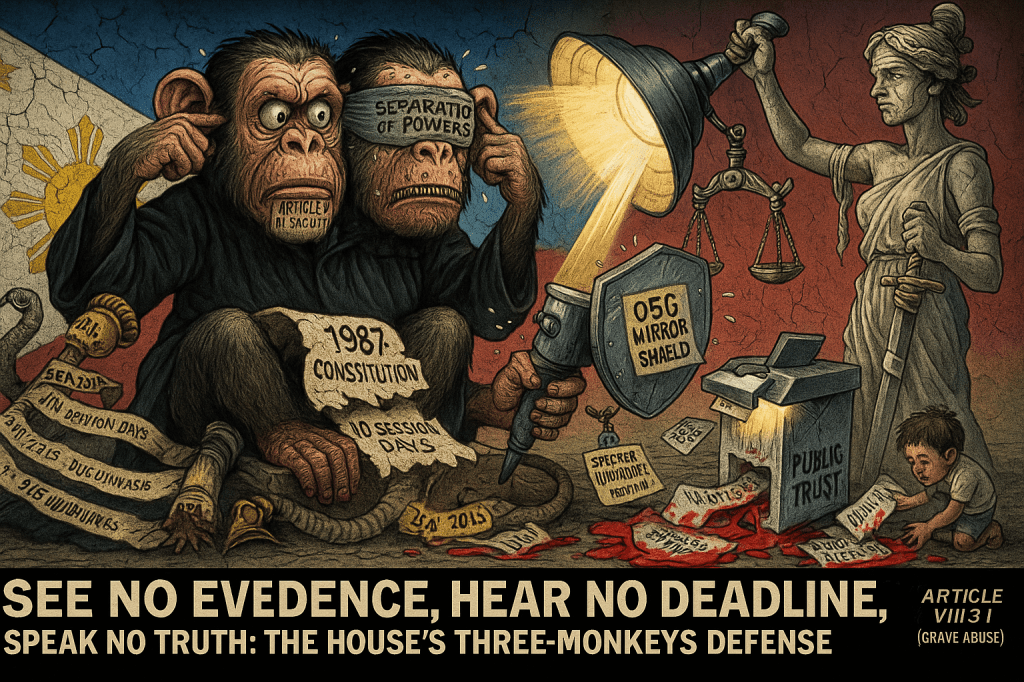
THE House of Representatives’ refusal to answer three critical Supreme Court queries on Vice President Sara Duterte’s impeachment is a brazen assault on constitutional integrity. By hiding behind the separation of powers, the House isn’t safeguarding its autonomy—it’s orchestrating a political cover-up Kweba ng Katarungan exposé tears through the House’s flimsy defenses, exposing procedural rot, constitutional violations, and raw political machinations. With public trust hanging by a thread, the stakes are nothing less than the soul of Philippine democracy. Buckle up for a no-holds-barred takedown.
Constitutional Carnage: Is Separation of Powers a Shield or a Sham?
The House, via the Office of the Solicitor General, claims its refusal to answer the Supreme Court’s queries—on who drafted the impeachment articles, when and how evidence was circulated, and whether Duterte got a fair shake—falls under the sacred umbrella of separation of powers. Citing Article VI, Section 16(3) of the 1987 Constitution, the House insists these are internal matters beyond judicial reach. But this isn’t principle—it’s a power grab cloaked in constitutional piety.
Separation of Powers: Fortress or Facade?
The House leans on Article XI, Section 3(1), which grants it “exclusive power to initiate all cases of impeachment.” Exclusivity, however, doesn’t mean a free pass. The Supreme Court’s expanded certiorari jurisdiction under Article VIII, Section 1 empowers it to smack down “grave abuse of discretion” by any branch. In Francisco v. House of Representatives (2003), the Court nullified a second impeachment complaint against Chief Justice Hilario Davide Jr. for violating the one-year bar, proving impeachment isn’t a judicial no-go zone. Likewise, Gutierrez v. House (2011) confirmed the Court’s power to enforce constitutional compliance, shredding the House’s claim of untouchable autonomy.
The House’s argument that its internal processes—like who drafted the articles or how evidence was shared—are non-justiciable is a dodge. The Supreme Court’s queries target compliance with constitutional mandates, like the 10-session-day referral rule under Article XI, Section 3(3). By stonewalling, the House isn’t defending its turf—it’s ducking accountability for potential procedural crimes.
The Black Hole of Transparency: Unanswered Queries Fuel Suspicion
The House’s refusal to answer screams cover-up:
- Who drafted the articles and when? This isn’t bureaucratic trivia—it’s about whether the process was deliberate or a political hit job. If a shadowy clique rushed the articles, the 215-member endorsement on February 5, 2025, loses legitimacy.
- When and how was evidence circulated? The House’s claim that this requires “subjective assessment” is absurd. Either evidence was shared pre-endorsement, or it wasn’t. Silence suggests the evidence was either thin or nonexistent, undermining the process’s credibility.
- Was Duterte afforded due process? The House’s dodge—that due process kicks in at the Senate trial—evades the query. Article III, Section 1 guarantees due process, and Corona v. Senate (2012) stressed fairness in impeachment proceedings. If Duterte was denied a chance to respond pre-endorsement, the House trampled her rights before the trial began.
The House’s silence isn’t restraint—it’s a calculated move to hide potential misconduct. As retired Justice Adolfo Azcuna stated on July 20, 2025, the Court’s inquiries are a “constitutional duty” to probe violations, not judicial overreach. The House’s defiance risks cementing a precedent where Congress can wield impeachment like a cudgel, free from scrutiny.
Procedural Butchery: Unraveling Grave Abuse of Discretion
The House’s handling of Duterte’s impeachment stinks of procedural foul play, particularly in the alleged withholding of the first three complaints to fast-track the fourth. Let’s dissect the rot.
The One-Year Bar: Sabotaged or Sidestepped?
Article XI, Section 3(5) bans initiating impeachment proceedings against the same official more than once within a year. Duterte and Mindanaoan lawyers allege House Secretary General Reginald Velasco “withheld” three complaints filed in December 2024 to pave the way for the fourth, endorsed on February 5, 2025. Did Velasco’s actions violate the Constitution?
Timeline Comparison:
| Complaint | Filed | Referred to Speaker | Endorsed |
|---|---|---|---|
| First | Dec 2024 | Allegedly delayed | Not endorsed |
| Second | Dec 2024 | Allegedly delayed | Not endorsed |
| Third | Dec 2024 | Allegedly delayed | Not endorsed |
| Fourth | Jan 2025 | Within 10 session days | Feb 5, 2025 |
The Constitution mandates complaints be included in the Order of Business within 10 session days (Article XI, Section 3(3)). House spokesperson Princess Abante claims compliance, but petitioners allege deliberate stalling of the first three complaints to skirt the one-year bar. If true, this is grave abuse of discretion by Velasco, as it undermines a constitutional safeguard. Francisco (2003) invalidated a complaint for violating this rule, setting a clear precedent for judicial intervention.
Fast-Tracking the Fourth: A Political Hit Job?
The fourth complaint’s lightning-fast endorsement—weeks after filing—contrasts with the alleged inaction on earlier complaints. This smells of a coordinated push to prioritize a politically charged complaint, tied to Duterte’s alleged misuse of confidential funds and her online death threat against President Marcos, the First Lady, and Speaker Martin Romualdez. The House’s refusal to clarify drafting and evidence circulation fuels suspicions of a rushed, politically driven process. If members endorsed the complaint without reviewing evidence, it violates the House Rules of Procedure in Impeachment Proceedings (2010), which demand diligence.
Ethical Collapse: Transparency Torched, Trust Trampled
The House’s opacity spits in the face of Republic Act No. 6713, the Code of Conduct and Ethical Standards for Public Officials, which demands transparency and accountability. By shrouding the impeachment process in secrecy, the House treats a constitutional safeguard like a backroom deal, betraying its ethical duty.
Public Trust in Tatters: Accountability or Witch Hunt?
A Social Weather Stations survey (July 2025) shows 66% public support for Duterte’s trial, signaling a hunger for accountability amid allegations of corruption and betrayal of public trust. But the House’s secrecy risks flipping this into a narrative of political vengeance, especially given Duterte’s public feuds with Marcos and Romualdez. The House’s refusal to answer the Court fuels distrust, suggesting it’s hiding flaws that could unravel the impeachment’s legitimacy.
Voter Sentiment Snapshot (SWS, July 2025):
| Question | Support Trial | Oppose Trial | Undecided |
|---|---|---|---|
| Should Duterte face trial? | 66% | 28% | 6% |
This data screams public demand for clarity. The House’s actions threaten to erode faith in democratic institutions, turning impeachment into a partisan spectacle.
Senate Trial Showdown: Constitutional Chaos Looms
The House’s defiance sets up a high-stakes clash with seismic implications.
The Nuclear Strike: Can the Court Kill the Impeachment?
Could the Supreme Court invalidate the impeachment? Hell yes. Francisco (2003) and Gutierrez (2011) prove the Court can ax impeachment proceedings that violate constitutional rules. If Velasco’s alleged withholding breached the one-year bar or Duterte was denied due process, the Court could nullify the fourth complaint, stopping the Senate trial dead. The Senate’s July 15, 2025, admission that it lacks House records only bolsters the case for judicial action.
Escudero’s High-Stakes Gamble: Courage or Catastrophe?
Senate President Francis “Chiz” Escudero’s July 21, 2025, vow that the trial “will proceed” despite pending Supreme Court petitions is a bold move—or reckless brinkmanship. His rejection of calls to inhibit himself, raised by groups like Samahan ng Progresibong Kabataan, signals defiance but risks painting the Senate as complicit in a tainted process. His coy refusal to confirm Senate support for his leadership hints at fractures that could derail the trial.
Battle Plan: Calling Out the House’s Constitutional Con
The Supreme Court must act to uphold constitutional supremacy without crossing into legislative territory. Here’s the playbook:
- Force Transparency: Order the House to answer the three queries. They’re not meddling—they’re about constitutional compliance and due process. Letting the House hide risks normalizing legislative overreach.
- Probe Velasco’s Role: If evidence shows Velasco withheld complaints to dodge the one-year bar, the Court should invalidate the impeachment and hold him accountable for grave abuse of discretion under Article VIII, Section 1.
- Name the Culprits: If evidence suggests certain House members expedited the endorsement process, their actions should be examined. Transparency requires accountability for all involved, ensuring the impeachment process upholds constitutional integrity rather than serving as a political tool.
- Set the Rules: Clarify judicial oversight limits in impeachment, balancing Congress’s autonomy with protections against procedural abuse. Guidelines on evidence circulation and pre-endorsement due process are overdue.
The House must come clean: disclose the drafting process, evidence circulation, and Duterte’s pre-endorsement rights. Anything less violates RA 6713 and public trust. The Senate should pause the trial pending the Court’s ruling to avoid squandering resources on a potentially void process.
The Final Verdict: Democracy on the Line
The House’s silence isn’t a defense—it’s a dare to the rule of law. By cloaking its actions in separation of powers, the House invites suspicion of political vendettas and procedural sleight-of-hand. The Supreme Court’s queries are a lifeline to ensure impeachment remains a constitutional check, not a partisan bludgeon. With 66% of Filipinos demanding a trial, the House’s secrecy risks turning public demand for accountability into disillusionment. Will the Court call the House’s bluff, or will legislative overreach become the new normal? This isn’t just about Sara Duterte—it’s a stress test for Philippine democracy. The House’s silence screams guilt. The Court must roar back.
Key Citations
- 1987 Philippine Constitution, Article XI, Section 3
- 1987 Philippine Constitution, Article VIII, Section 1
- 1987 Philippine Constitution, Article III, Section 1
- Francisco v. House of Representatives, G.R. No. 160261 (2003)
- Gutierrez v. House of Representatives, G.R. No. 193459 (2011)
- Corona v. Senate, G.R. No. 200242 (2012)
- Republic Act No. 6713 (Code of Conduct and Ethical Standards)
- House Rules of Procedure in Impeachment Proceedings (2010)
- Social Weather Stations, July 2025 Survey
- BusinessWorld, 2025: SWS: 66% of Filipinos support impeachment trial for Vice-President
- Philippine Daily Inquirer, “House won’t reply to 3 SC queries on impeach raps,” July 21, 2025
Disclaimer: This is legal jazz, not gospel. It’s all about interpretation, not absolutes. So, listen closely, but don’t take it as the final word.

- ₱75 Million Heist: Cops Gone Full Bandit

- ₱6.7-Trillion Temptation: The Great Pork Zombie Revival and the “Collegial” Vote-Buying Circus

- ₱1.9 Billion for 382 Units and a Rooftop Pool: Poverty Solved, Next Problem Please

- ₱1.35 Trillion for Education: Bigger Budget, Same Old Thieves’ Banquet

- ₱1 Billion Congressional Seat? Sorry, Sold Out Na Raw — Si Bello Raw Ang Hindi Bumili

- “We Will Take Care of It”: Bersamin’s P52-Billion Love Letter to Corruption

- “Skewed Narrative”? More Like Skewered Taxpayers!

- “Scared to Sign Vouchers” Is Now Official GDP Policy – Welcome to the Philippines’ Permanent Paralysis Economy

- “Robbed by Restitution?” Curlee Discaya’s Tears Over Returning What He Never Earned

- “No Pressure” Luistro? The House Pork Bazaar Exposed

- “My Brother the President Is a Junkie”: A Marcos Family Reunion Special

- “Mapipilitan Akong Gawing Zero”: The Day Senator Rodante Marcoleta Confessed to Perjury on National Television and Thought We’d Clap for the Creativity



 KWEBA ni BAROK
Leave a comment