By Louis ‘Barok‘ C. Biraogo — July 29, 2025
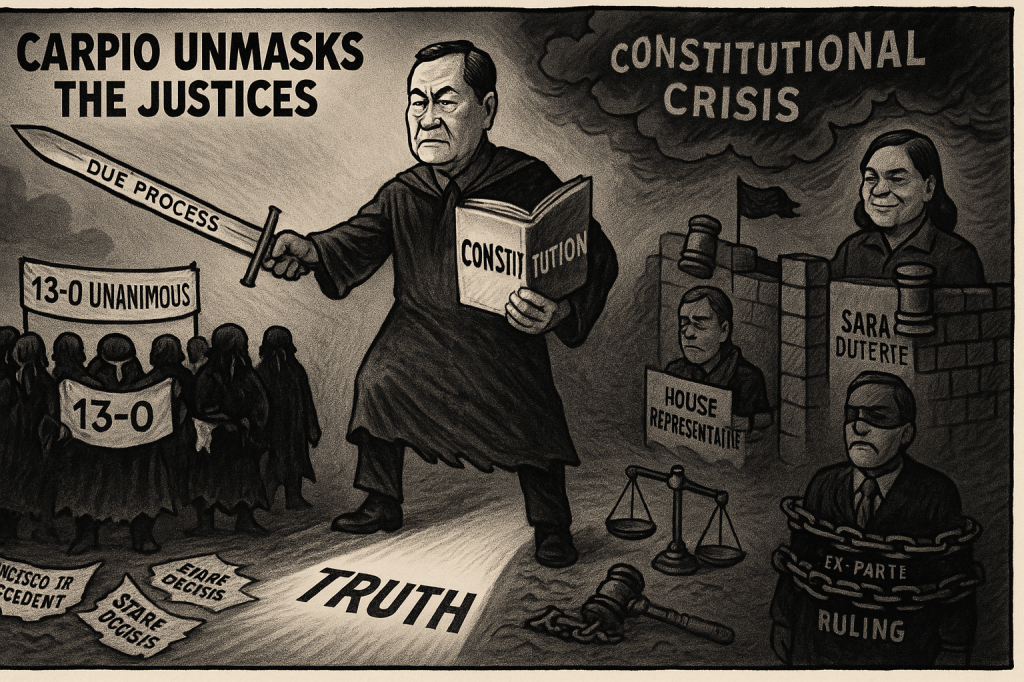
THE Philippine Supreme Court’s 13-0 ruling on July 25, 2025, to torch the impeachment proceedings against Vice President Sara Duterte isn’t just a legal blunder—it’s a full-blown assault on the Constitution. With due process shredded, precedent gutted, and unanimity weaponized as a shield, the Court has handed Duterte a political lifeline while castrating the House of Representatives. Only retired Justice Antonio Carpio stands as the lone sentinel of constitutional integrity, his arguments a searing indictment of a judiciary run amok.
Let’s carve up this travesty with the precision it deserves.
1. Due Process? More Like a Judicial Kangaroo Court
Carpio’s Battle Cry:
The House was ambushed, denied any chance to counter petitions to dismiss the impeachment articles. Carpio’s words cut deep: “There is no due process if the House was not given the opportunity to answer” (GMA News, July 27, 2025). He’s dead-on—Article III, Section 1 of the Constitution demands notice and a hearing, not a backroom ex parte execution. Compare this to Francisco Jr. v. House (2003), where the Court insisted on robust adversarial testing before meddling with impeachment.
The Court’s Shameless Hypocrisy:
This is the same Court that preached “candor and fairness” in Vinuya v. Executive Secretary (G.R. No. 162230, April 28, 2010), only to now ditch both to protect Duterte. No comments, no oral arguments—just a 13-0 edict. What’s the endgame? Voiding legislative acts without debate? This isn’t jurisprudence; it’s judicial tyranny. By muzzling the House, the Court has paved the way for ex parte annihilation of any legislative process.
The Sting:
Carpio’s demand for a fair hearing isn’t legal nitpicking—it’s a desperate stand against a Court itching to play dictator.
2. Retroactive Rule-Making: The Court’s Constitutional Con Job
Carpio’s Warning Shot:
The Court’s redefinition of impeachment “initiation” as mere filing—contradicting Francisco Jr.’s clear standard of committee referral or inclusion in the order of business—is a retroactive rewrite of constitutional law (Rappler, July 25, 2025). Carpio, backed by retired Justice Adolf Azcuna, slams this as a betrayal of stare decisis and the House’s reliance on established precedent. The Constitution’s one-year bar (Art. XI, §3(5)) was never meant to be a judicial booby trap.
Twisting the Knife:
The Court’s “filing = initiation” rule is a legal fabrication so audacious it makes Dred Scott look timid. In Gutierrez v. House (2011), the Court upheld the one-year bar without inventing new triggers. Why the sudden sleight of hand? This isn’t interpretation—it’s judicial legislation, retroactively punishing the House for playing by the rules. Carpio’s invocation of the Doctrine of Operative Facts is a legal lifeline: actions under prior precedent should stand, not be obliterated by judicial whim.
The Danger:
If the Court can rewrite constitutional terms on a lark, what stops it from redefining “elections” or “term limits”? Carpio’s stand is a barricade against this constitutional free-for-all.
3. The 13-0 Mirage: Unanimity as a Mask for Judicial Cowardice
Carpio’s Scorching Rebuke:
A unanimous ruling without oral arguments or dissent isn’t strength—it’s a glaring sign of judicial groupthink (Inquirer, July 26, 2025). Carpio’s critique mirrors his dissent in Republic v. Sereno (2018), where he blasted the Court’s quo warranto power grab as a constitutional overreach. History repeats as a sick joke. The Court’s refusal to hear arguments or allow dissent screams not clarity but fear—fear of scrutiny, fear of debate, fear of Carpio’s unyielding logic.
The Farce:
Unanimity should reflect robust consensus, not a rubber stamp. By dodging oral arguments, the Court sidestepped the transparent deliberation it embraced in cases like Macalintal v. COMELEC (G.R. No. 263590, June 27, 2023), where oral arguments ensured public scrutiny of constitutional issues. Carpio’s call for open hearings isn’t procedural pedantry—it’s a demand for a Court that answers to the public, not itself.
The Burn:
If 13 justices can’t muster a single dissent or demand a single hearing, they’re not justices—they’re puppets dancing to a prewritten script.
4. The Aftermath: Rule of Law or Rule by Judicial Fiat?
Political Fallout:
The Court’s ruling shields Sara Duterte from impeachment until February 2026, strengthening her 2028 presidential narrative by framing her as a target of political persecution (TIME, July 26, 2025). The House, stripped of its impeachment power, is reduced to a bystander, while the Senate’s trial role becomes a meaningless ritual (Philippine Star, July 27, 2025).
Institutional Carnage:
- House Crippled: Future impeachments will be pre-litigated in the Supreme Court, turning a legislative power into a judicial obstacle course. The Constitution’s checks and balances are now a judicial chokehold.
- Public Trust in Ashes: A Court that tramples due process for a co-equal branch invites comparisons to the Marcos-era judiciary, when legitimacy was a cruel joke, echoing historical critiques of judicial subservience. Carpio’s warnings ring true: this isn’t justice—it’s a power grab that risks plunging the judiciary into a legitimacy abyss.
The Question:
Carpio asks if the rule of law can survive when judges act like emperors. The answer, post-ruling, is a chilling one.
Recommendations: Striking Back with Vengeance
- Motion for Reconsideration with Claws:
The House must file a motion for reconsideration, demanding oral arguments and exposing the Court’s factual blunders—like the “two-hour window” Carpio flagged, where the Senate received the articles before the House adjourned, potentially keeping the complaint within the one-year bar (GMA News). Make the Court choke on its own contradictions. - Congressional Rebellion:
Amend the Rules of Court to bar ex parte judgments on impeachment matters. If the Court wants to play overlord, force it to respect co-equal branches. This isn’t just pushback—it’s a fight for constitutional survival. - Carpio’s Public Crusade: Carpio should lead a coalition of legal luminaries—scholars, retired justices, and bar leaders—in a Law Professors’ Manifesto, echoing UP Law’s 2010 anti-plagiarism campaign (PhilStar, 2010). This public shaming campaign must call out the justices for hiding behind their 13-0 smokescreen, demanding transparency and accountability. Truth isn’t just a principle—it’s a battering ram to dismantle judicial cowardice.
Closing Salvo: Carpio’s Lone Stand Against a Judiciary Gone Rogue
The Supreme Court’s decision isn’t just a mistake—it’s a constitutional betrayal. By obliterating due process, rewriting precedent, and hiding behind a 13-0 facade, the justices haven’t upheld the rule of law; they’ve hijacked it. Carpio’s arguments—grounded in Francisco Jr., due process, and the Doctrine of Operative Facts—are the last line of defense against a Court that’s traded principle for power.
The question isn’t whether Duterte escapes accountability until 2026. It’s whether the Court can escape the stench of its own cowardice. Carpio’s indictment is clear: this isn’t justice—it’s a judicial coup.
Key Citations
- Judicial Overreach:
Rappler, Supreme Court Decision Blocks Sara Duterte Impeachment Trial, July 25, 2025 - Due Process Hypocrisy:
GMA News, No Due Process if No Chance to Answer Petitions to Junk Articles of Impeachment vs. VP Sara — Carpio, July 27, 2025 - Historical Precedents:
- Political and Institutional Fallout:
- Public Shaming Precedent:
Disclaimer: This is legal jazz, not gospel. It’s all about interpretation, not absolutes. So, listen closely, but don’t take it as the final word.

- ₱75 Million Heist: Cops Gone Full Bandit

- ₱6.7-Trillion Temptation: The Great Pork Zombie Revival and the “Collegial” Vote-Buying Circus

- ₱1.9 Billion for 382 Units and a Rooftop Pool: Poverty Solved, Next Problem Please

- ₱1.35 Trillion for Education: Bigger Budget, Same Old Thieves’ Banquet

- ₱1 Billion Congressional Seat? Sorry, Sold Out Na Raw — Si Bello Raw Ang Hindi Bumili

- “We Will Take Care of It”: Bersamin’s P52-Billion Love Letter to Corruption

- “Skewed Narrative”? More Like Skewered Taxpayers!

- “Scared to Sign Vouchers” Is Now Official GDP Policy – Welcome to the Philippines’ Permanent Paralysis Economy
- “Robbed by Restitution?” Curlee Discaya’s Tears Over Returning What He Never Earned

- “No Pressure” Luistro? The House Pork Bazaar Exposed
- “My Brother the President Is a Junkie”: A Marcos Family Reunion Special

- “Mapipilitan Akong Gawing Zero”: The Day Senator Rodante Marcoleta Confessed to Perjury on National Television and Thought We’d Clap for the Creativity



 KWEBA ni BAROK
Leave a comment