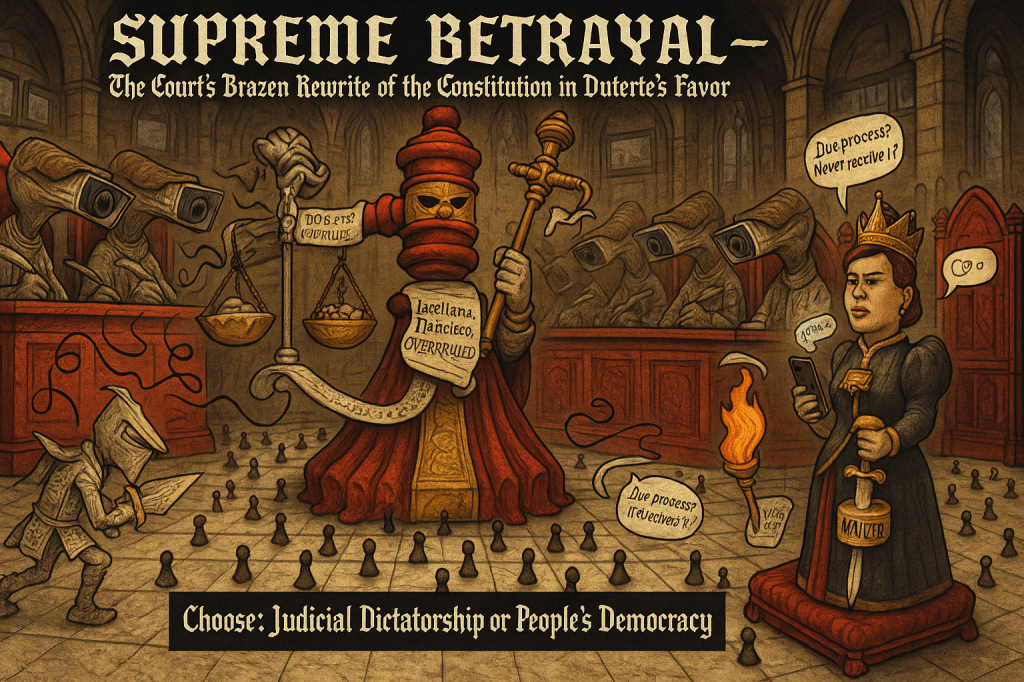
By Louis ‘Barok’ C Biraogo — July 30, 2015
THE Philippine Supreme Court’s July 25, 2025, ruling on Vice President Sara Duterte’s impeachment is not just a misstep; it’s a full-blown judicial coup. By declaring the House of Representatives’ impeachment process unconstitutional, the Court didn’t merely interpret Article XI—it vandalized it, rewriting the rules of impeachment with a brazenness that demands a takedown. The House’s accusation that the Court “amended the Constitution” isn’t hyperbole; it’s a clarion call to expose this overreach. Let’s dissect the Court’s reasoning, expose its constitutional violations, and arm the House with a battle plan to reclaim its power.
I. Constitutional Coup Unveiled: The Court’s Assault on Impeachment Power
The House’s argument is unassailable: Article XI, Section 3(1) grants it exclusive power to initiate impeachment proceedings. Yet, the Supreme Court’s 13-0 ruling conjures a “super-checklist,” redefining “initiation” to include archived complaints and erecting barriers absent from the constitutional text. This isn’t interpretation—it’s a judicial rewrite of the Republic’s founding document.
- Shredding the Court’s Logic: The Court claims the first three complaints, filed in December 2024 and archived, triggered the one-year bar under Article XI, Section 3(5). This defies House Journal No. 36 (February 5, 2025, PDF), which confirms plenary approval of the fourth complaint before any final action on prior ones. The Court’s insistence that archiving equals initiation is a fabrication, unsupported by Gutierrez v. House of Representatives (2011), which defines initiation as filing and referral, not archiving. Francisco v. House (2003) rejected extra-constitutional hurdles, yet the Court here does the opposite—crafting a timeline that castrates the House’s prerogative.
- Trampling Separation of Powers: The ruling violates the separation of powers, a bedrock principle since Javellana v. Executive Secretary (1973), which forbade courts from “engrafting” new requirements onto the Constitution. By dictating impeachment procedures, the Court usurps a legislative role, acting as a super-legislature in a Marbury v. Madison-style delusion of unchecked judicial supremacy.
- Judicial Legislation Unmasked: The Court’s invented “super-majority” or redefined “initiation” lacks any basis in Article XI, Section 3(2-4), which requires only a one-third vote for transmittal. This echoes Teehankee v. Rovira (1957), where the Court was rebuked for adding non-textual limitations. The House’s exclusive power is sacrosanct; the Court’s meddling is a constitutional felony.
II. Due Process Sham: The Court’s Crocodile Tears for Duterte
The Court’s claim that Vice President Duterte was denied due process is a theatrical farce, contradicted by irrefutable evidence and legal precedent.
- House’s Ironclad Evidence: House Journal No. 36 proves Duterte was repeatedly invited to respond to the fourth complaint but chose not to appear—a clear waiver of rights. Ang Tibay v. CIR (1940) establishes that due process requires only an opportunity to be heard, not compulsion. Duterte’s absence was her choice, not the House’s failure.
- Court’s Willful Blindness: Ignoring conclusive House records, the Court breaches Canon 1 of the New Code of Judicial Conduct for the Philippine Judiciary, which demands impartiality. Its selective fact-finding—disregarding certified roll-call votes and plenary approval—suggests bias, if not outright collusion.
- Procedural Overreach: By demanding Duterte receive draft articles or evidence before the vote, the Court imposes a standard absent from Article XI or precedents like Neri v. Senate (2008), which clarified that impeachment inquiries don’t require trial-like formalities. This invented hurdle is a judicial booby trap, designed to paralyze the House.
III. Ethical Rot: A Judiciary Betraying Its Oath
The Court’s ruling oozes ethical decay. Canon 3 of the New Code of Judicial Conduct mandates independence, yet the Court’s factual distortions—misrepresenting the complaint timeline and ignoring Duterte’s waiver—hint at a predetermined outcome. The Franciscan Province’s condemnation of the ruling as a “spiritual wound” (Philstar, July 28, 2025) isn’t mere rhetoric; it signals a judiciary teetering on illegitimacy. By aligning with PDP-Laban’s narrative and dismissing 1Sambayan’s factual corrections, the Court flirts with political partisanship, violating Canon 4’s ban on political conduct.
IV. Catastrophe Looming: The Stakes of Judicial Tyranny
If the Court’s logic prevails, the Republic faces a constitutional apocalypse:
- Impeachment Annihilation: Redefining “initiation” could retroactively invalidate past impeachments, like those of Estrada or Corona, unraveling decades of precedent. This opens a Pandora’s box of legal chaos.
- Legislative Emasculation: The House’s constitutional power becomes a paper tiger, subject to judicial veto. This isn’t balance—it’s the House reduced to a judicial puppet.
- Public Trust Collapse: The Franciscan Province’s outcry reflects a judiciary bleeding legitimacy. When courts are seen as political tools, public faith in justice erodes, as warned in Civil Liberties Union v. Executive Secretary (1991).
V. The House’s War Plan: Striking Back Against Judicial Overlords
The House must unleash a relentless counteroffensive to restore its constitutional authority:
- Impeachment Barrage: File articles of impeachment against complicit justices for “culpable violation of the Constitution” under Article XI, Section 2. Their overreach is a betrayal of public trust, ripe for accountability.
- Legislative Fortress: Pass a resolution under Article XVII defining “initiation” as plenary approval, locking the Court out of future meddling. This fortifies the House’s constitutional turf.
- Public Siege: Leak irrefutable evidence—House records, Duterte’s invitations, and vote certifications—to ignite public fury. Wage a PR war, forcing the Court to defend its distortions in the court of public opinion.
The Final Stand: Democracy or Judicial Dictatorship?
The Supreme Court’s ruling isn’t a legal misstep; it’s a declaration of war on the House’s constitutional authority. By conjuring requirements and ignoring evidence, the Court has staged a constitutional heist, threatening the Republic’s democratic foundations. The House faces a stark choice: capitulate to judicial overlords or fight to preserve democracy. Armed with unassailable records and constitutional clarity, it must expose this judicial arson and reclaim its rightful power.
The House must choose: surrender to judicial supremacy or defend democracy. The clock is ticking.
Key Citations
- 1987 Philippine Constitution
- Gutierrez v. House of Representatives (2011)
- Francisco v. House of Representatives (2003)
- Javellana v. Executive Secretary (1973)
- Teehankee v. Rovira (1957)
- Ang Tibay v. CIR (1940)
- Neri v. Senate (2008)
- Civil Liberties Union v. Executive Secretary (1991)
- New Code of Judicial Conduct for the Philippine Judiciary
- House Journal No. 36, February 5, 2025
- Philstar News Report, July 28, 2025
Disclaimer: This is legal jazz, not gospel. It’s all about interpretation, not absolutes. So, listen closely, but don’t take it as the final word.

- ₱75 Million Heist: Cops Gone Full Bandit

- ₱6.7-Trillion Temptation: The Great Pork Zombie Revival and the “Collegial” Vote-Buying Circus

- ₱1.9 Billion for 382 Units and a Rooftop Pool: Poverty Solved, Next Problem Please

- ₱1.35 Trillion for Education: Bigger Budget, Same Old Thieves’ Banquet

- ₱1 Billion Congressional Seat? Sorry, Sold Out Na Raw — Si Bello Raw Ang Hindi Bumili




 KWEBA ni BAROK
Leave a comment