By Louis ‘Barok‘ C. Biraogo — July 29, 2025
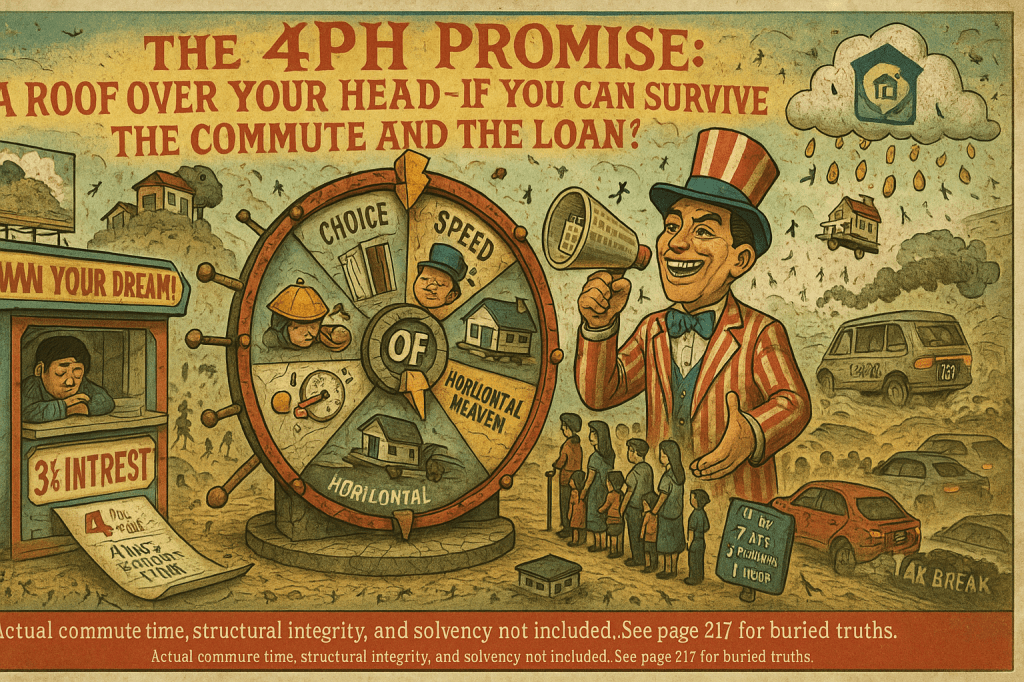
THE Philippine government’s Expanded Pambansang Pabahay para sa Pilipino (4PH) program is a glittering monument to bureaucratic self-delusion, a scheme so drenched in noble rhetoric it could make a cynic weep. Launched in 2022 under President Ferdinand Marcos Jr., it vows to slay a 6.5 million-unit housing backlog by 2028 with one million homes annually. Dignity for the poor! A roof for every Filipino! Yet, as the government’s own reports admit—before burying the truth on page 217—this is less a housing revolution than a speculative art project titled How to Pretend to Help the Poor While Enriching Land Oligarchs.
Curated by: Every Philippine Administration Since Marcos Sr.
[Pause for applause.]
Let’s dissect Department of Human Settlements and Urban Development (DHSUD) Secretary Jose Ramon Aliling’s promises, which shimmer with the earnest charm of a used-car salesman’s warranty. His four big lies deserve a scalpel sharper than his press releases. Buckle up.
Aliling’s Four Big Lies
Lie #1: “Filipino buyers are no longer a captive market.”
Naks, how liberating! The 4PH offers “choices”—subdivisions, rentals, Community Mortgage Program (CMP) units—like a buffet for the destitute. Except it’s a cruel joke: unaffordable subdivisions in commuter hellscapes or flood-prone CMP shacks. It’s like choosing between cholera and dysentery. The poor aren’t “empowered”; they’re funneled into whatever developers deign to build, with large conglomerates dominating land banking and squeezing out smaller players (PNA, 2025). Choice? Only if you define it as picking your poison.
Lie #2: “Streamlined processes speed up delivery.”
Translation: Fewer pesky inspections mean more “Oops, the roof collapsed” surprises. Digital one-stop centers aim to cut red tape, but the government’s own data reveals understaffed agencies like the Social Housing Finance Corporation (SHFC) and Pag-IBIG (PNA, 2025). Faster approvals often mean weaker due diligence, inviting ghost projects and substandard materials. If speed is the goal, congratulations: the poor will get their crumbling homes quicker.
Lie #3: “Private sector will deliver 250,000 socialized units.”
Math check: At this rate, the 6.5 million backlog clears in… checks notes… 78 years. Four developers’ groups pledged these units over three years, leveraging private capital to spread fiscal risk (PNA, 2025). Sounds lovely, until you realize “socialized” units—priced just below the PHP 450,000 legal cap—are unreachable for the bottom 30% of earners. Developers, eyeing margins, build in remote areas or skimp on materials. The result? Shoddy homes in nowhere, branded as “progress”… if you ignore the corpses of affordability.
Lie #4: “Horizontal housing aligns with buyer preference.”
Sure, if “preference” means “forced exile to commuter hellscapes.” Filipinos may favor landed homes, but these subdivisions devour scarce land, pushing the poor to the urban periphery (PNA, 2025). Infrastructure like roads, water, or mass transit? Optional, apparently. A family in Bulacan might “own” a house but spend four hours daily commuting to Manila, assuming the jeepney doesn’t break down. It’s not a home; it’s a sentence.
The Wheel of Misfortune
Spin the wheel, dear urban poor, and see what 4PH has in store! Will you win…
- ✅ A Legal Shack!
Congrats, you’re a homeowner! (Terms: 4-hour daily commute to your job in Manila.) The CMP could legalize 1.5 million informal settler homes, but local government units (LGUs) often delay zoning revisions for political leverage (PNA, 2025). Enjoy your “asset” while dodging gentrification-driven property tax hikes. - ⚠️ A Pag-IBIG Loan!
At a dreamy 3% interest rate, it’s only… checks math… 60% of a minimum-wage earner’s income (PNA, 2025). With a PHP 750,000 loan ceiling and monthly incomes around PHP 15,000, the debt-to-income ratio laughs at global prudence thresholds (30%). Bankruptcy, anyone? - 💀 A Climate-Proof Home!
Built on a former landfill in flood-prone CALABARZON, naturally (PNA, 2025). New Building Code compliance is touted, but without mandatory flood-risk certifications or affordable insurance, your “green” home might float away in the next typhoon.
Bloodless Impact Analysis
For the Urban Poor:
“Congratulations! You ‘own’ a house!” (Terms: 2-hour jeepney ride to the nearest water supply.) The CMP and rental options might offer temporary relief, but without safe transport corridors, these homes trap families in poverty’s orbit—far from jobs, schools, or hope (PNA, 2025). The working poor face high transport costs and hidden fees, while the ultra-poor are excluded from formal financing altogether.
For Taxpayers:
Take a bow: your PHP 450 billion subsidy is now a developer tax break. Gratitude, please. Public-private partnerships (PPPs) reduce immediate government outlays but pile up contingent liabilities. If projects underperform, taxpayers foot the bill (PNA, 2025).
Future Headlines?
“4PH Wins UN Award!” (Meanwhile, 90% of beneficiaries sell kidneys to pay loans.) The construction multiplier—1 housing unit equals 2.5 jobs—sounds rosy, but rushed builds risk inflationary pressure on wages and materials, starving sectors like agriculture (PNA, 2025). And don’t forget the environmental cost: subdivisions on volcanic hazard zones or floodplains expose the poor to disasters, with insurance as mythical as a unicorn (PNA, 2025).
Kristof’s ‘Solutions’ (With Eye Rolls)
How to fix this mess? Some “innovations” as bold as Aliling’s promises:
- Transit-Oriented Development?
More like Transit-Implied Development. Scribble a jeepney doodle on the zoning map and call it a day. Mandating mass-transit timelines for subdivisions is logical, but LGUs and developers will fight it tooth and nail (PNA, 2025). Good luck. - Open-Data Dashboards:
Perfect for tracking which official’s nephew got the juiciest contract. Transparency sounds nice, but without enforcement, it’s just a website no one visits (PNA, 2025). - Climate-Proofing:
Mandate life vests for Bulacan subdivisions. Flood-risk certifications and pooled Pag-IBIG insurance are sensible, but developers will cry “cost!” while building on the cheapest, riskiest land (PNA, 2025). - Community Land Trusts (CLTs):
Lock resale prices to income levels to prevent gentrification. A great idea—if you ignore the political will required to challenge land oligarchs (PNA, 2025).
The Grand Finale
The Expanded 4PH isn’t a housing program; it’s performance art for the elite. It socializes losses while privatizing gains, dressing up developer profits as charity. The poor get debt, commutes, and flood risks; developers get tax breaks and land deals. Aliling’s promises shine like a used-car salesman’s warranty—gleaming until you drive it off the lot.
For the Philippines’ poorest, 4PH isn’t a lifeline; it’s a mirage, shimmering just out of reach. And the tragedy? Everyone knows the script. It’s been running since Marcos Sr., with new actors but the same tired plot.
So, here’s to 4PH: a masterpiece of well-meaning incompetence, where the poor are props, and the real beneficiaries build mansions with the proceeds.
Bravo, Philippines. Bravo.
Source:
- Philippine News Agency (PNA). (2025, July 27). DHSUD chief assures fair, expeditious handling of homebuyers’ complaints.
Primary source for program details, Aliling’s assertions, and data on the 6.5 million housing backlog, 250,000 socialized units, financing structures, and infrastructure challenges.

- “Forthwith” to Farce: How the Senate is Killing Impeachment—And Why Enrile’s Right (Even If You Can’t Trust Him)

- “HINDI AKO NAG-RESIGN!”

- “I’m calling you from my new Globe SIM. Send load!”

- “Mahiya Naman Kayo!” Marcos’ Anti-Corruption Vow Faces a Flood of Doubt

- “Meow, I’m calling you from my new Globe SIM!”

- “No Special Jail for Crooks!” Boying Remulla Slams VIP Perks for Flood Scammers

- “PLUNDER IS OVERRATED”? TRY AGAIN — IT’S A CALCULATED KILL SHOT

- “Several Lifetimes,” Said Fajardo — Translation: “I’m Not Spending Even One More Day on This Circus”

- “Shimenet”: The Term That Broke the Internet and the Budget

- “We Did Not Yield”: Marcos’s Stand and the Soul of Filipino Sovereignty

- “We Gather Light to Scatter”: A Tribute to Edgardo Bautista Espiritu

- $150M for Kaufman to Spin a Sinking Narrative





 KWEBA ni BAROK
Leave a comment